

Planning a Tanzania safari with children? This practical family safari guide helps parents understand when to go, which parks and experiences suit different ages, how to prepare for health and safety, and what to expect from accommodations, game drives, and wildlife encounters. It also explains how Kijani Tours can tailor a private safari to your family's needs, from the Serengeti and Ngorongoro to cultural experiences and Tanzania's coast, from Pangani to Mafia...
THE NIGHT BEFORE THE SUMMITKilimanjaro Summit Night: How to Prepare Mentally and What to Expect
Posted by Wolfgang on Sun August 30, 2026 in KILIMANJARO AND TREKKING | SUMMIT PREPARATION.
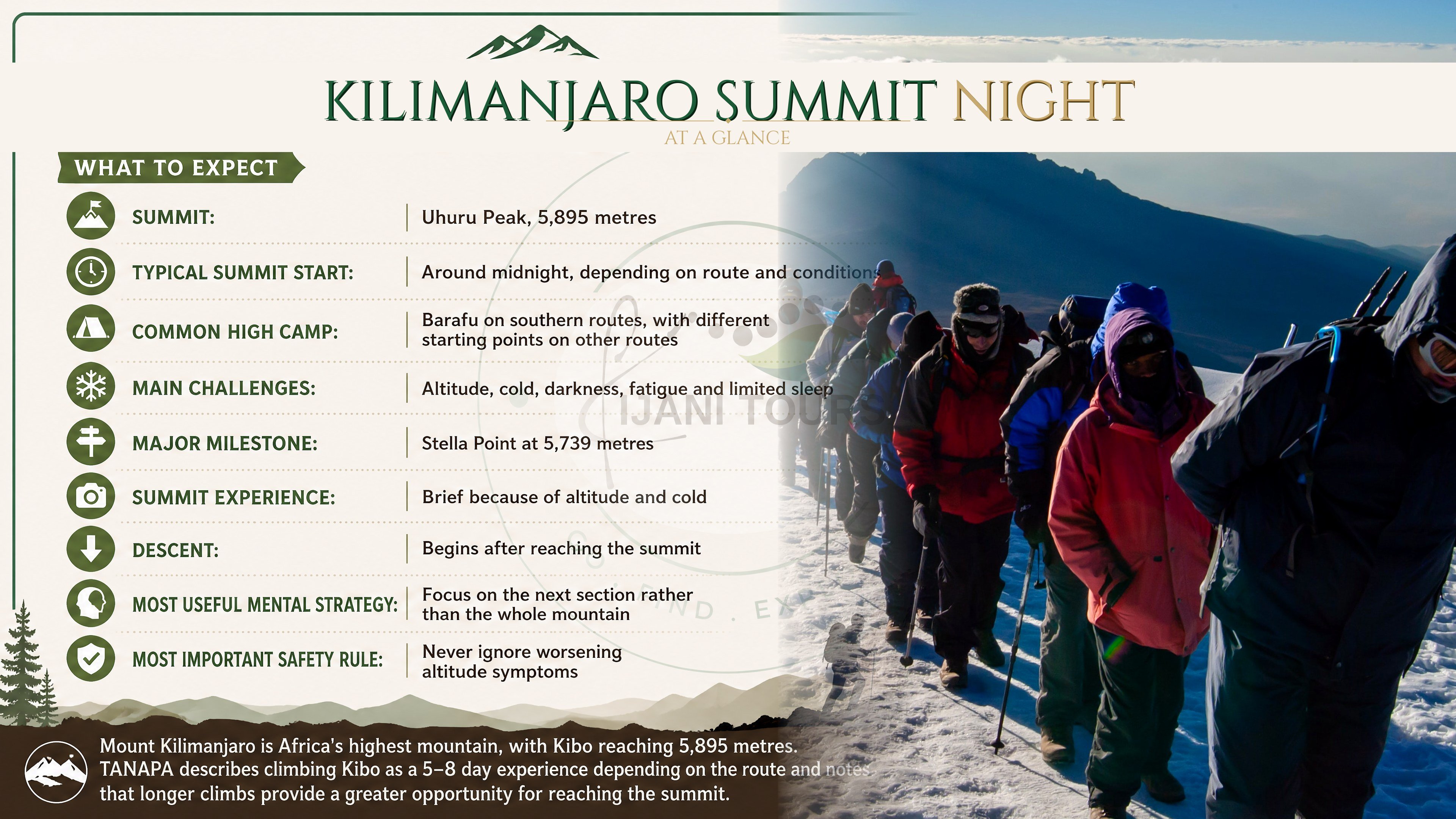
Kilimanjaro Summit Night: The Final Hours Before Uhuru Peak
At midnight, the mountain disappears. Your headlamp becomes your horizon.
Kilimanjaro summit night is the final and most demanding stage of the journey to Uhuru Peak at 5,895 metres. Starting around midnight, climbers face several hours of darkness, cold, fatigue, limited sleep and reduced oxygen availability. The challenge is physical, but it is also deeply mental.
The key to managing summit night is not trying to conquer the entire mountain at once. It is learning to focus on the next step, the next rest point and the next section of trail. A slow and consistent pace, good acclimatisation, proper preparation and trust in your guide are more valuable than rushing to prove your strength.
Preparation begins before the trek. Choose an itinerary that allows sufficient time for acclimatisation, train for long days of walking, prepare your summit clothing and equipment in advance, and understand the symptoms of altitude sickness. Most importantly, know the difference between normal fatigue and signs that require you to stop ascending.
Reaching Stella Point at 5,739 metres is a major milestone, but the final walk to Uhuru Peak still demands patience. When the sun finally rises over the Tanzanian landscape, and you reach the summit, the achievement is not simply standing at Africa's highest point. It is knowing that you managed thousands of small decisions and steps to get there.
Written by Wolfgang Valerian, founder of Kijani Tours, Moshi.
You trained for the mountain. You packed for the cold. You prepared for the altitude. Then midnight arrives.
Your headlamp turns on. The mountain disappears into darkness. You cannot see Uhuru Peak. You cannot see how far you have to go. You can only see the few meters of trail ahead of you.
Then your guide says, "Pole, pole." You start walking. This is the night of the Kilimanjaro summit.
For many climbers, the final ascent to Uhuru Peak is the hardest part of the entire trek. It is not simply because the trail is steep. By this point, you have already spent several days walking at altitude. You are tired, have had limited sleep, the temperature is below freezing, and your body is working with much less oxygen than it is accustomed to at sea level.
But summit night is also a mental challenge. You have to remain patient when progress feels slow, stay focused when the summit is out of sight, and make sensible decisions when your body tells you it is tired.
I have spent years working with travelers on Kilimanjaro from Moshi, and one lesson has become clear: reaching Uhuru Peak is not about being the strongest in the group. It is about preparation, pacing, acclimatization, patience, and knowing when to listen to your body and your guide. The summit is reached step by step.
What Is Kilimanjaro Summit Night?
The Kilimanjaro summit night is the final overnight ascent from a high-altitude camp to Uhuru Peak, the highest point on Mount Kilimanjaro at 5,895 meters. On many routes, climbers begin around midnight to reach the summit at sunrise and start descending while there is still daylight.
The exact schedule depends on the route, camp location, weather conditions, group pace, and the guide's assessment. On southern routes such as Machame and Lemosho, climbers commonly begin the summit attempt from Barafu Camp, while other routes use different high camps.
The night typically begins with an early dinner, followed by a brief rest. After waking, you dress in your summit layers, have a warm drink and a light snack, check your headlamp, and begin walking in the dark.
For official information about Mount Kilimanjaro and Kilimanjaro National Park, travelers can consult the Tanzania National Parks Authority (TANAPA).
Why Do Climbers Start the Kilimanjaro Summit at Midnight?
The midnight start is primarily designed around the summit and descent timing. Starting at night allows climbers to reach the crater rim and Uhuru Peak around sunrise before beginning the descent.
It also means that much of the hardest climbing is done before the day grows warmer and the mountain grows busier. However, the timing has an obvious disadvantage: you are climbing the most demanding section after very little sleep.
That is why summit night feels different from the previous days of a Kilimanjaro trek. You are not starting a normal hiking day after breakfast. You are starting the final ascent with your body already carrying several days of accumulated fatigue.
What Does Kilimanjaro Summit Night Feel Like?
During the day, the mountain gives you visual information. You can see the trail, the surrounding landscape, and sometimes the summit itself. At night, most of that disappears.
Your headlamp illuminates only a small area in front of you. Often, you see the boots of the person ahead rather than the landscape around you. Other climbers may appear as a line of small lights moving slowly up the mountain.
This changes your perception of distance.
You can walk for an hour and feel as though you have hardly moved. You may look up to see another switchback that seems to continue indefinitely.
This is one reason mental preparation is so useful. Instead of thinking about the entire distance to Uhuru Peak, break the climb into smaller sections. Focus on reaching the next rest point, completing the next section of the trail, or simply maintaining your pace for the next few minutes.
At 5,000 meters, the entire mountain is too large a thought. The next step is manageable.
What Happens During Kilimanjaro Summit Night?
A typical summit attempt begins with dinner in the early evening. Your appetite may already be reduced due to altitude, so the goal is to eat something familiar and comfortable rather than force yourself to eat a very large meal.
After dinner, you usually have a few hours to rest. You may sleep, but you may not. Sleep can be difficult at high altitude, and knowing this in advance can prevent unnecessary anxiety. Even if you do not sleep deeply, lying down and conserving energy is still helpful.
Around midnight, you wake up, have a warm drink and a light snack, put on your summit clothing, and prepare your daypack. Your guide will normally check that everyone is ready before the group begins walking.
The first hours are often spent climbing slowly through darkness. Your guide sets the pace, and the goal is to establish a rhythm you can sustain for several hours. This is where the familiar Swahili expression "pole, pole," meaning slowly, slowly, becomes more than a phrase. Slow, steady movement is a practical part of climbing at altitude.
As the night progresses, fatigue becomes more pronounced. Around the early morning hours, some climbers enter what I call the psychological dead zone. You have already been walking for several hours, yet the summit still seems distant. It is cold, you are tired, and the darkness makes it hard to gauge your progress.
This is the point where your preparation matters.
Do not try to mentally climb the remaining mountain. Focus on the next section.
Eventually, you reach Stella Point at about 5,739 meters on the crater rim. For many climbers, this is a key psychological milestone because the steepest part of the summit approach is now behind them. Uhuru Peak, however, is still ahead.
The trail then follows the crater rim toward the summit. The terrain is less steep than on the ascent to Stella Point, but the altitude remains extreme. The final section can therefore feel surprisingly difficult.
Then, after several hours of darkness, the horizon begins to brighten.
And eventually, you reach Uhuru Peak at 5,895 metres.
Why Is Kilimanjaro Summit Night So Difficult?
The difficulty of summit night stems from several factors acting simultaneously. You are climbing at extreme altitude, dealing with cold temperatures, walking in darkness, carrying accumulated fatigue, and operating on very little sleep.
There is also a common misunderstanding about oxygen at altitude. The atmosphere does not suddenly contain half as much oxygen by percentage at Uhuru Peak. Oxygen still makes up approximately 21% of the atmosphere. What changes significantly is atmospheric pressure, which lowers the partial pressure of oxygen and means each breath delivers less oxygen to your body.
The CDC's guidance on high-altitude travel and altitude illness explains the physiological effects of altitude and why gradual acclimatization is important. This is why a person who can comfortably hike for hours at sea level can still find the summit night of Kilimanjaro extremely demanding. Fitness helps, but it does not remove the effects of altitude.
How Do You Mentally Prepare for Kilimanjaro Summit Night?
The best mental preparation begins before you reach the mountain. You should expect summit night to be uncomfortable, rather than imagining that determination will somehow make it easy.
You will likely be tired. You may be cold. You may wonder how much longer you have to walk. You may have moments when you question your decision to climb Kilimanjaro. None of those thoughts automatically means that you cannot continue.
The important skill is learning to distinguish normal discomfort from warning signs of altitude illness.
Another useful strategy is to decide in advance how you will respond when the climb becomes difficult. Some climbers prefer to talk with their guide or fellow trekkers, while others prefer silence and concentration. Some focus on their breathing, while others think about why they decided to climb Kilimanjaro in the first place.
There is no single mental technique that works for everyone.
What matters is having something to return to when your mind starts fixating on how difficult the climb feels.
Why Is Pacing So Important on Kilimanjaro?
Pacing is one of the few variables you can control during the ascent. You cannot control the altitude, the weather, or the mountain's height. But you can control how quickly you move.
This is why experienced Kilimanjaro guides use a slow, deliberate pace, especially during the summit attempt.
Walking too quickly can cause unnecessary fatigue and make it harder to sustain effort. A slower pace helps you conserve energy and gives your guide a better opportunity to observe how you are responding to altitude.
The aim is not to finish the first hour in a hurry.
The aim is to still be moving several hours afterward.
Does Physical Training Help with Summit Night?
Yes, but it needs to be understood correctly. Training improves your endurance, leg strength, and ability to handle long days of walking. It can also make the physical demands of the trek feel more manageable.
However, being extremely fit does not guarantee that you will acclimatize well. People respond differently to altitude, regardless of their fitness level.
Before traveling to Tanzania, include regular walking and hiking in your preparation. Longer walks are especially helpful because Kilimanjaro requires sustained effort over multiple days.
You can also read Kijani Tours' Mount Kilimanjaro Climbing Guide for broader preparation guidance.
The purpose of training is not to turn yourself into an elite athlete.
It is to arrive on Kilimanjaro with enough physical reserve that the mountain does not become harder than it needs to be.
How Many Days Should You Spend Climbing Kilimanjaro?
There is no universal number of days that is right for everyone, but the length of the itinerary matters because acclimatization is one of the most important factors in a successful high-altitude climb.
TANAPA describes Kilimanjaro climbing routes spanning several durations and notes that longer climbs offer more opportunity for acclimatization. The TANAPA Kilimanjaro visitor information should be consulted alongside your operator's route plan.
For many first-time trekkers, choosing the shortest itinerary simply because it is cheaper or faster is not necessarily the best choice.
More time on the mountain can allow for a more gradual ascent and a better opportunity for your body to adapt.
At Kijani Tours, we generally prefer giving climbers enough time to acclimatize rather than treating the shortest possible climb as the ideal option.
Is the Lemosho Route Suitable for Summit Preparation?
The Lemosho Route is a popular choice for climbers seeking a longer approach to Kilimanjaro's summit.
The western approach takes you through several ecological zones before joining the southern circuit. When planned as part of a longer itinerary, it gives climbers more time on the mountain and a gradual progression toward higher elevations.
Kijani Tours offers a 9-Day Lemosho Route to Uhuru Peak, designed for travelers who want more time to acclimatize and a measured approach to the summit.
When comparing Lemosho itineraries, do not look only at the route name. Consider the number of days, sleeping elevations, daily elevation gain, and overall acclimatization profile.
Is the Machame Route Good for Summit Preparation?
The Machame Route is one of the best-known routes on Kilimanjaro and is often chosen by travelers seeking a scenic and challenging approach to the summit.
The route crosses several ecological zones and includes significant ascent and descent before the final summit attempt. A longer Machame itinerary can offer better acclimatization than the shortest versions of the route.
Kijani Tours provides information about the Machame Route for travelers comparing their options.
The important question is not whether Machame or Lemosho is universally "better." The more useful question is whether the specific itinerary gives you enough time to acclimate to altitude.
Is the Northern Circuit Route Suitable for Acclimatization?
The Northern Circuit is the longest-established trekking route around Mount Kilimanjaro and is particularly relevant to travelers who have more time for their expedition.
Its longer itinerary allows climbers to spend more time on the mountain before the summit attempt.
Kijani Tours offers an 11-Day Northern Circuit Route for travelers seeking a longer, more gradual Kilimanjaro experience. Again, the number of days matters more than simply choosing a route because the route has a particular name.
What Should You Pack for Kilimanjaro Summit Night?
Your equipment can directly affect how comfortable and focused you feel during the final ascent.
Before summit night, your warm layers should already be organized. Your headlamp should be working, with spare batteries available. Your gloves should be accessible, and your water and snacks should be ready.
You should not have to unpack your entire backpack at 11:30 PM to find your gloves.
A good Kilimanjaro packing plan is about both comfort and reducing decisions when you are tired.
Summit night typically requires particularly warm clothing because you will be moving through the coldest hours of the day at extreme altitude. Your guide or operator should also advise you based on the season and current mountain conditions.
What Is the Role of a Kilimanjaro Guide During Summit Night?
Your guide's role extends well beyond simply showing you the route.
During summit night, an experienced guide monitors the group's pace, communication, coordination, alertness, and overall condition. They also help regulate the pace and decide when rest is appropriate.
This matters because altitude can affect judgment.
A climber may be determined to continue even when the safer choice is to stop.
A responsible guide must therefore be willing to engage in difficult conversations.
At Kijani Tours, we believe a Kilimanjaro guide's responsibility is not simply to get a guest to the summit. It is to help the guest make responsible decisions throughout the expedition.
Sometimes the right instruction is "pole, pole."
Sometimes it is "We need to descend."
Both can be the correct decision.
What Are the Signs of Altitude Sickness on Kilimanjaro?
Acute mountain sickness, commonly called AMS, can cause symptoms such as headache, fatigue, loss of appetite, and nausea and vomiting.
These symptoms should be reported to your guide rather than hidden because you are afraid of being asked to stop.
More serious altitude illnesses include high-altitude cerebral edema (HACE) and high-altitude pulmonary edema (HAPE). Warning signs can include confusion, severe drowsiness, difficulty walking normally, loss of coordination, and significant breathing difficulties.
These are medical emergencies.
The CDC's altitude-illness guidance explains that travelers should not continue ascending when experiencing altitude illness and that worsening symptoms require descent.
Mental strength does not mean ignoring dangerous symptoms.
Knowing when to stop is part of responsible climbing.
Can You Take Diamox Before Climbing Kilimanjaro?
Acetazolamide, commonly known as Diamox, is a medication used to help prevent and treat acute mountain sickness in appropriate travelers.
It can help accelerate acclimatization, but it is not a substitute for gradual ascent, nor does it make climbing at nearly 6,000 meters risk-free.
Whether you should take acetazolamide depends on your health circumstances, medications, and medical history. Discuss it with a qualified healthcare professional before traveling.
The CDC Yellow Book guidance on high-altitude travel provides current medical information on preventing altitude illness and on acetazolamide.
What Happens If You Cannot Reach Uhuru Peak?
Not every climber who starts a Kilimanjaro trek makes it to the summit.
Weather can change. Altitude can affect people differently. A climber can become unwell, exhausted, or unable to continue safely.
If that happens, the appropriate decision may be to turn around.
Turning around is not failure. A mountain does not reward you for ignoring your body's warning signs. A successful expedition is not measured solely by the photograph at Uhuru Peak. It is also measured by the decisions you make along the way.
A responsible guide will help you descend safely and without embarrassment if continuing is no longer appropriate.
What Makes Uhuru Peak Special?
Uhuru Peak is the highest point on Mount Kilimanjaro at 5,895 meters and the highest summit in Africa.
But the importance of the summit is not solely geographical.
People remember the sunrise, the darkness before it, the person who walked beside them, the guide who kept the pace slow, and the moment they realized they had reached the top.
For some people, the summit is a personal goal they have carried for years. For others, it is part of a larger journey that includes family, friendship, charity, adventure, or personal change.
The meaning varies for every climber.
That is why the summit is only one part of the story.
What Can Kilimanjaro Teach You About Purpose?
A mountain has a way of simplifying life. For several days, your priorities become straightforward. Walk. Eat. Drink. Rest. Stay warm. Reach camp. Wake up. Walk again.
On summit night, that simplicity becomes even more pronounced. At 3 AM, you cannot solve every problem in your life. You can only take the next step. That can become one of Kilimanjaro's unexpected lessons. Purpose does not always arrive as a single dramatic revelation. Sometimes it is simply knowing what matters to you and moving toward it, one deliberate step at a time.
That is why the summit experience is different for each traveler.
Some people remember the view.
Others remember the journey.
Most remember both.
Frequently Asked Questions About Kilimanjaro Summit Night
What time does Kilimanjaro summit night start?
Most summit attempts begin around midnight, though the exact departure time depends on the route, high-camp location, weather, group pace, and the guide's assessment.
How long does the Kilimanjaro summit night take?
The ascent from high camp to Uhuru Peak takes several hours for most climbers, followed by the descent to a lower camp. The total duration varies by route, pace, weather, altitude response, and rest periods.
Why do you climb Kilimanjaro at night?
The night start allows climbers to attempt the summit around sunrise and begin descending relatively early. It also allows much of the summit ascent to occur before the heat and activity of the day.
How cold is the Kilimanjaro summit at night?
At high altitudes, temperatures can drop well below freezing, especially before sunrise. Wind can make conditions feel even colder. Appropriate insulating layers, warm gloves, headwear, and suitable footwear are essential.
What is the hardest part of Kilimanjaro summit night?
For many climbers, the most difficult period is the early morning, when accumulated fatigue, cold, altitude, and the psychological effect of not seeing the summit combine.
What happens at 3 AM on Kilimanjaro?
Around 3 AM, many climbers are several hours into the summit ascent. This can be a psychological low point because the summit may still be out of sight. Focusing on the next section of the trail rather than the entire remaining distance can make the climb more manageable.
What is Stella Point?
Stella Point is approximately 5,739 meters above sea level on the crater rim of Kibo. It is an important landmark on the summit approach, before the final section toward Uhuru Peak.
How far is Uhuru Peak from Stella Point?
The final crater-rim section from Stella Point to Uhuru Peak is less steep than the ascent to the crater rim, but the extreme altitude still makes it physically demanding.
Can beginners climb Kilimanjaro?
Yes. Previous mountaineering experience is not typically required for a standard guided Kilimanjaro trek. However, Kilimanjaro should not be underestimated. The main challenges are altitude, endurance, cold, long trekking days, and the final summit attempt.
How many days should I spend climbing Kilimanjaro?
The appropriate duration depends on the route and your individual circumstances. TANAPA describes Kilimanjaro climbing itineraries across a range of durations and emphasizes the importance of allowing sufficient time for acclimatization.
For first-time trekkers, choosing a longer itinerary can be preferable to opting for the shortest available climb.
Is Lemosho better than Machame?
Neither route is inherently better for every climber. The number of days, sleeping elevations, daily elevation gain, and overall acclimatization profile are more important than the route name alone.
Is the Northern Circuit good for acclimatization?
The Northern Circuit is a longer route that allows more time on the mountain and, when planned appropriately, can provide a gradual acclimatization profile. It is particularly suitable for travelers who have enough time for a longer expedition.
Can you sleep before summit night?
You may sleep, but many climbers find it difficult to sleep at high altitude. Even if you do not sleep deeply, resting in your tent and conserving energy is still useful.
Should I eat before summit night?
Yes, but you should eat what your body can tolerate. Appetite can decrease at altitude, so a familiar meal and a light snack before departure are often more practical than forcing yourself to eat a large meal.
Can you get altitude sickness during summit night?
Yes. Altitude illness can occur during the ascent, especially as you approach the highest elevations. Report symptoms immediately to your guide.
Should I continue climbing if I have altitude sickness?
You should not continue ascending if your altitude symptoms are worsening or have not resolved. Inform your guide and follow their assessment. Serious symptoms require descent.
Is mental strength important for climbing Kilimanjaro?
Yes, but mental strength should not mean ignoring medical warning signs. Patience, concentration, emotional control, communication, and the ability to break the climb into smaller sections are more effective forms of mental preparation.
What should I think about when I want to give up?
Think about the next section rather than the whole mountain. Remind yourself why you started, slow your breathing, and listen to your guide. If you are experiencing symptoms of serious altitude illness, however, the correct response is to stop ascending rather than simply trying harder.
What happens if I turn around before reaching Uhuru Peak?
Your guide will help you make the safest decision and plan your descent. Turning around because of altitude, illness, weather, or another safety concern is not failure. It is responsible mountaineering.
Preparing for Your Kilimanjaro Summit
The best preparation for summit night is not a single thing. It is a combination of physical preparation, appropriate equipment, good acclimatization, realistic expectations, and mental readiness.
Start by choosing an itinerary that gives your body enough time to adapt. Compare the Lemosho Route, Machame Route, and Northern Circuit Route based on the number of days and acclimatization profile rather than choosing simply by price.
Prepare your body with regular walking and hiking. Prepare your equipment before you arrive. Understand the basics of altitude sickness and acclimatization. And make sure you know what your summit-night clothing and equipment will be before you go to sleep at high camp.
Most importantly, understand what summit night actually is.
It is not a test of whether you can force your body to do something at any cost. It is a long, cold, slow ascent at extreme altitude. Your job is to remain steady. Your guide's job is to help you navigate the mountain safely. And your job is to keep taking the next appropriate step. Eventually, the darkness begins to lift.
The horizon shifts. The clouds spread beneath you. The first light touches the Tanzanian landscape. And the point you could not see for hours finally comes into view.
Uhuru Peak.
At that moment, you may realize that the summit was never the whole journey. It was simply where the journey became visible. The summit is the photograph. The journey is the story.
And on Kilimanjaro, that story begins long before sunrise.
Through Kijani Tours, Wolfgang develops locally informed journeys focused on responsible travel, meaningful experiences, and a deeper understanding of Tanzania's mountains, wildlife, communities, and natural heritage.
Medical note: This article provides general travel information and does not replace professional medical advice. Travelers planning a Kilimanjaro climb should discuss altitude exposure, relevant medical conditions, and medications with a qualified healthcare professional before traveling.
Final Thoughts
The hardest part of Kilimanjaro is often the part you cannot see. It is the darkness before dawn. The cold in your gloves. The tiredness in your legs. The doubt that arrives when the summit still seems impossibly far away.
But this is also where the mountain teaches its most valuable lesson. You do not need to conquer Kilimanjaro in one night. You only need to take the next appropriate step. Sometimes that step takes you closer to Uhuru Peak. Sometimes it means slowing down. And sometimes, when your health or safety demands it, the right step is turning around.
That is not failure.
A successful Kilimanjaro journey is not measured only by the summit photograph. It is measured by how responsibly you prepare, how patiently you climb, how well you listen and how you respond when the mountain becomes difficult.
Then, if the conditions are right and your body allows it, the darkness eventually gives way to sunrise. You look across Tanzania from 5,895 metres. And you understand that the summit was never just a point on the map. The summit is the photograph. The journey is the story.
Pole, pole.
Share This Post
Latest News
Tanzania Travel Guide | Safaris, Kilimanjaro, Beaches, Culture and Responsible Travel
Is Tanzania Safe for Kids on Safari?: A Parent's Guide to Family Safari in Tanzania, 2026–2029
Sat August 29, 2026
Read This Article
Climbing Kilimanjaro as a Woman: What No One Tells You Before You Go
Thu August 27, 2026
Read This Article
Climbing Kilimanjaro as a woman is absolutely possible, but there are practical things to prepare for before you arrive. This guide covers the realities many women want to know about, including hygiene at mountain camps, managing your period, physical preparation, altitude sickness, and what to expect on summit night. You will also learn which questions to ask Kijani Tours' team regarding privacy, female guides, hygiene and waste management, health monitoring, and emergency...
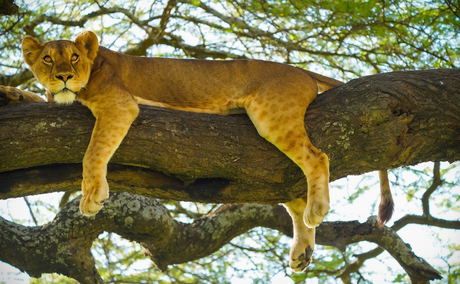
Lions in Tanzania: Understanding Manes, Prides, and Where to Find Them
Tue August 25, 2026
Read This Article
Africa has 20,000 lions left. Tanzania has half of them. The question is not whether you will see one. It is whether you will understand what you are looking at when you do. Tanzania is not one safari. It is a set of completely different landscapes, each producing a different kind of lion. In the Serengeti, prides live off the Migration and rest on granite kopjes that have been used for generations....
Share This Post