

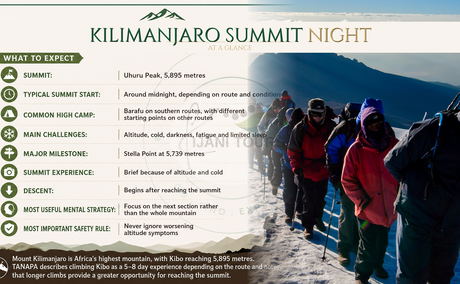
Kilimanjaro Summit Night: The Final Hours Before Uhuru Peak At midnight, the mountain disappears. Your headlamp becomes your horizon. Kilimanjaro summit night is the final and most demanding stage of the journey to Uhuru Peak at 5,895 metres. Starting around midnight, climbers face several hours of darkness, cold, fatigue, limited sleep and reduced oxygen availability. The challenge is physical, but it is also deeply mental. The key to managing summit night is...
THE QUESTION EVERY PARENT ASKSIs Tanzania Safe for Kids on Safari?: A Parent's Guide to Family Safari in Tanzania, 2026–2029
Posted by Wolfgang on Sat August 29, 2026 in Tanzania Together: A Family Safari Adventure | 2026 2029.
Planning a Tanzania safari with children? This practical family safari guide helps parents understand when to go, which parks and experiences suit different ages, how to prepare for health and safety, and what to expect from accommodations, game drives, and wildlife encounters. It also explains how Kijani Tours can tailor a private safari to your family's needs, from the Serengeti and Ngorongoro to cultural experiences and Tanzania's coast, from Pangani to Mafia Island.
Written by Wolfgang Valerian, founder of Kijani Tours, a Tanzanian-owned safari operator based in Moshi.
What if your family could experience Tanzania in a way that your children will remember, understand, and carry with them?
Tanzania offers more than wildlife, mountains, and beaches. For families, every journey can become a chance for children to see animals in their natural habitat, meet local people, understand different traditions, and learn why Tanzania's landscapes are worth protecting. The experience becomes more than a holiday. It becomes a lesson, a shared story, and a memory made together.
The goal is simple: help your family travel to Tanzania prepared, comfortable, and confident, while giving your children a meaningful experience of wildlife, nature, culture, and local communities.
Tanzania rewards families who come prepared. This guide explains Kijani Tours' comprehensive family travel resource for 2026–2029: how to plan the trip, when to go, what it costs, which experiences suit which ages, and the health and safety preparations every family needs before departure. The central question is not whether Tanzania is safe for children, but how to design a trip that fits a family's specific children and gives them a lasting memory.
Planning Logistics
Park Payments
Tanzania National Parks (TANAPA) processes park fees through the Government Electronic Payment Gateway (GePG), with options including Visa/Mastercard, mobile money, bank transfer, and online payment. This means a safari operator must arrange park entries and conservation fees before the vehicle reaches the gate; families should never be left waiting at an entrance while payment is sorted out. Kijani arranges and pays all park and conservation fees in advance for every itinerary, which is especially important on multi-park journeys where fees and conditions vary by park. Families should still carry a payment card and some mobile money for incidentals, since procedures continue to evolve.
Tanzania eVisa
Every traveler, including infants, needs an individual Tanzania eVisa, which can be applied for online at visa.immigration.go.tz. Processing typically takes 3–5 business days; apply at least two weeks in advance. Kijani advises each family on the exact steps for their nationality, but requirements should always be confirmed on the official immigration website before travel.
When to Go: The Family Travel Calendar
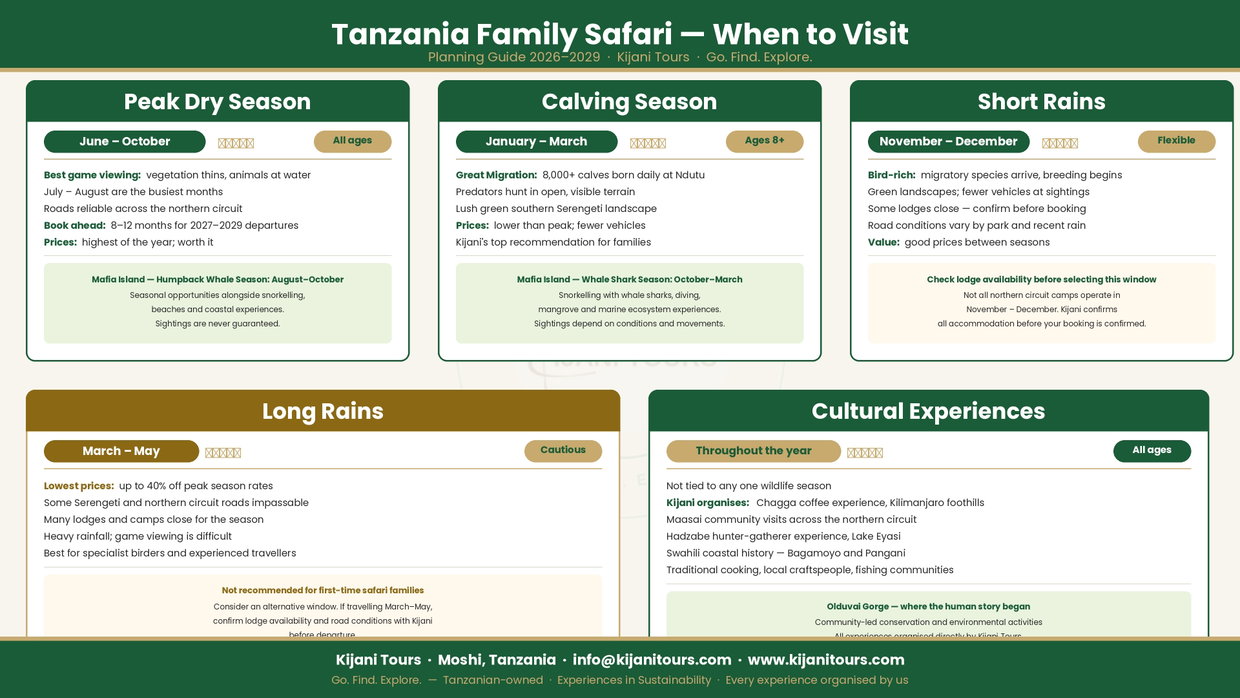
Tanzania's wildlife and weather follow a broadly consistent annual pattern, though timing shifts year to year. Rather than asking only when the best time to visit is, Kijani asks what a family wants to learn, see, and remember; the answer then shapes which regions and seasons belong in the itinerary.
Source: Kijani Tours
Peak dry season (June–October): the recommended window for first-time families with children ages six to twelve. Vegetation thins, animals congregate at water sources, and roads are reliable. July–August overlap with UK, European, and Australian school holidays, so Kijani recommends booking 8–12 months in advance for any 2027–2029 peak-season departure.
Calving season (January–March): the strongest migration experience for families with children eight and up. Around half a million wildebeest calves are born on the southern Serengeti/Ndutu plains, with over 8,000 a day at the peak, drawing predators into full daylight view. Prices are lower, and vehicles are fewer than in peak season.
Shoulder seasons (June, November): Underrated windows offer good value, active herd movement, and fewer vehicles at sightings, making them worth considering for families with flexible school schedules.
What the Parks Cost
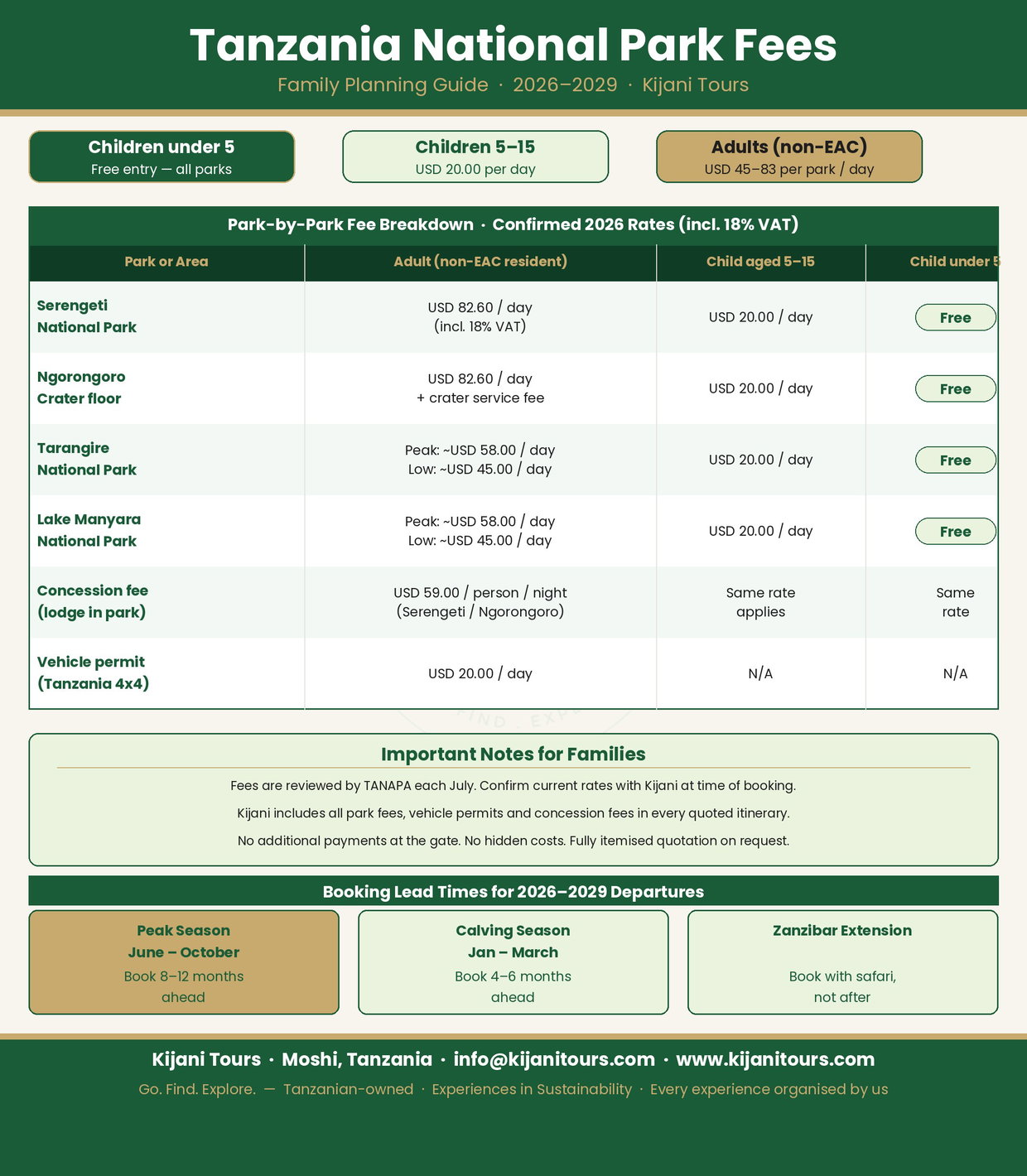
Kijani includes all park fees, vehicle permits, and concession fees in every quoted itinerary, so there are no surprise payments at the gate. Rates below reflect confirmed 2026 tariffs; TANAPA reviews fees each July, so confirm current rates with Kijani for any 2027–2029 booking.
Source: Kijani Tours
Children under five enter every national park free of charge; children ages five to fifteen pay up to USD 20 per day at most northern-circuit parks.
The Game Drive Circuit
Tarangire: Kijani's usual starting point, home to one of Africa's densest elephant populations (herds up to 3,000 in the dry season). Elephant behavior is easier for children to follow and hold their interest in than a resting lion.
Lake Manyara: a half-day park featuring a groundwater forest, tree-climbing lions, and flamingo-lined alkaline waters; varied scenery that suits shorter attention spans, typically the opening day of a circuit itinerary.
Ngorongoro Crater: A contained caldera supports roughly 30,000 large mammals year-round, including the Big Five and the black rhino. The rim sits at about 2,300m, and mornings are genuinely cold; warm layers are essential for every child.
The Serengeti: roughly 14,700 square kilometers, the Maasai's "place where the land runs forever." Essential for children ages ten and up; for younger children, driving distance is the key planning factor, so Kijani positions camps to minimize transit time.
"The Serengeti is more than a place your family visits to see wildlife. It is a place where children can begin to understand how animals, landscapes, seasons, and people are connected." Wolfgang Kijani Tours' founder
Beach Extension: Pangani to Mafia Island
Kijani's coastal route runs from Pangani to Mafia Island along Tanzania's Indian Ocean coast, highlighting quiet villages, protected marine parks, and family-friendly beach lodges. Pangani offers a slower pace: quiet, uncrowded beaches, a historic Swahili town explored with a local guide, and a traditional dhow trip along the coast or river.
Families meet residents and craftspeople to learn about fishing, food, and coastal livelihoods, making it well suited to travelers who want their beach time to include a genuine connection with the place rather than staying entirely within a resort.
Bagamoyo is one of Tanzania's most historically significant coastal towns, where Swahili, Arab, Indian, German, and African histories intersect. Families can explore the old town, visit historic buildings and heritage sites, meet local artists and craftspeople, watch traditional dhow-building, and taste coastal Swahili cuisine for a deeper look at the town's role in Indian Ocean trade and East African history.
Mafia Island offers a more intimate island experience: beaches and marine ecosystems, local fishing communities, and traditional coastal life, plus responsible snorkeling, diving, and seasonal whale shark and humpback whale encounters. Together, the three stops offer families three distinct ways to experience the coastal pace and culture at Pangani, history at Bagamoyo, and island marine life at Mafia.
Mafia's waters host two distinct seasonal draws. Whale sharks, generally encountered from October to March, are commonly seen while snorkeling. Humpback whales, which pass through from August to October as part of their migration between tropical breeding waters and colder southern feeding grounds, are air-breathing mammals observed from a boat without entering the water.
On a calm sea, you may suddenly see a blow on the horizon, a rolling back, or, if fortunate, a full breach. Sightings of either are never guaranteed: Kijani treats both as wildlife encounters shaped by season, sea conditions, and experienced local crews, not guaranteed attractions, and gives the animals the space they need. For children, a guide's explanation of migration and marine ecosystems beforehand turns the outing into more than a search for a photograph. Island accommodations book quickly during the school holidays, so book the coastal extension alongside the safari.
Cultural and Conservation Experiences
Kijani designs and leads every cultural encounter directly, working to community-agreed protocols with income going directly to the people involved, not through intermediaries:
Maasai community visit (all ages, half-day, year-round): families are welcomed into the boma's daily life: mud-and-thatch houses, the central cattle enclosure, and the fire kept for warmth and safety. Children see how a family of seven lives in a single room-sized structure, learn that cattle represent wealth and relationships rather than food, and buy beadwork directly from the women who made it.
Hadzabe hunter-gatherer morning at Lake Eyasi (ages 8+, full morning): The Hadzabe, roughly 1,300 people, are among the last hunter-gatherer communities on Earth, hunting with bow and arrow and speaking a click language with no documented relatives. Children walk into the acacia bush with the men at dawn, watching them track, read the wind, and communicate without sound. The morning pairs naturally with a visit to nearby Datoga blacksmiths, contrasting two very different relationships with the same landscape.
Kilimanjaro foothills coffee experience with a Chagga community (ages 5+, half-day from Moshi): a private walk through working coffee and banana plantations with a Chagga host, ending with children grinding, roasting, and brewing their own cup; a walk to an 80-meter waterfall with a safe swimming pool; and a Chagga lunch for a single group, no shared departures.
Olduvai Gorge (ages 8+, younger visitors welcome with preparation, 2–3 hours en route between Ngorongoro and the Serengeti): a canyon that cuts 90 meters into geological layers spanning three million years, where Mary and Louis Leakey's excavations reshaped understanding of human origins. The stop includes the Laetoli Footprints museum and adds no extra driving time, since it sits on the road already being traveled.
Maasai walking, Ngorongoro Highlands (ages 8+ for half-day, 12+ for multi-day): walking routes with Maasai warrior partners across ridgelines and highland grasslands inaccessible by vehicle, including a demanding multi-day route to Lake Natron at the base of the volcano Ol Doinyo Lengai for teenagers.
Further options: Mkomazi rhino conservation (ages 8+); the Chagga living landscape on Kilimanjaro's slopes (ages 6+); Enduimet Wildlife Management Area, where community land and elephants share space (ages 8+); Lake Natron's flamingos, volcanic scenery, and Maasai life (ages 8+); a genuine family conservation day, such as an indigenous tree nursery, where a real local need is met rather than a staged photo; and Mafia Island's marine-learning experience covering coral reefs, mangroves, and coastal livelihoods.
Every guide is trained to prompt active observation rather than deliver commentary, asking why a matriarch elephant might be moving her herd away from water or what a secretary bird is about to do, rather than simply naming the species. Families with children of different ages receive a guide whose approach matches the specific age range, decided in conversation before the trip departs.
Age, Health and Safety
Which Ages Suit Which Experiences
● Under 5: most camps set a minimum age of five to six for game drives; long days and limited medical access make this age genuinely difficult. Kijani recommends South Africa's malaria-free reserves instead.
● 5–7: private-vehicle game drives with a flexible schedule; Tarangire, the Maasai visit, the Chagga coffee experience and the Zanzibar spice farm all work well.
● 8–12: the ideal first-safari window, old enough to grasp ecological explanations and young enough for the encounter to be formative; every experience in this guide is accessible.
● 13+: longer drives, walking safaris, multi-day Maasai trekking, the Hadzabe morning, and Olduvai Gorge suit this age group particularly well.
Malaria: The Most Important Health Decision
Malaria risk varies by destination and is a serious concern for younger children. Consult a doctor or travel-health specialist before departure to select prevention medication appropriate for a child's age, weight, and health. Four layers of protection are required throughout the trip:
● Paediatric antimalarial medication, prescribed 4–6 weeks before departure, is never sourced without a prescription.
● DEET or Picaridin repellent (20–30%), applied to exposed skin at dawn and dusk.
● Treated bed nets, confirmed at every property on the itinerary.
● Long sleeves and trousers from dusk onward, including in coastal areas.
A fever within 30 days of returning home is a medical emergency: seek care immediately and disclose travel to Tanzania, since malaria can appear weeks after exposure, even with precautions.
Routine childhood vaccinations should be up to date, and travel vaccinations (yellow fever documentation if arriving from an endemic country, hepatitis A, typhoid, and tetanus) should be discussed with a travel health clinic. Tap water in the parks is not safe to drink; Kijani confirms that filtered or bottled water is available at every property.
Read more: https://www.cdc.gov/yellow-book/hcp/contents/index.html
What Children Actually Pay Attention To
Kijani's experience shows that the families with the strongest safaris are not the ones who see the most animals, but those whose children are actively engaged rather than passively watching. The difference lies in how a guide works with children: prompting questions and predictions rather than delivering facts.
This approach aligns with research on risky outdoor play and adventure education, which links active, self-directed engagement with nature to the well-being of children and adolescents (Grey et al., Behavioral Sciences, December 2025). Kijani applies the same principle across every game drive and cultural encounter: children are asked to recall specific moments for decades, not a general impression of "a lot of wildlife."
Vehicles, Guides and Camps
A shared safari vehicle runs on a schedule designed for an average adult group, which rarely suits a mixed-age family. Kijani provides a private vehicle for every family, so departure times, rest stops, and time spent at a sighting are tailored to that family's children. Vehicles are well-maintained Land Cruisers with pop-top roofs, charging ports, and first-aid equipment; the roughly USD 20/day vehicle permit is included in every itinerary.
Guides are matched to a family's specific children and trained to engage rather than narrate, asking children what they think an elephant is about to do rather than simply naming it. Before including any property in a family's itinerary, Kijani checks:
● Whether the property accepts children of the family's specific age range.
● Whether family rooms, family suites, or interconnecting tents are physically available, not just listed.
● Whether wildlife moves freely through the accommodation area.
● The exact procedure if wildlife enters the camp at night.
● Whether a pool is available for a midday rest between drives.
● Whether a children's program or guided nature activity exists.
● How the camp accommodates children's specific dietary requirements.
Wildlife Safety
Wild animals are never approached, fed, called, or deliberately disturbed. Children remain inside the vehicle unless a guide confirms it is safe to step out. The guide alone determines a safe distance based on species, individual animal behavior, group size, and wind direction. Kijani guides explain the reasoning behind each rule to children directly and in age-appropriate terms, since understanding why a rule exists produces better behavior than being told what to do.
Why Families Choose Kijani
Kijani treats sustainability as integral to trip design, not an add-on message: where guests' money goes, how guides and crew are treated, and how wildlife encounters are conducted all factor into planning. The company does not claim certifications it does not hold, focusing instead on what is within its control: respectful local partnerships, fair treatment of crew, adherence to wildlife regulations, and itineraries that invite curiosity rather than passive sightseeing.
Planning: Key Questions Answered
When is the best time to go? June–October (peak dry season) is the safest, most consistently productive window for first-time families. January–March (calving season) is the best value for the Migration and is best suited for children eight and up. Both windows apply across all four years, though the exact Migration position should be confirmed with Kijani closer to the departure date.
Booking lead time: 8–12 months in advance for 2027–2029 peak-season departures; 4–6 months for calving season; book any Zanzibar or coastal extension alongside the main safari, not afterward, especially during UK, European, or Australian school holidays.
Do children need their own visa? Yes, every traveler, including infants, needs a separate Tanzania eVisa or visa on arrival, depending on nationality, and applications should be submitted online at least two weeks in advance.
What Kijani handles: park fees and electronic payments, vehicle permits, concession fees, domestic flights, coastal accommodations, cultural-experience coordination, guide assignment, camp briefings, and eVisa guidance. Families handle passports, health preparations, and travel insurance.
Can Tanzania's coastal beaches be added?
Yes. Tanzania's mainland coast offers a more diverse, locally grounded beach experience, stretching from the historic town of Pangani to the marine environment of Mafia Island. Kijani can combine a safari with time in Pangani, where you can experience Swahili coastal heritage, or continue south toward Mafia Island for quieter beaches, marine experiences, and time on the water. The journey can be tailored to your preferences, whether you want cultural heritage, relaxed beach time, marine wildlife, or a combination of all three.
Cost: varies by park, duration, season, and accommodation level. Every Kijani quotation is fully itemized: park fees, permits, concessions, flights, and experiences, with nothing added at the gate. Children under five pay no park fees; children ages five to fifteen pay reduced rates at most northern-circuit parks.
Cultural experiences and the coastal extension: built into the itinerary from the start rather than offered as afterthoughts, so no significant detour or extra travel day is needed.
Closing Thought
The lasting part of a Tanzania trip is rarely the lodge or the kilometers travelled; it is a child waiting quietly for an elephant at a Tarangire waterhole, walking with a Hadzabe guide at dawn, or standing above Olduvai Gorge, looking at the layered story of human history. Kijani designs the logistics, health guidance, and seasonal calendar as scaffolding; what a family actually brings home is the experience that scaffolding makes possible.
Plan Your Family Safari With Confidence
Every family is different. Your children's ages, interests, travel dates, comfort level, and pace should shape the journey.
Talk to Kijani Tours about your family safari in Tanzania. We can help you choose the right parks, accommodation, wildlife experiences, cultural encounters, and coastal extension, and build a private itinerary around your family.
Share This Post
Latest News
Tanzania Travel Guide | Safaris, Kilimanjaro, Beaches, Culture and Responsible Travel
Kilimanjaro Summit Night: How to Prepare Mentally and What to Expect
Sun August 30, 2026
Read This Article
Climbing Kilimanjaro as a Woman: What No One Tells You Before You Go
Thu August 27, 2026
Read This Article
Climbing Kilimanjaro as a woman is absolutely possible, but there are practical things to prepare for before you arrive. This guide covers the realities many women want to know about, including hygiene at mountain camps, managing your period, physical preparation, altitude sickness, and what to expect on summit night. You will also learn which questions to ask Kijani Tours' team regarding privacy, female guides, hygiene and waste management, health monitoring, and emergency...
Lions in Tanzania: Understanding Manes, Prides, and Where to Find Them
Tue August 25, 2026
Read This Article
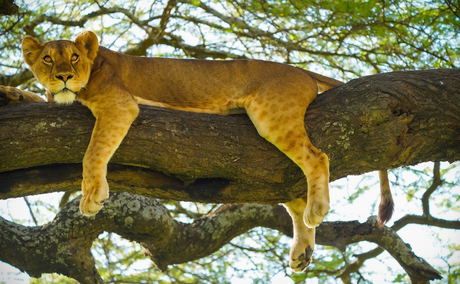
Africa has 20,000 lions left. Tanzania has half of them. The question is not whether you will see one. It is whether you will understand what you are looking at when you do. Tanzania is not one safari. It is a set of completely different landscapes, each producing a different kind of lion. In the Serengeti, prides live off the Migration and rest on granite kopjes that have been used for generations....
Share This Post