
Tanzania Travel Guide: Safaris, Kilimanjaro, Beach Holidays, Culture and Responsible Travel - Page 2
Explore Tanzania with travel guides crafted by local experts. Dive into legendary safaris, trek up Mount Kilimanjaro, or relax on white-sand beaches on the Indian Ocean. Learn about Tanzania’s rich cultural heritage and discover genuine, responsible travel experiences. Whether you’re after wild adventures or off-the-beaten-path discoveries, these guides show you Tanzania through the eyes of those who know it best.
Welcome to the Kijani Tours Tanzania Travel Guide, your go-to spot for practical advice and insider tips for exploring Tanzania. We cover everything: wild safaris in the Serengeti, trekking up Mount Kilimanjaro, chilling out on Zanzibar’s beaches, diving into adventures on Mafia Island, discovering Pangani’s history, and getting into the heart of local culture.
You will find fresh, practical guides packed with local knowledge, covering national parks and World Heritage Sites, conservation stories, community traditions, and ways to travel responsibly. Whether you are planning a safari, ready to tackle Africa’s highest peak, looking to unwind by the Indian Ocean, or hoping to connect with people and culture beyond the usual tourist route, our guides have you covered. Discover Tanzania from a whole new angle.
Do Hyenas Hunt? Tanzania’s Spotted Hyena Behavior Explained
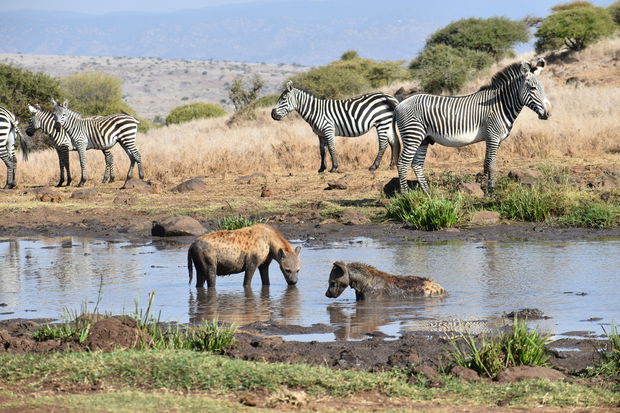
Introduction: The Real Story of Hyenas in the African Wilderness
In the vast, sun-drenched plains of the Serengeti ecosystem in northern Tanzania, life unfolds with a raw intensity that few landscapes on Earth can match. Here, every movement has meaning, every sound carries information, and survival is a continuous negotiation between predator and prey.
Among the most misunderstood inhabitants of this world are hyenas. For decades, they have been labeled as scavengers, opportunists that simply wait for others to make the first kill. Yet in the wild heart of Tanzania’s safari landscapes, this narrative collapses under observation. Hyenas are not passive followers of lions—they are intelligent, adaptive, and highly effective predators in their own right.
To witness them during a Tanzania safari is to observe a complex social system in motion, where strategy, communication, endurance, and cooperation define survival. With Kijani Tours, travelers encounter these moments in a responsible and eco-conscious way, ensuring that wildlife behavior remains undisturbed while supporting conservation and local communities.
Tanzania Biodiversity Guide: Wildlife, Ecosystems and Conservation
Introduction: Journey to the Heart of Tanzania
There is something about Tanzania that refuses to stay behind when you leave. You carry it home without meaning to. The low rumble of hooves across the plains of the Serengeti. The sharp, cold breath of air near the top of Mount Kilimanjaro. The way the light settles over Lake Tanganyika at sunrise, turning the surface into hammered silver. Weeks later, a warm breeze hits your face somewhere else in the world, and you’re suddenly back on the Indian Ocean coast, watching the tide shift.
It is not dramatic in an obvious way. It’s wide, yes. Vast plains, open sky, horizons that don’t seem to end. But it is also close and textured. The crunch of dry earth under your boots. The smell of wood smoke in the evening. Fishing boats nudging against the shoreline. And always, people are at the center of it all. More than 120 tribes, each with its own stories, rhythms, and ways of seeing the world. Daily life moves forward here with or without an audience. You are not watching a performance. You are being invited, briefly, into something real.
The wildlife feels the same. Wildebeest tracing ancient migration paths. Elephants cut quiet silhouettes against the dusk. Lions resting in the shade, completely unbothered by your presence. These patterns are older than borders, older than roads. The land still holds them. You start to understand that this isn’t a place to rush through with a checklist. The more patient you are, the more it gives back.
That is how we approach it at Kijani Tours. Not as a series of highlights, but as an experience you move through slowly. You climb Kilimanjaro with guides who grew up on its lower slopes and know the mountain in their bones. You cross the Serengeti with people who can read tracks and wind like a language. You sit in a village courtyard where tourism income has helped build classrooms and improve water access, and you see exactly where your visit makes a difference. Later, on the beaches of Zanzibar, you rest knowing your stay supports families and local partners, not some distant office.
This isn’t about ticking off landmarks. It is about paying attention. Tanzania asks for that. And if you give it the time, it has a quiet way of shifting something inside you.
Ngorongoro Crater Guide: Wildlife Density, Tours, and Travel Planning
The Ngorongoro Conservation Area rises from the northern Tanzanian highlands as one of Africa’s most layered landscapes. Here, volcanic geology shaped a vast caldera, wildlife adapted to enclosed grasslands and permanent springs, Maasai pastoralists continue centuries-old grazing traditions, and some of the earliest evidence of human evolution lies preserved in nearby sediment. Few destinations integrate ecology, anthropology, and living culture with such clarity.
When you stand on the rim of the Ngorongoro Crater at sunrise, you do not simply look down at wildlife. You observe a functioning ecological system. Lions patrol territories defined by prey density. Elephants navigate forest corridors shaped by groundwater flow. Flamingos respond to alkaline lake chemistry influenced by seasonal rainfall. Each sighting reflects a deeper process.
This guide provides a comprehensive framework for understanding and planning a visit to Ngorongoro in 2026 and beyond. It integrates wildlife behavior, highland trekking routes, Olduvai Gorge archaeology, Laetoli footprints, Gol Mountain vulture ecology, climate change implications, and practical logistics. The goal is not only to inform but to equip you with insight that transforms a safari into an informed, responsible, and strategically planned journey.
Responsible Kilimanjaro Trekking: Protecting Africa’s Highest Mountain
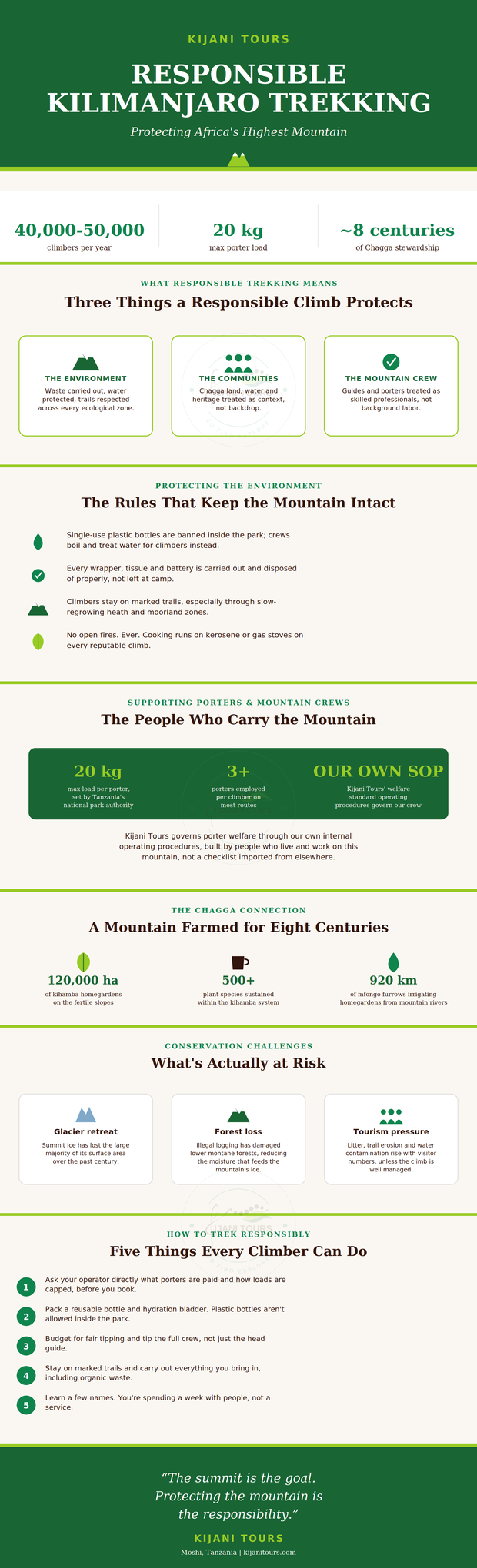
Climbing Kilimanjaro is only half the story. Behind every summit is a mountain ecosystem under real pressure, a crew of porters and guides whose treatment defines what "responsible" actually means, and Chagga communities who have farmed these slopes for centuries. This guide, written from Kijani Tours' own base on Kilimanjaro's southern slopes, lays out what protecting the mountain actually requires, from porter welfare to waste management to the traditional knowledge still keeping this ecosystem alive.
Kilimanjaro and Safari Combination: Tanzania Adventure Guide
Before dawn on Mount Kilimanjaro, every step toward Uhuru Peak is a test of will against thin alpine air. You move through five distinct ecosystems—rainforest, moorland, alpine desert, and arctic summit—until sunrise spills over Africa’s highest point. The climb demands resilience, but it offers something rare in return: clarity, strength, and a deep connection to the land.
Days later, the stillness of the summit gives way to the sweeping plains of the Serengeti, where lions stir and the Great Migration pulses through ancient grasslands. From the wildlife-rich floor of the Ngorongoro Crater to the elephant-dotted baobab landscapes of Tarangire National Park, safari becomes both reward and revelation—a chance to witness nature’s intricate balance up close.
With Kijani Tours, this multi-adventure journey is crafted with safety, sustainability, and community at its heart. Expert-guided climbs, ethical wildlife experiences, and meaningful cultural connections with local communities create more than a trip—they create perspective. First, you conquer the mountain. Then, the wild reshapes you.
Kilimanjaro for Seniors: A Safe and Steady Summit Guide
A silver mist drifts through Lemosho’s mahogany glades, carrying the scent of damp earth and ferns. Your trekking poles press into the soft trail, each step intentional, each breath a conversation with the mountain. Unlike the rush of younger climbers chasing Kilimanjaro’s summit, this is a slow-paced climb designed for senior adventurers.
At Kijani Tours, we believe a senior-friendly ascent is about seeing, feeling, and connecting. Our guides move with care, watching your health and every rhythm of the mountain. Beyond the peak, this journey immerses you in Tanzania’s wild heart, supports local communities, and honors glaciers that have endured centuries.
As sunlight lights the Shira Plateau, you realize: your years are your strength. The summit favors patience, curiosity, and steady purpose. Welcome to the “Slow Adventure.” The mountain is calling, and with Kijani Tours, you are ready to answer.
Chagga People of Kilimanjaro: Culture, History and Village Life
The Chagga people of Kilimanjaro have spent centuries demonstrating that farming, faith, and governance need not compete with conservation; they can reinforce it. This guide explores the four-tiered Kihamba garden system, the Isale plant that still settles land disputes without a single court date, the Mfongo canals that have moved water fairly across the mountain for generations, and the missionary-era coffee trade that grew into Africa's first African-run cooperative. Kijani Tours explores the people, land, and living history behind Tanzania's most storied mountain community.
Solo vs Group Kilimanjaro Climbs: What Actually Changes on the Mountain
Choosing between a solo (private) and group Kilimanjaro climb is one of the most overlooked decisions in trek planning, and it shapes nearly every aspect of the experience. The blog clarifies that no one truly climbs "solo" because KINAPA requires a licensed guide on every trek; what climbers actually choose is a private departure with a dedicated crew versus a scheduled group with shared logistics.
A private climb gives trekkers a personalized pace tailored to their acclimatization needs, deeper one-on-one time with their guide and cook, and a more introspective, solitary experience. The Northern Circuit is often cited as the strongest route match. A group climb offers built-in psychological support during hard moments like summit night, a genuinely international trail community, and a lower per-person cost since expenses are shared. Machame is the most socially popular route.
Regardless of format, the post stresses that safety and ethics don't change: a 20kg porter weight limit, twice-daily health monitoring, proper hydration and nutrition protocols, and Leave No Trace practices apply to every climb. The piece closes with an FAQ addressing common questions (cost differences, summit success rates, safety parity between formats) and a call to choose the climb style that matches the climber's actual reason for attempting the mountain.
The Unifying Power of Swahili Language in Tanzania: A Bridge Between Cultures and Communities
Swahili (Kiswahili) is Tanzania's National and unifying language, deliberately chosen after independence to connect the country's 120+ ethnic groups without favoring any one of them. It's safeguarded today by BAKITA, the National Kiswahili Council of Tanzania, and celebrated globally every July 7 on UNESCO's World Kiswahili Language Day. Travelers don't need it to visit Tanzania, but a handful of phrases change how guides, porters, and communities receive you.
Travel Deeper: How Cultural Respect Creates Truly Sustainable Tourism
Travel Deeper: How Cultural Respect Creates Truly Sustainable Tourism
1) True sustainability goes beyond eco‑habits—it begins with a respectful mindset toward local cultures.
2) Cultural respect strengthens the three pillars of tourism: environmental protection, economic resilience, and socio‑cultural preservation.
3) Empowering communities as guardians, artisans, and storytellers ensures conservation and dignified livelihoods.
4) Travel becomes legacy‑building when it shifts from extraction to authentic human connection.

Share This Page