

Kilimanjaro Summit Night: The Final Hours Before Uhuru Peak At midnight, the mountain disappears. Your headlamp becomes your horizon. Kilimanjaro summit night is the final and most demanding stage of the journey to Uhuru Peak at 5,895 metres. Starting around midnight, climbers face several hours of darkness, cold, fatigue, limited sleep and reduced oxygen availability. The challenge is physical, but it is also deeply mental. The key to managing summit night is...
Why Are Kilimanjaro's Glaciers Disappearing? Climate Change Explained | Kijani Tours
Posted by Wolfgang on Mon July 20, 2026 in Climate change and Mount Kilimanjaro glaciers.
Kilimanjaro Glacier Facts at a Glance
Mount Kilimanjaro’s glaciers are disappearing because of a combination of climate change, reduced snowfall, and increased ice loss through sublimation. Since 1912, the mountain has lost more than 90% of its ice cover, shrinking from approximately 11.4 square kilometres to less than one square kilometre today.
Although the glaciers are not the main water source for communities around Kilimanjaro, they are one of the world’s most important climate indicators. Their retreat reveals how global climate change is affecting even the highest mountains in tropical regions.
Key facts:
Location: Mount Kilimanjaro, Tanzania
Highest point: Uhuru Peak (5,895 metres)
Ice loss since 1912: More than 90%
Remaining glacier area: Approximately 0.98 km² (2021–2022 measurements)
Oldest summit ice: More than 10,000 years old
Main driver of loss: Climate change
Main water source for communities: Kilimanjaro’s montane forests
Why Are Kilimanjaro's Glaciers Disappearing?
Mount Kilimanjaro has lost more than 90% of its ice cover since scientists began measuring it in 1912, shrinking from about 11.4 square kilometers to less than one square kilometer today. The main cause is climate change: warmer temperatures, reduced snowfall and drier air have accelerated ice loss through melting and sublimation. Researchers project the remaining glaciers could disappear between the 2030s and 2050s if current trends continue.
For generations, the snow-covered summit of Mount Kilimanjaro has been one of Africa's most recognizable natural symbols. A white crown rising above the tropical plains, the glaciers of Kibo have inspired explorers, scientists, photographers and climbers from around the world.
But that frozen landscape is changing.
The story of Kilimanjaro's disappearing glaciers is not only about melting ice. It is a story about climate change, ancient climate records, fragile mountain ecosystems, forests, and the relationship between people and one of Africa's most important landscapes.
|
Category |
Information |
|
Ice cover in 1912 |
Approximately 11.4 km² |
|
Remaining ice cover (2021–2022) |
Approximately 0.98 km² |
|
Total glacier loss since 1912 |
More than 90% |
|
Main cause of glacier retreat |
Climate change, including rising temperatures, reduced snowfall, and sublimation |
|
Projected glacier disappearance |
Between the 2030s and 2050s under current climate trends |
|
Age of oldest summit ice |
More than 10,000 years old |
|
Type of glacier |
Tropical glaciers, found on only three mountains in Africa: Kilimanjaro, Mount Kenya, and the Rwenzori Mountains |
|
Main water source for the Kilimanjaro region |
The montane forest belt, not the glaciers |
How Much Ice Has Kilimanjaro Lost?
More than 90% since records began. When scientists first mapped the mountain's ice in 1912, glaciers covered approximately 11.4 square kilometers of the summit area. Satellite measurements from 2021 to 2022 recorded approximately 0.98 square kilometers remaining.
The decline of Kilimanjaro's glaciers is one of the best-documented glacier retreats in the world, mapped for over a century, first by photography, then by aerial survey, and now by satellite. The timeline shows the dramatic transformation:
1. 1912: Approximately 11.4 km² of ice-covered Kilimanjaro.
2. 1989: The glaciers had reduced significantly, losing around two-thirds of their area.
3. 2011: Only about 1.76 km² remained.
4. 2021 to 2022: Satellite measurements recorded approximately 0.98 km² of remaining ice.
The remaining ice bodies include:
1. Northern Ice Field
2. Southern Ice Field
3. Furtwängler Glacier inside Kibo's crater
4. Smaller remnants such as the Kersten Glacier
These glaciers are not simply becoming smaller. They are also becoming thinner, and the retreat is accelerating: as bright snow cover disappears, the exposed ice loses its ability to reflect sunlight, absorbs more heat, and wastes away faster.
Kilimanjaro's glaciers are tropical glaciers, among the rarest ice formations on Earth. They exist just three degrees south of the Equator only because the summit rises nearly 6,000 meters into permanently freezing air. Africa has tropical glaciers on only three mountains: Kilimanjaro, Mount Kenya, and the Rwenzori Range, and Kilimanjaro holds the largest share.
Most people picture glaciers in polar regions or high mountain ranges far from the tropics, which is why ice at the Equator seems impossible. The explanation is altitude. Air cools as it rises, and at Kilimanjaro's summit plateau, around 5,700 to 5,800 meters, temperatures remain below freezing even as the plains below bake in equatorial heat. The rarity on this scale is worth stating plainly: of all the tropical glacier area on Earth, the overwhelming majority lies in the South American Andes. East Africa holds only a few square kilometers, and a tiny remnant survives in the mountains of New Guinea. Standing beside Kilimanjaro's ice fields means standing beside one of the last members of a vanishing category.
Tropical glaciers also live by different rules from the alpine glaciers of Europe or North America, and the differences explain much of what climbers see at the summit.
No winter, no summer. Near the Equator there is no seasonal temperature swing. The temperature difference between morning and afternoon is greater than the difference between January and July. Instead of a winter of snow accumulation and a summer of melt, Kilimanjaro's glaciers depend on the rhythm of wet and dry seasons for the snowfall that sustains them. When the wet seasons weaken, the glaciers have no winter to fall back on.
Fed and shielded by snow. Fresh snowfall does two jobs at once: it adds mass to the glacier, and its bright surface reflects the fierce equatorial sun away from the ice beneath. When snow fails to fall, the darker exposed ice absorbs solar radiation directly and wastes away far faster. This is why drier conditions have been as damaging to Kilimanjaro's ice as warming itself.
The vertical ice walls. Kilimanjaro's summit ice cap sits on the flat crater plateau and ends in sheer cliffs of ice, in places tens of meters high, one of the most distinctive glacier forms anywhere in the world. The walls exist because of the geometry of equatorial sunlight: the overhead sun works on the flat top while the low morning and evening sun works laterally on the exposed edges, carving faces so clean they look deliberately cut. These white walls rising from dark volcanic rock are the image most summit photographs capture.
Retreat from within, not just the edges. The ice is thinning as well as shrinking. The Northern Ice Field, the largest remaining body, developed a hole at its center that grew into a canyon, exposing rock beneath the ice for the first time in roughly 11,000 years, and the ice field has since split in two. The glaciers are not simply pulling back at their margins; they are coming apart.
Understanding what these glaciers are makes their disappearance easier to grasp. Ice this rare, surviving this far outside its natural range, has no margin for a changing climate.
Why Are Kilimanjaro's Glaciers Melting?
The main cause is climate change. Kilimanjaro's tropical glaciers survive on a delicate balance between snowfall and ice loss, and warming temperatures, reduced snowfall, and extremely dry summit air have tipped that balance, driving ice loss through both melting and sublimation.
Kilimanjaro's glaciers persist in an unusual environment. The mountain lies near the Equator, where sea-level temperatures remain warm year-round. The glaciers exist only because the summit rises nearly 6,000 meters into the atmosphere, creating freezing conditions. This makes them especially sensitive to climate change. Three factors are driving their decline.
Rising Temperatures and Changing Climate Patterns
Global warming has increased temperatures around the world, including in East Africa. Warmer conditions raise the altitude at which snow can survive and accelerate ice loss from the summit.
Temperature alone does not explain the entire story. Kilimanjaro's glaciers also depend on regular snowfall to maintain their frozen surface. In recent decades, the mountain has experienced changes in atmospheric conditions, including reduced snowfall and drier air. Without enough fresh snow covering the glaciers, the ice becomes more exposed and vulnerable.
Direction: When Ice Disappears Without Melting
One of Kilimanjaro's most unusual glacier processes is sublimation. Unlike normal melting, where ice turns into liquid water, sublimation occurs when ice changes directly into water vapor.
At Kilimanjaro's summit, the air is extremely dry, and intense tropical sunlight reaches the glacier surface. Under these conditions, ice can slowly disappear into the atmosphere without ever becoming water. This process helps explain why Kilimanjaro's glaciers continue shrinking even though summit temperatures often remain below freezing, and it is why the ice fields have developed their distinctive sheer vertical walls.
Pressure on the Mountain's Forests
The connection between Kilimanjaro's glaciers and forests is often misunderstood, but it is real. The montane forests on the lower slopes release moisture into the air, moisture that can rise, condense and fall as snow higher up. Deforestation and land-use change reduce that flow, adding local pressure to a glacier system already under global stress. What happens in the forest belt is connected to what happens at the summit.
When Will Kilimanjaro's Glaciers Disappear?
Research indicates that Kilimanjaro's remaining glaciers could disappear sometime between the 2030s and 2050s if current trends continue. A United Nations assessment of World Heritage glaciers identifies Kilimanjaro as one of the world's most vulnerable glacier systems and projects its ice could be lost around 2050.
Scientists cannot predict an exact date, because glacier survival depends on future climate conditions and snowfall patterns as much as temperature. But every mapped trend points the same direction, and the acceleration measured since 2011 has made the nearer estimates look realistic. The disappearance of these glaciers would represent the end of an ice record that has existed for thousands of years.
What Climate Record Does Kilimanjaro's Ice Hold?
Ice cores extracted from the Northern Ice Field contain layers formed over 10,000 years ago, preserving evidence of past climate conditions in tropical Africa, including ancient droughts and environmental change. As the glaciers disappear, this natural archive is being lost.
The glaciers of Kilimanjaro are valuable not only because they are beautiful, but because they contain information about Earth's history. Each layer of ancient ice records the conditions of the year it formed, and scientists have used these cores to reconstruct the climate story of the continent across the entire period of human civilization.
The mountain is not only losing ice. It is losing a scientific record of Africa's climate history, and losing it faster than science can fully read it.
Do Kilimanjaro's Glaciers Provide Water?
No. This is one of the most common misconceptions about Mount Kilimanjaro. The remaining glaciers are too small to provide a significant water supply. The region's water comes from the montane forest ecosystem on Kilimanjaro's lower slopes, which captures rainfall and cloud moisture and feeds the springs, streams, and rivers below.
The true water system of Kilimanjaro begins much lower down than the summit ice. The forests intercept rain and cloud moisture, store it, and release it steadily into the rivers that support farming communities, wildlife and towns across the Kilimanjaro Region.
This distinction matters because it shows where conservation efforts have the greatest impact. Protecting forests, preventing degradation and supporting sustainable land management are among the most important actions for protecting Kilimanjaro's future, and they do far more for the region's water security than anything that can be done for the glaciers themselves.
Why Does Glacier Loss Matter for Conservation?
The glaciers are a record of ancient climate history, a symbol of Africa's natural heritage, a warning about global climate change, and an important part of Kilimanjaro's identity. Their retreat cannot be reversed locally, which makes protecting the mountain's surviving ecosystems the work that counts.
The disappearance of Kilimanjaro's glaciers is a visible reminder that mountain ecosystems are changing. While local communities cannot stop global climate change alone, they can protect the ecosystems that remain.
Protecting Kilimanjaro’s Future Requires:
Protecting the mountain’s ecosystems through several important conservation actions:
1. Protecting the montane forests: Safeguarding the forests on Kilimanjaro’s lower slopes helps maintain the mountain’s water cycle, protect biodiversity, and support local communities.
2. Preserving biodiversity: Conserving Kilimanjaro’s unique plants, wildlife, and ecological zones protects the species that depend on the mountain environment.
3. Maintaining wildlife corridors: Protecting natural movement routes allows elephants, primates, and other wildlife to move safely between habitats.
4. Supporting sustainable agriculture: Encouraging farming practices that protect soil, water, and forests helps communities live sustainably around the mountain.
5. Encouraging responsible tourism: Sustainable trekking practices help fund conservation, support local livelihoods, and reduce pressure on Kilimanjaro’s fragile ecosystems.
Every responsible trek on Kilimanjaro contributes to protecting the mountain through conservation fees, employment opportunities and support for local communities. How a climb is run decides how much it gives back, which is why choosing a responsible operator matters as much as choosing a route.
Can You Still See Glaciers When Climbing Kilimanjaro?
Yes. Although Kilimanjaro's glaciers are much smaller than a century ago, climbers can still see impressive ice formations near the summit. Routes such as the Northern Circuit, Lemosho and Machame approaches pass through landscapes where the remaining glaciers can be viewed.
Standing beside the white walls of Kibo's ice fields, surrounded by volcanic rock and the vast African landscape below, is a powerful reminder that mountains are constantly changing. The sight of the glaciers glowing gold at sunrise from the crater rim remains one of the most extraordinary images in African trekking, and one of the photographs climbers keep for life.
Will Kilimanjaro Still Be Worth Climbing Without Glaciers?
Absolutely. The glaciers are one part of Kilimanjaro's story, but they are not the whole story. A Kilimanjaro trek is a journey through five ecological zones, as well as through geology, wildlife, culture, and human history, and all of that will remain.
Every climb crosses five distinct worlds:
1. cultivated farmland
2. tropical rainforest
3. heath and moorland
4. alpine desert
5. Arctic summit environment
The mountain's volcanic origins, Chagga heritage, unique ecosystems and incredible landscapes will remain long after the glaciers change.
Frequently Asked Questions About Kilimanjaro's Glaciers
1. Why are Kilimanjaro's glaciers disappearing?
Kilimanjaro's glaciers are disappearing mainly because of climate change, which has caused warmer temperatures, reduced snowfall, and increased ice loss through melting and sublimation. Deforestation on the lower slopes adds local pressure by reducing the moisture that rises up the mountain.
2. How much ice has Kilimanjaro lost?
Mount Kilimanjaro has lost more than 90% of its glacier area since 1912, decreasing from approximately 11.4 square kilometres to less than one square kilometre today. Satellite measurements from 2021 to 2022 recorded about 0.98 square kilometres remaining.
3. Are there still glaciers on Kilimanjaro?
Yes. Small glaciers remain around Kibo's summit, including the Northern and Southern Ice Fields, the Furtwängler Glacier inside the crater, and remnants such as the Kersten Glacier. All are shrinking and thinning.
4. When will Kilimanjaro's glaciers disappear?
Scientists estimate that Kilimanjaro's remaining glaciers could disappear between the 2030s and 2050s, depending on future climate conditions. A United Nations assessment of World Heritage glaciers projects the ice could be lost around 2050.
5. Why are there glaciers on Kilimanjaro if it is near the Equator?
Because of altitude. Air cools as it rises, and Kilimanjaro's summit stands nearly 6,000 metres above sea level, high enough for temperatures to stay below freezing year-round even three degrees from the Equator. These rare formations are called tropical glaciers.
6. Where else do tropical glaciers exist?
Tropical glaciers survive in only three regions on Earth: the South American Andes, which hold the vast majority, the mountains of New Guinea, and East Africa, where they exist on just three mountains: Kilimanjaro, Mount Kenya, and Uganda's Rwenzori Range.
7. Is there still snow on Mount Kilimanjaro?
Yes. Snow still falls on the summit, particularly around the short and long rainy seasons, and the peak is often white after storms. Seasonal snow is separate from the permanent glaciers, which continue to retreat regardless of individual snowfalls.
8. What is sublimation and why does it matter on Kilimanjaro?
Sublimation is when ice changes directly into water vapor without melting into liquid first. In the extremely dry, sun-intense air of Kilimanjaro's summit, much of the ice loss happens this way, which is why the glaciers keep shrinking even when temperatures stay below freezing.
9. How old is the ice on Kilimanjaro?
Ice cores drilled from the Northern Ice Field contain layers formed more than 10,000 years ago. They preserve a record of tropical Africa's climate across that whole period, including ancient droughts, and that archive is being lost as the ice disappears.
10. Do Kilimanjaro's glaciers provide water to local communities?
No. The glaciers are too small to be a significant water source. The region's water comes from the montane forest belt on the lower slopes, which captures rainfall and cloud moisture and feeds the springs and rivers supplying farms and towns across the Kilimanjaro Region.
11. Can the glaciers on Kilimanjaro be saved?
Realistically, no. Their retreat is driven by global climate change, which cannot be reversed locally. What can be protected is the mountain's forest belt, biodiversity and wildlife corridors, which is where conservation and responsible tourism make a real difference.
12. Can tourists still see glaciers on Kilimanjaro?
Yes. Climbers can still see the remaining glacier formations near the summit, although they are much smaller than historical photographs show. Routes such as the Northern Circuit, Lemosho and Machame pass through landscapes with views of the remaining ice.
13. Will Kilimanjaro still be worth climbing without glaciers?
Yes. The trek crosses five ecological zones from farmland and rainforest to alpine desert and the Arctic summit zone, and the mountain's volcanic landscapes, wildlife and Chagga heritage remain. But travellers hoping to see the ice should climb sooner rather than later.
14. Does climbing Kilimanjaro contribute to the glaciers melting?
Trekking itself has no meaningful effect on the glaciers, whose retreat is driven by global climate patterns. A responsibly run climb funds park protection and forest conservation through fees, supporting the mountain systems that can still be protected.
Conclusion: Kilimanjaro’s Ice Is Disappearing, but the Mountain’s Story Continues
Mount Kilimanjaro’s glaciers are disappearing, but the mountain itself remains a living landscape shaped by geology, climate, nature, and human connection. The retreat of Kibo’s ice fields is one of the clearest reminders of a changing climate, revealing how even the most remote and iconic places on Earth are being affected by global environmental changes.
The loss of the glaciers is not only about disappearing ice. It represents the disappearance of an ancient climate archive, the transformation of a landscape that has inspired generations, and a warning about the importance of protecting mountain ecosystems. While the glaciers may not be the main source of water for communities around Kilimanjaro, the forests, wildlife habitats, and agricultural landscapes connected to the mountain remain essential for the future of the region.
For travellers who climb Kilimanjaro today, the journey is about more than reaching Uhuru Peak. It is an opportunity to witness a mountain in transition, to understand the fragile relationship between ice, forests, wildlife, and people, and to become part of a story that has been unfolding for millions of years.
The glaciers of Kilimanjaro may not remain forever, but the responsibility to protect the mountain’s forests, biodiversity, and cultural heritage continues. Every responsible journey to Kilimanjaro can contribute to keeping this extraordinary landscape alive for future generations.
The mountain is still standing. The forests are still breathing. The ice is still there—but its story is being written now.
Share This Post
Latest News
Tanzania Travel Guide | Safaris, Kilimanjaro, Beaches, Culture and Responsible Travel
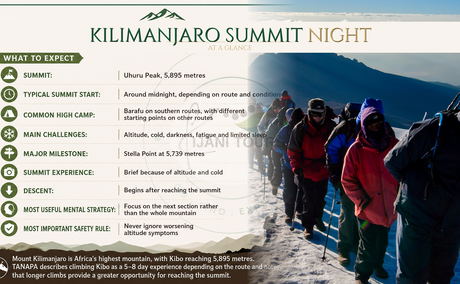
Kilimanjaro Summit Night: How to Prepare Mentally and What to Expect
Sun August 30, 2026
Read This Article
Is Tanzania Safe for Kids on Safari?: A Parent's Guide to Family Safari in Tanzania, 2026–2029
Sat August 29, 2026
Read This Article
Planning a Tanzania safari with children? This practical family safari guide helps parents understand when to go, which parks and experiences suit different ages, how to prepare for health and safety, and what to expect from accommodations, game drives, and wildlife encounters. It also explains how Kijani Tours can tailor a private safari to your family's needs, from the Serengeti and Ngorongoro to cultural experiences and Tanzania's coast, from Pangani to Mafia...
Climbing Kilimanjaro as a Woman: What No One Tells You Before You Go
Thu August 27, 2026
Read This Article
Climbing Kilimanjaro as a woman is absolutely possible, but there are practical things to prepare for before you arrive. This guide covers the realities many women want to know about, including hygiene at mountain camps, managing your period, physical preparation, altitude sickness, and what to expect on summit night. You will also learn which questions to ask Kijani Tours' team regarding privacy, female guides, hygiene and waste management, health monitoring, and emergency...
Share This Post