

Kilimanjaro Summit Night: The Final Hours Before Uhuru Peak At midnight, the mountain disappears. Your headlamp becomes your horizon. Kilimanjaro summit night is the final and most demanding stage of the journey to Uhuru Peak at 5,895 metres. Starting around midnight, climbers face several hours of darkness, cold, fatigue, limited sleep and reduced oxygen availability. The challenge is physical, but it is also deeply mental. The key to managing summit night is...
Serengeti Calving Season: 500,000 Wildebeest Births in Three Weeks
Posted by Wolfgang on Sun August 23, 2026 in The Great Migration and Calving Season.
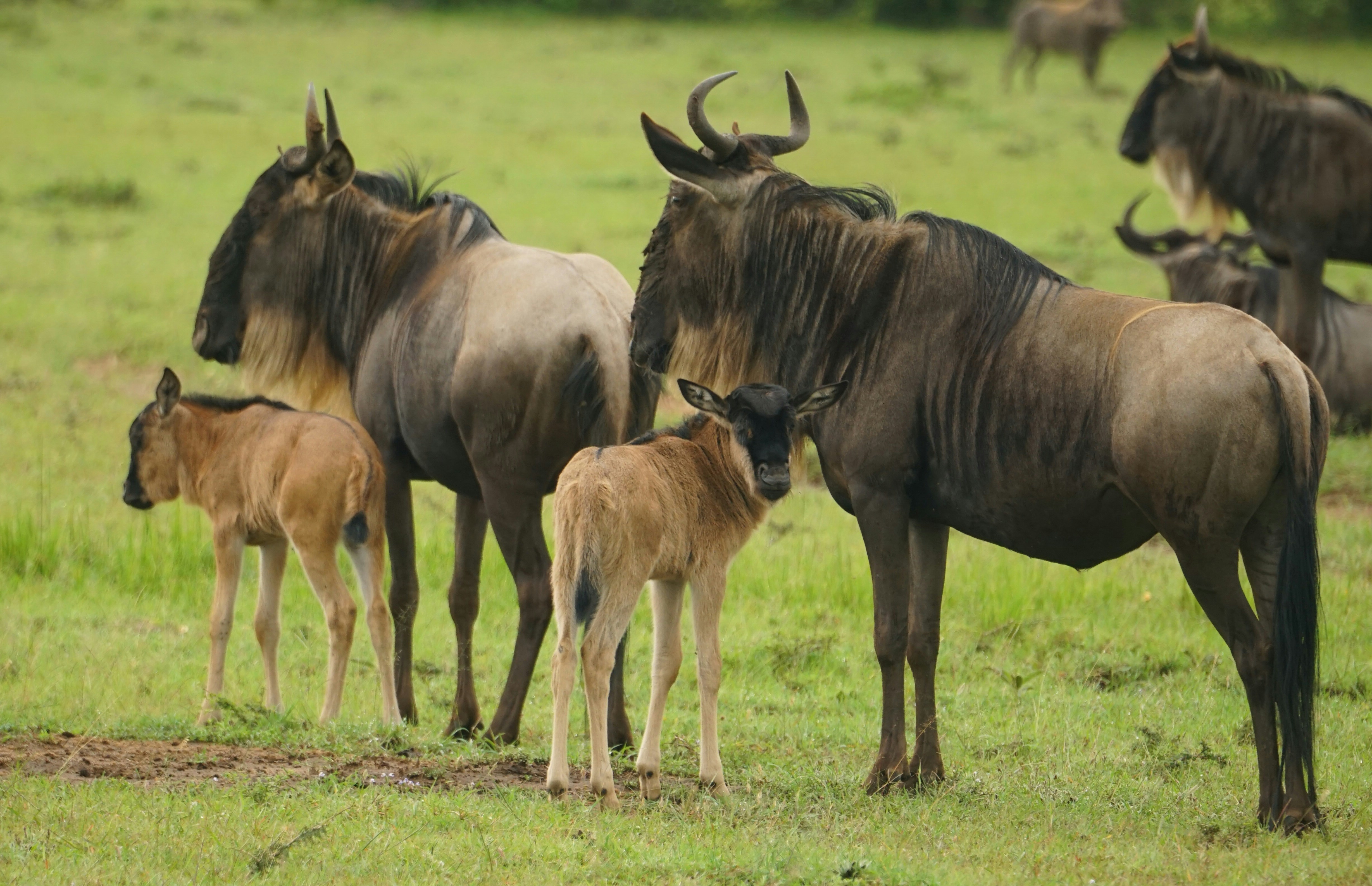
This blog explores the breathtaking drama of the wildebeest calving season in Tanzania’s southern Serengeti, where over 500,000 calves are born within a few short weeks between January and March. It highlights the synchronized birthing strategy known as predator satiation, which helps ensure survival by overwhelming predators, such as lions, cheetahs, and hyenas, with sheer numbers. The piece captures the emotional intensity of this natural phenomenon, where life and death unfold in real time, and and positions it as a must-see experience for safari travelers seeking raw, unforgettable encounters with nature’s rhythms.
Serengeti Calving Season: The Complete Safari Planning Guide
When to go, where to be, and what you will actually see on the southern Serengeti plains
Primary Keyword: wildebeest calf creche
Secondary Keywords: wildebeest calving season, Serengeti calving season, wildebeest synchronized calving, wildebeest calf survival, wildebeest mother and calf, predator satiation, wildebeest birth synchrony, Ndutu calving season, Serengeti calving safari Tanzania
The calf runs before you have time to ask how old it is.
The calf's legs are still uncertain. Its mother is already moving. Around them, the short grass teems with hundreds of other calves, each learning the same urgent lesson: keep up. This is the southern Serengeti during calving season, and nothing quite prepares you for it.
From a safari vehicle, surrounded by all of this, most people reach for the same word. Nursery. Others have heard the term wildebeest calf creche, a natural daycare, they are told, where wildebeest mothers take turns watching over hundreds of calves while others go off to feed.
What is actually unfolding on these plains is more scientifically interesting than any daycare metaphor, and understanding it properly transforms the calving season from a spectacular sighting into one of the most meaningful wildlife experiences in Africa.
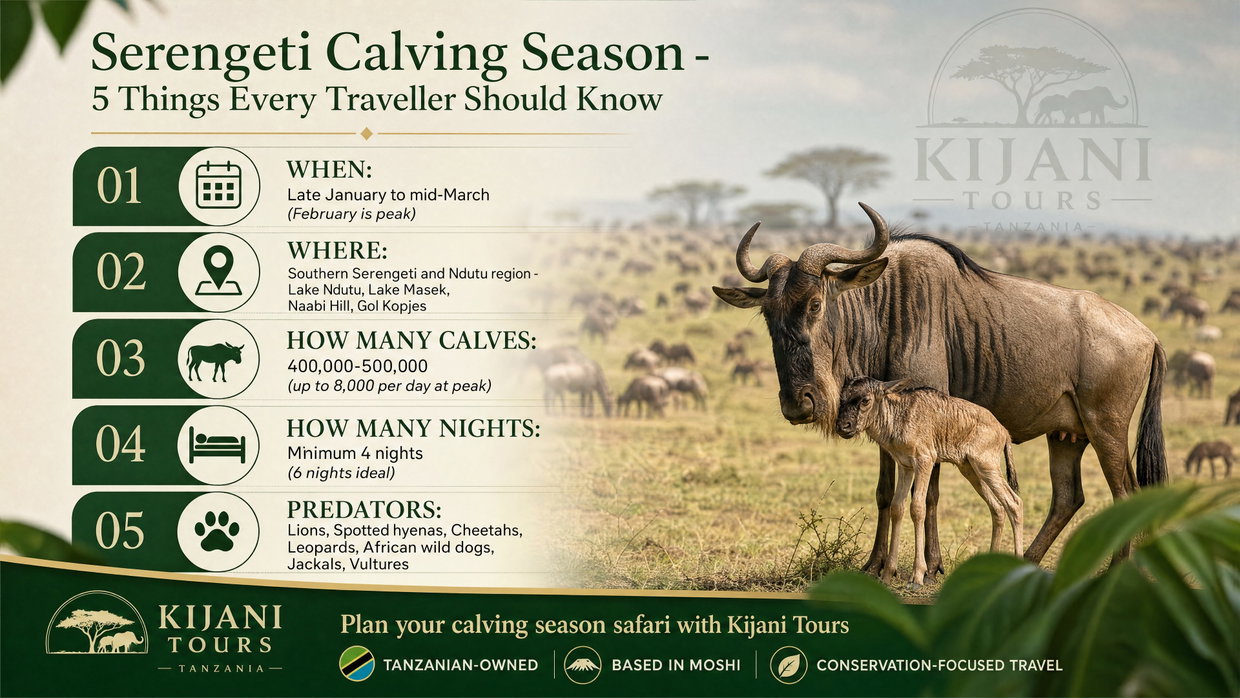
The calving season raises the same five questions every year. Here are the short answers; the rest of this guide explains why.
What You Are Looking At
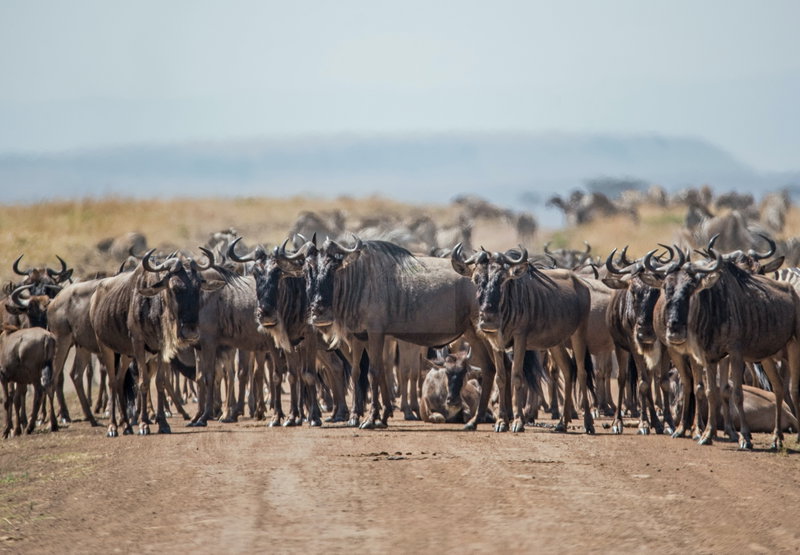
Visit the southern Serengeti during the calving season, and the landscape feels different from any other time of year. The plains turn green after the November short rains. Wildebeest stretch across the horizon in numbers that are hard to count. Pregnant females move slowly through the grass. Then, almost everywhere you look, there are calves.
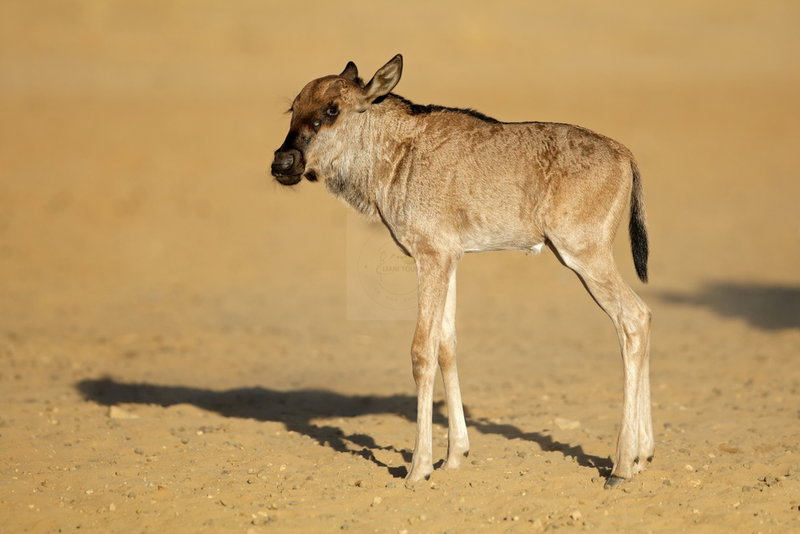
Some are only hours old, their tawny coats still damp. Others are already taking short, skittish bursts that look like practice. Some stand pressed against their mothers. Others move among groups of similarly aged calves, drifting and regrouping as the herd shifts.
The atmosphere can change in seconds.
One moment, the herd is quietly grazing. Then something shifts a hyena's posture, a movement at the edge of the group. Heads rise across the herd. Calves tighten toward adults. A mother turns sharply toward her young. The entire landscape goes on alert at once. Then it passes, and grazing resumes.
You are not simply watching animals. You are watching relationships unfold among mothers and calves, among the herd and its predators, and between the Serengeti and the rain that brought them all here.
What Is a Wildebeest Calf Creche?
The word "creche" is borrowed from French and is used loosely in wildlife biology to describe groups of young animals that gather. In some species, such as giraffes, flamingos, and certain penguins, the term describes a genuinely cooperative arrangement in which specific adult animals take turns guarding groups of young while others feed and drink.
For wildebeest, the term is applied more loosely. And that looseness matters.
During the Serengeti calving season, blue wildebeest (Connochaetes taurinus), the western white-bearded subspecies that forms the great migratory population, give birth to an extraordinary number of calves in a very short period. Calves naturally form groups across the plains. These groups are dense and striking.
But large groups of calves appearing together do not necessarily indicate that they are being supervised cooperatively. The distinction between an aggregation of young animals and an organized childcare system is not trivial. Popular safari descriptions often portray the creche as a sophisticated communal nursery: mothers taking turns, dedicated "aunties" staying behind, and even a deliberately created collective scent barrier to confuse predators. None of these specific claims are clearly supported by the scientific literature on wildebeest.
What is supported and what is genuinely fascinating is a more precise ecological narrative.
"What looks like a nursery is actually the Serengeti, revealing the power of numbers." David Kijani Tours Safari Guide
Why Are So Many Wildebeest Calves Born Together?
The answer is one of the great ecological stories from the Great Migration: birth synchrony at the population level.
In a typical year on the Serengeti, a very large proportion of fertile wildebeest females give birth within a remarkably compressed period, often described as roughly two to three weeks, with births typically peaking in late January to mid-February. The result is an extraordinary pulse of newborn animals concentrated across the short-grass plains.
When that many newborns enter the same landscape at nearly the same time, dense aggregations of calves are an inevitable consequence, not a planned one. Calves and their mothers feed, rest, and move across the same terrain. Groups of young animals form and dissolve as the herd shifts. From a distance, what appears to be an organized nursery is, in large part, the natural outcome of extreme synchrony in a species that already lives in enormous herds.
"The Serengeti follows the rain, not our calendars." David Kijani Tours Safari Guide
The Science Behind the Synchrony
Researchers have long understood that wildebeest calving is highly synchronized. Why it is so precisely synchronized, far more than rainfall and seasonal vegetation alone could explain, and even more than closely related species in the same habitat could explain, remained uncertain until recently.
That wild calving season in February? It really started six months earlier, all because of something most people wouldn't even notice: the deep, rumbling calls from male wildebeest during their rut. Every year in May and June, bulls, both territorial and bachelor types, flood the Serengeti with nonstop calls. It's loud, it rolls on for weeks, and honestly, it's easy to tune out if you're not paying attention.
Back in 2018, Smithsonian researchers finally explained what those calls actually do. Turns out, when female wildebeest hear that chorus, they sync up their breeding much more tightly, more than three times tighter than those that miss out on the calls. That sound pulls the whole herd into line, setting up thousands of births to happen all at once, right in that short window in January and February.
So, the next time you are out in the bush, surrounded by newborn calves, remember that the rain isn't the only reason for all this. The magic began with a sound echoing across the plains six months ago, one that almost everyone ignored.
The implication is striking. Wildebeest calving synchrony is not merely a response to the wet season. It appears to be an active evolutionary adaptation, shaped and reinforced over generations through the animals' reproductive behavior.
And the ecological consequence of that adaptation is a calving peak so compressed and dense that predators are overwhelmed.
The Survival Strategy Hidden Inside the Crowd
This is the science behind what you are seeing in the plains.
When thousands of calves are born in a short period, lions, hyenas, and cheetahs suddenly have an abundance of potential prey. They can hunt and kill, but they cannot eat every calf.
Ecologists call this predator satiation: the point at which prey reproduce in such large numbers that predators cannot consume enough individuals to meaningfully reduce the overall population. The Serengeti wildebeest calving season is a striking example of this phenomenon.
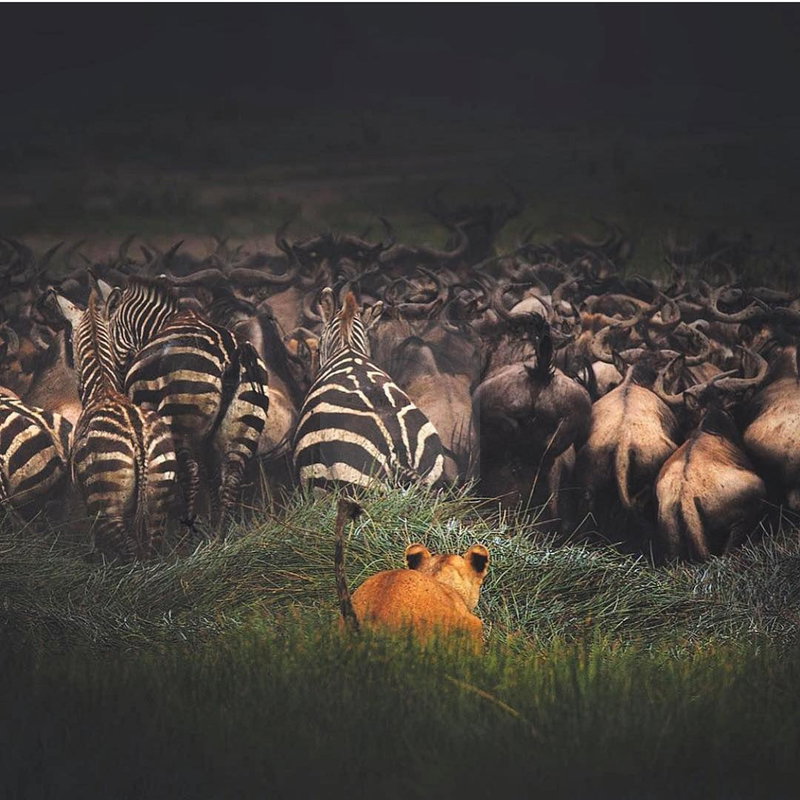
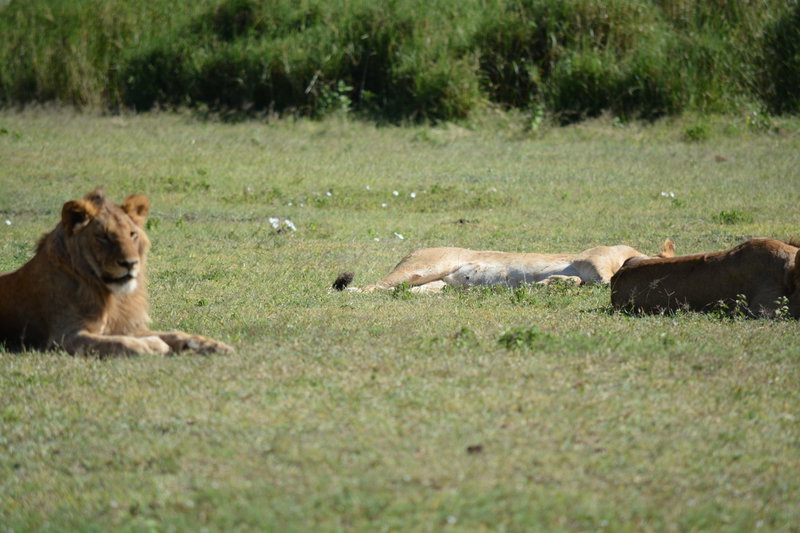
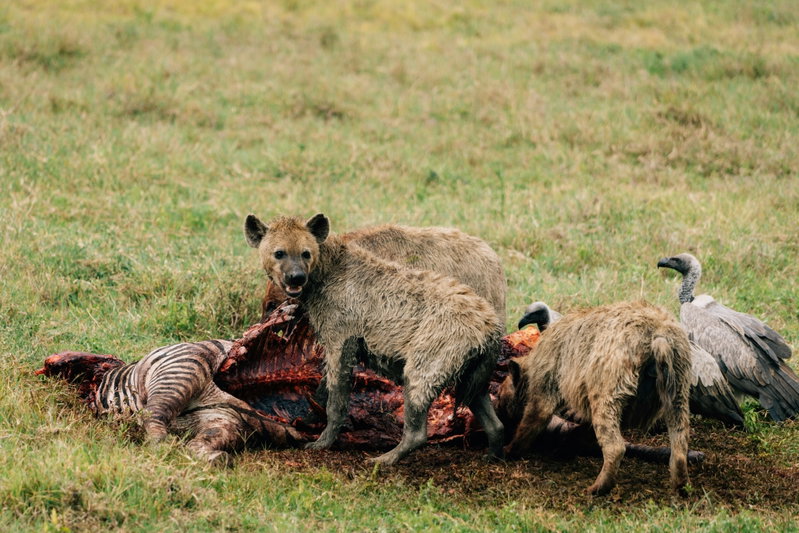
Here is something worth watching for on a calving-season game drive: a predator doing nothing. A lion pride lying in the grass, surrounded by hundreds of newborn calves, motionless. A spotted hyena sitting at the edge of the herd, already fed, unable to hunt again. This is predator satiation, and it is why synchronized calving works. No single calf is safe.
But the population does not need every calf to survive. It needs enough of them, and by producing thousands within a short window, the wildebeest ensure that no predator on the plains can keep up. Richard Estes saw it in Ngorongoro. Long-term Serengeti research confirmed it across multiple species. And you can see it yourself from the vehicle, not as a theory but as a lion that has stopped hunting because there is simply too much prey to process.
The wildebeest strategy is not to protect each calf. It is to produce so many calves in such a short period that the herd sustains itself even after predators have taken their toll.
"The wildebeest do not need every calf to escape. They need enough calves to make it through." Wolfgang Kijani Tours' founder
This matters for our understanding of the creche. The calves are not safer because someone is watching them. They are safer because there are so many of them that the odds have shifted in their favor.
The First Minutes of a Wildebeest's Life
One of the most remarkable things about watching a birth in the Serengeti is how quickly it becomes something else entirely.
Wildebeest calves are highly precocial, developmentally advanced at birth, and able to move within minutes. Research on wildebeest birth behavior, largely based on Estes's field studies, indicates that a healthy calf can stand within about six minutes of birth and nurses shortly thereafter. Within hours, it keeps pace with a moving herd.
This rapid development is not incidental; it is essential. Estes described wildebeest as a "follower-calf" species, unique among the bovids: unlike impala fawns, calves do not remain hidden in cover while their mothers feed. From its first minutes, a wildebeest calf follows. That system, Estes argued, is remarkably effective at protecting newborns even under heavy predation pressure.
There is no long childhood spent in a den or nest. The Serengeti is open, the herd is on the move, and predators are nearby. The calf has to keep up, and it does.
For a traveler watching those first uncertain steps from a respectful distance, it is one of the most quietly extraordinary moments among African wildlife.
"In the Serengeti, a newborn's first lesson is not patience. It is movement." Kijani Tours
How Does a Mother Find Her Own Calf?
Now imagine the challenge facing a wildebeest mother.
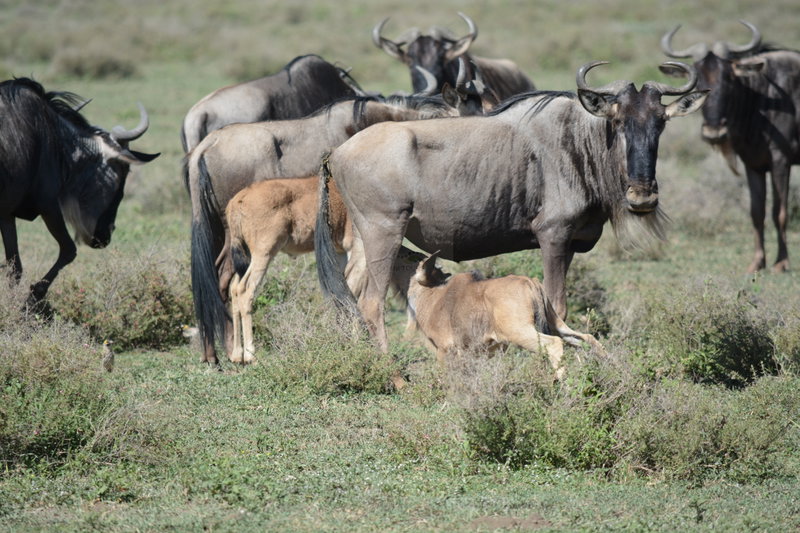
Thousands of animals move around her. Hundreds of calves pass through the same stretch of grass. Many of them look almost identical. Yet she needs to find and maintain contact with her own offspring.
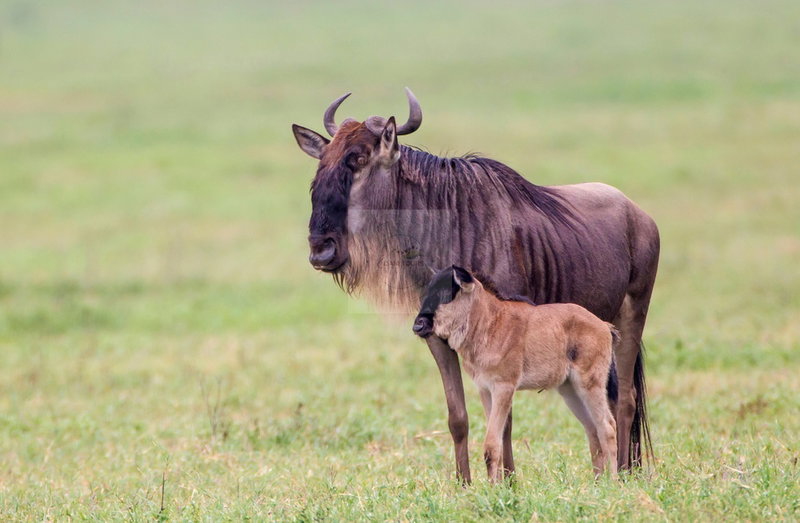
Mother-calf recognition in wildebeest is initially established through scent. The imprinting process begins immediately after birth and is time-sensitive. Within that critical window, the mother learns her calf's individual identity. Once established, the bond enables her to locate her calf within a herd of many thousands.
This is one reason the idea of a generic communal nursery misrepresents wildebeest society. Even among hundreds of others, a calf still has a specific mother, and that mother recognizes it. The herd provides safety in numbers, while the mother-calf bond provides the individual connection that sustains the calf.
When you watch a mother and calf reconnect within a moving herd, pressing close after a brief separation, you are witnessing something small yet essential within something vast.
Do Wildebeest Mothers Really Leave Their Calves with Babysitters?
This is the question where safari storytelling most reliably runs ahead of the evidence.
You will sometimes hear the wildebeest calf creche described as a formal cooperative system: mothers leave their calves in a supervised group, specific females are designated as "aunties" or babysitters, and rotations are managed to benefit everyone. It is the kind of story that is easy to tell and hard to forget.
Be careful with it.
When you see the calving season from a vehicle, it genuinely looks like a nursery. Hundreds of calves gather, with mothers nearby, young animals mingling and moving around each other. It is easy to assume that some adults are babysitting while others feed, and you may hear that story from other travelers or even some guides. The reality is simpler but no less interesting. Mothers stay close.
The herd offers safety in numbers. Calves naturally cluster together because so many are born at the same time. But scientists have not found evidence that specific females deliberately take turns caring for calves that are not their own. The giant nursery you are looking at is real. The organized babysitting rota is not, or at least, nobody has been able to prove it yet.
Genuine cooperative breeding has been documented in other ungulates, including giraffes, where a single female has been observed staying with calves while other mothers disperse. That evidence should not be automatically generalized to wildebeest.
The most scientifically defensible explanation for what you are seeing remains the combination of synchronized births, high herd density, precocial calf development, and the seasonal concentration of the herd on productive calving plains. That explanation is less sentimental than the babysitter story and more honest.
"Good safari storytelling should make nature more understandable, not more fictional." David Kijani Tours Safari Guide
What Scientists Know and What Remains Open
It is worth being specific about where the evidence is strong and where it runs thin.
Wildebeest do not calve randomly. Births are tightly synchronized, far more than seasonal rainfall alone would explain. Research shows that male rutting vocalizations during the breeding season help align reproductive timing across the herd, compressing the calving window to weeks. For a traveler on the ground, the effect is dramatic: the southern Serengeti fills with newborn calves almost overnight.
Each calf stands within minutes of birth, finds its mother by scent, and begins moving. There is no grace period. The herd does not wait. The reason so many are born at once is not a coincidence; it is protection. When thousands of calves appear simultaneously, predators cannot consume them all. Even spotted hyenas, the most effective calf hunters on the plains, are physically overwhelmed by the abundance. More calves survive because more are born at the same time. That is the logic the Serengeti runs on.
What remains less certain: The extent to which adult females other than the biological mother exhibit consistent, deliberate protective behavior toward specific calves, beyond the herd's generalized vigilance, is not clearly documented in the wildebeest literature. The relative contributions of predator satiation and predator confusion to calf survival have not been fully disentangled. The effects of rainfall variability and habitat change on calving synchrony and calf recruitment remain active areas of research.
When the evidence is incomplete, we say so. The calving season does not need exaggeration to be extraordinary.
When Predators Arrive
There is another dimension to the beauty of the calving season that no article should ignore.
Predators know when the calves arrive. They move onto the calving plains and remain.
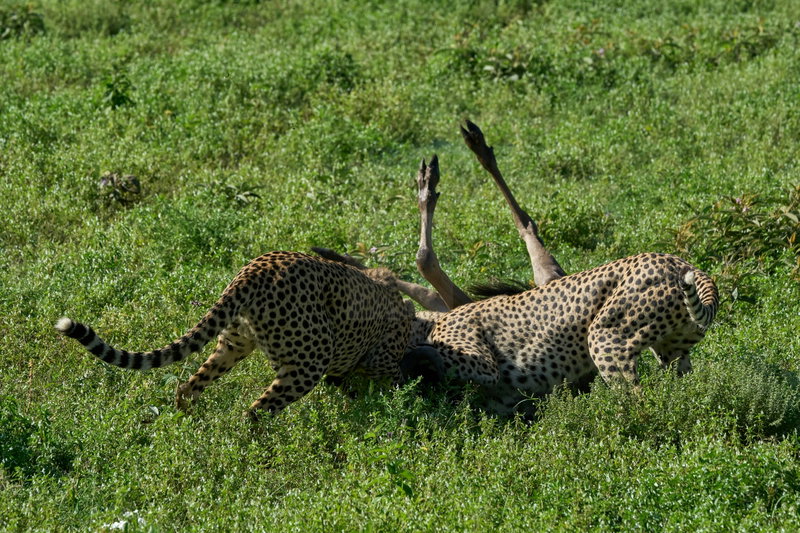
Lions patrol the short grass. Spotted hyenas work the herd's edges in relays. Cheetahs choose elevated terrain to scan the largest possible area. During peak calving, carnivore density around the Ndutu plains and the southern Serengeti is among the highest recorded in East Africa.
The short-grass landscape makes all of this visible in a way that forest safaris cannot match. From a single vehicle position, you can sometimes see a lion pride resting 50 meters from the herd, a hyena trotting along the far edge, and a cheetah scanning from a slight rise, all at once in the same field of view.
For minutes, sometimes longer, nothing obvious happens.
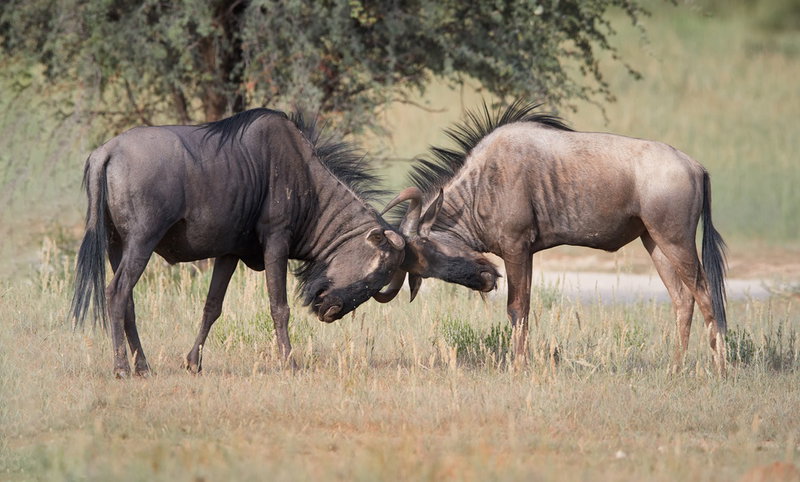
Then a calf stumbles. A mother turns sharply. A hyena breaks into a run. The herd shifts in a wave. Adults mob the predator. Within ten seconds, the entire ecological relationship between predator and prey is laid bare across a stretch of open grass.
"On these plains, life does not arrive quietly. It arrives with predators in wait." David Kijani, Tours Safari Guide
Adult wildebeest are not passive witnesses. They are large, powerful animals that actively mob and chase predators, especially hyenas. Mothers with calves are highly vigilant. The calving herd is a dynamic system, not a defenseless one.
Why the Southern Serengeti Matters
The southern Serengeti is not merely where the wildebeest happen to be during calving season. The landscape offers a specific combination of conditions that make it one of the most productive calving grounds on Earth.
Seasonal rainfall produces fresh vegetation. The volcanic soils of the Ndutu area and the wider short-grass plains produce grass that is not only abundant but also unusually nutritious, high in calcium and phosphorus, precisely the minerals that heavily pregnant and lactating females need. The open terrain gives newborn calves long-range visibility and allows them to follow the herd without the obstacles of dense bush. For predators, the same openness makes hunting efficient. For safari visitors, it makes observation exceptional.
Everything here is connected. Rain produces grass. Grass draws wildebeest. Wildebeest produce calves. Calves feed predators. Predators shape prey behavior. And the wildebeest themselves, through grazing and the return of nutrients via dung across hundreds of thousands of hectares, help maintain the very grassland conditions they depend on. The calving season is not just a wildlife event. It is the Serengeti's reproductive engine running at full power.
The Calving Season and the Great Migration
The Great Migration is often portrayed as a circular journey. It is more accurately understood as the ongoing response of a vast population to rainfall and grass quality across the Serengeti-Mara ecosystem, with the calving season serving as the hinge on which the cycle turns.
Wildebeest typically arrive on the southern short-grass plains after the November short rains. Calving occurs from late January through March, with most concentrated in the Ndutu area, which straddles the boundary between Serengeti National Park and the Ngorongoro Conservation Area, and across the wider plains extending toward Naabi Hill and the Gol Kopjes. By April, the herds begin drifting north and west, eventually reaching the Grumeti River in June.
In July and August, the northern Serengeti and Kenya's Maasai Mara become the focus, with the Mara River crossings the most widely filmed stage of the cycle. The calves born on the Ndutu plains in February are the ones that will attempt that crossing in August.
"The Great Migration does not begin at a river crossing. It begins with a calf strong enough to follow its mother." Denis Kijani, Tours' Product Development Manager.
Migration timing is not fixed. Rainfall variability shifts herd locations from year to year. Any safari plan built around the calving season should account for this variability. At Kijani, we track current conditions rather than selling a calendar month.
When and Where to Go
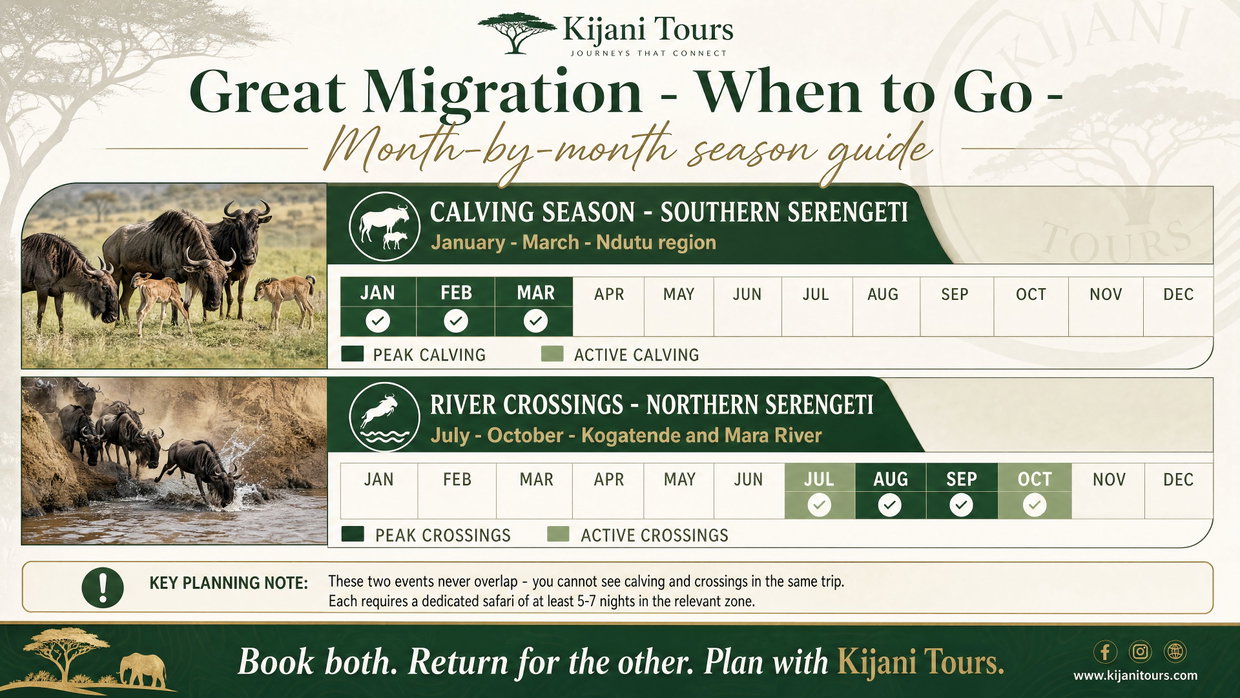
The calving season typically peaks from late January through mid-February, with the broader window extending from late January through March.
The primary viewing area is the Ndutu plains and southern Serengeti, centered on Lake Ndutu, Lake Masek, Naabi Hill, and the Gol Kopjes, in the region straddling Serengeti National Park and the Ngorongoro Conservation Area. Volcanic soils, open terrain, and seasonal grass quality converge here to draw the herds.
The calving season is also a green-season experience, part of its considerable appeal. The landscape is fresh and lush after the rains. The afternoon skies are dramatic. The low morning sun casts exceptional light across the green grass. Visitor numbers are significantly lower than during the dry-season river crossings, and accommodation rates in many camps and lodges drop by 30 to 50 percent.
You may see:
- Newborn wildebeest taking their first steps across the open plains
- Large concentrations of mothers and calves stretching to the horizon
- Lions watching the herds, patient and unhurried
- Spotted hyenas working the herd's edges
- Cheetahs hunting in the open grasslands, the clearest cheetah country in Africa
- Migratory birds at peak plumage, drawn to the same seasonal conditions
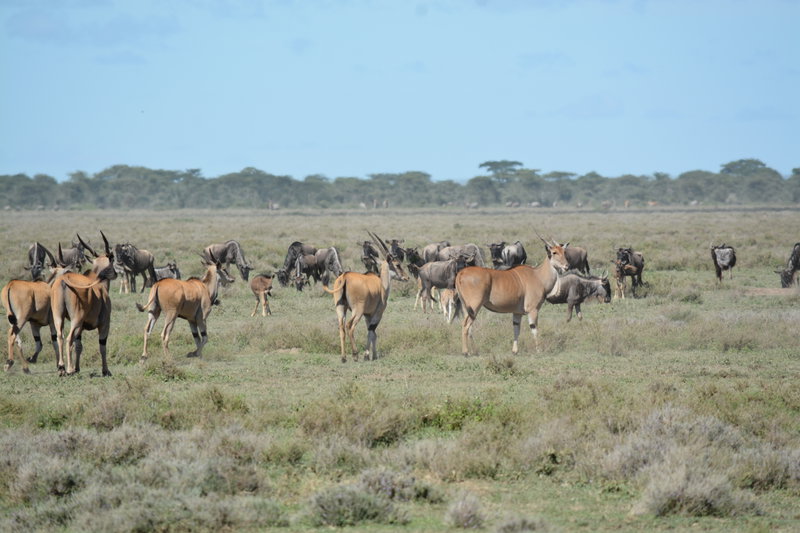
- Zebra foals, Thomson's gazelle fawns, and other young animals born during the same green window.
Calving Season or Mara River Crossings: Which Is the Better Safari Option?
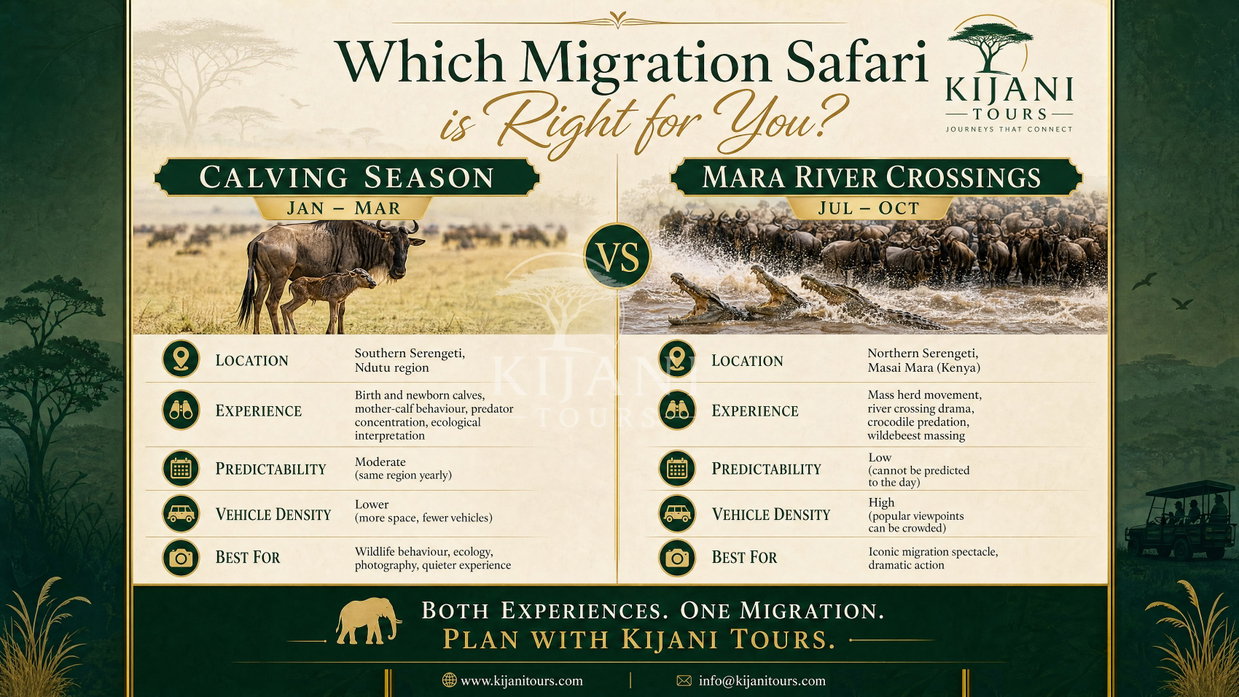
Neither experience is universally better. The Mara River crossings are famous for dramatic mass movement and intense predator-prey interactions. The calving season focuses more strongly on reproduction, newborn animals, mother-calf relationships, and the ecological start of the next generation of the migration. The river crossing is a dramatic chapter. The calving season is where every individual calf's story begins.
If your priority is the dramatic migration, the northern Serengeti and Mara River period may suit you. If your priority is newborn animals, behavioral observation, ecological interpretation, and the quieter intensity of predator-prey dynamics on the open plains, the southern Serengeti calving season is the better choice. Both experiences occur within the same Great Migration cycle. What you choose depends on what you want to understand.
The Great Migration does not begin at a river. It begins with a calf strong enough to stand.
Thousands of newborn wildebeest fill the Serengeti plains as mothers stay close and predators gather. Watch a calf take its first steps, and you’ll understand why seasoned safari travelers keep coming back.
Kijani Tours: “The river crossing is a moment. Calving season is the story.”
A Different Way to See the Calving Season
A wildebeest calf is easy to photograph.
Understanding why that calf is standing there, why the herd is where it is, why the predators have gathered, and why the grass beneath them looks the way it does constitutes the deeper experience.
At Kijani Tours, our guides are well trained by Tanzania's leading professional wildlife management institution. They do more than identify animals. They explain relationships: between rainfall and grass, between grass and wildebeest, between wildebeest and the predators that have evolved alongside them for millions of years, and between a mother and the calf she will lead north across the Serengeti for the next eight months.
A calving season safari is not about getting closer. It is about seeing more clearly. You start with a calf, one animal, minutes old, finding its feet on the Ndutu plains. Then you notice the mother. Then the herd surrounds them both. Then the predator you had not seen until your guide pointed it out lies still in the grass less than three hundred meters away. Then something quieter happens. You stop looking at the animals and start looking at the landscape.
The grass is green. It is short. It is why the wildebeest are here. The rain is why the grass is here, and why the calves are being born now rather than three months from now. One observation leads to the next, and by the end of the morning, you are not simply watching wildlife; you are reading an ecosystem. You are seeing why the Serengeti needs wildebeest as much as wildebeest need the Serengeti. That is the experience we design for. Not the closest sighting. The clearest one.
"Do not just watch the wildebeest. Learn why the Serengeti needs them." Wolfgang Kijani Tours Founder
Watching Responsibly
Newborn animals deserve space.
A vehicle positioned between a mother and her calf can cause the mother to flee during the critical imprinting window. Surrounding a hunting predator with multiple vehicles degrades the animal's welfare and diminishes the quality of the experience for everyone watching. Crowding a birthing female can interrupt a process that has unfolded without human involvement for a very long time.
Our guide reads the herd's behavior before positioning a vehicle. Sometimes the right decision is to stop farther away. Sometimes the most valuable thing you can do is simply wait and watch so the animals have space to behave naturally.
"The goal is not to get closer to wildlife. The goal is to understand it without altering its behavior." Christine Kijani Tours' Sustainability Manager
Frequently Asked Questions
What is a wildebeest calf creche?
The term refers to the large concentrations of young wildebeest calves that form during the Serengeti calving season. These gatherings arise because many thousands of females give birth within a short, compressed period while the herd is concentrated on the southern Serengeti's short-grass plains. The term is descriptive and does not imply an organized cooperative childcare system.
Why do wildebeest calves form groups?
Wildebeest calves appear in large groups because many are born in the same area within a very short period, the result of highly synchronized reproduction in a species that lives in enormous social herds. Groups form naturally without deliberate organization.
Do wildebeest calves have babysitters?
Scientific evidence for organized cooperative babysitting in wildebeest, with specific adult females consistently taking turns to guard the calves of other mothers, is not clearly established in the peer-reviewed literature. Each mother maintains an individual bond with her calf through scent imprinting from birth. The large calf groups seen during calving season are primarily a consequence of synchronized births and herd density.
When is the wildebeest calving season?
Calving typically peaks in late January to mid-February, with the broader season running from late January through March. The precise timing varies year to year with rainfall patterns and herd movements.
How quickly can a wildebeest calf stand after birth? A healthy wildebeest calf can stand within about six minutes of birth, a critical adaptation that helps it keep pace with the herd and reduce its exposure to predators from the earliest moments of life.
How does a wildebeest mother recognize her calf?
Mother-calf recognition is initially established through scent, an individual imprinting process that occurs in the first hours after birth. This allows each mother to identify her own offspring within very large, dense herds.
What predators hunt wildebeest calves?
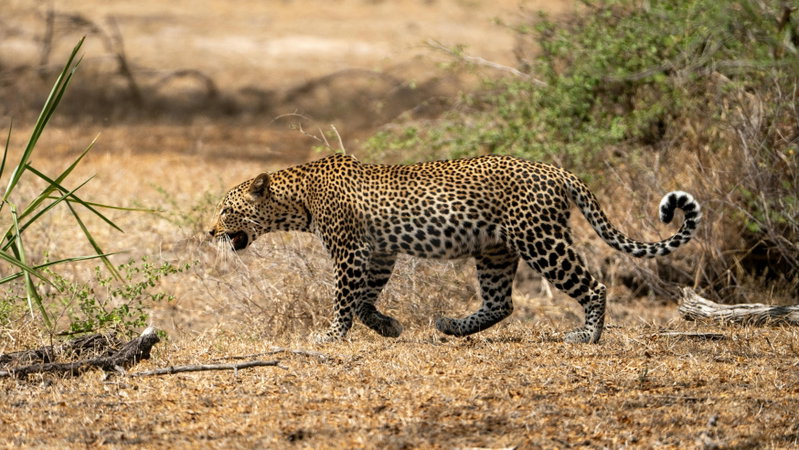
Spotted hyenas are the primary predators of wildebeest calves during the calving season. Lions, cheetahs, and leopards also take calves. Despite significant predation pressure, the high density of births during the calving peak means predators cannot kill at a rate that substantially reduces the overall calf crop, a mechanism ecologists call predator satiation.
Where can you see wildebeest calves in Tanzania?
The best viewing area is the Ndutu plains and southern Serengeti, including Lake Ndutu, Lake Masek, Naabi Hill, and the Gol Kopjes. This area straddles the boundary between Serengeti National Park and the Ngorongoro Conservation Area, providing exceptional visibility across open terrain.
Is the Serengeti calving season good for a safari?
Yes, it is widely underrated. The calving season offers extraordinary concentrations of young animals, intense predator activity, excellent visibility in open terrain, fewer visitors than in the dry season, and accommodation rates that are significantly lower than in the peak season. Many experienced safari travelers to Tanzania consider it the most rewarding single wildlife event in East Africa.
Is February a good time to visit the Serengeti? February is typically the peak of the calving season and one of the most intense months for wildlife activity on the southern plains. The landscape is green, the light is dramatic, and the density of newborn animals and predators is exceptional. It is among the best months on the Serengeti calendar and one of the least crowded.
Final thoughts
When you sit in a vehicle in the southern Serengeti in February, surrounded by hundreds of newborn wildebeest, the temptation is to see it as a spectacle. It is not. It is a strategy, one of the most precisely timed reproductive events in nature, producing so many calves in such a short window that no predator on the plains can keep up.
Look past the numbers. Choose one mother and one calf. Watch her sniff the calf's scent. Watch the calf try to stand, fall, and try again. Watch the predator at the edge of the herd, waiting but not yet moving. Watch the green grass beneath them all, fed by rain that drew the herd south in the first place. Every part of this scene is connected, and every connection is why the Great Migration continues.
The calf you watch on the Ndutu plains in February, still unsteady, still learning to follow, may be the same animal you see crossing the Mara River in August. That is the story most travelers miss. They see the river and think that is where the migration happens. It does not. It happens here, on a quiet morning in the south, when a calf stands for the first time and begins to walk.
The migration is not only the herd's journey. It is the survival story of every calf born along the way.
Kijani Tours: Go. Find. Explore
You Have Read the Science. Now Come and Watch It.
Predator satiation, synchronized births, and mother-calf recognition by scent are not abstract concepts in the southern Serengeti in February. You can see them from the vehicle, with a guide who can explain what is happening and why. Kijani Tours is Tanzanian-owned, Moshi-based, and built for travelers who leave the Serengeti with a deeper understanding of what they saw.
Share This Post
Latest News
Tanzania Travel Guide | Safaris, Kilimanjaro, Beaches, Culture and Responsible Travel

Kilimanjaro Summit Night: How to Prepare Mentally and What to Expect
Sun August 30, 2026
Read This Article
Is Tanzania Safe for Kids on Safari?: A Parent's Guide to Family Safari in Tanzania, 2026–2029
Sat August 29, 2026
Read This Article
Planning a Tanzania safari with children? This practical family safari guide helps parents understand when to go, which parks and experiences suit different ages, how to prepare for health and safety, and what to expect from accommodations, game drives, and wildlife encounters. It also explains how Kijani Tours can tailor a private safari to your family's needs, from the Serengeti and Ngorongoro to cultural experiences and Tanzania's coast, from Pangani to Mafia...
Climbing Kilimanjaro as a Woman: What No One Tells You Before You Go
Thu August 27, 2026
Read This Article
Climbing Kilimanjaro as a woman is absolutely possible, but there are practical things to prepare for before you arrive. This guide covers the realities many women want to know about, including hygiene at mountain camps, managing your period, physical preparation, altitude sickness, and what to expect on summit night. You will also learn which questions to ask Kijani Tours' team regarding privacy, female guides, hygiene and waste management, health monitoring, and emergency...
Share This Post