

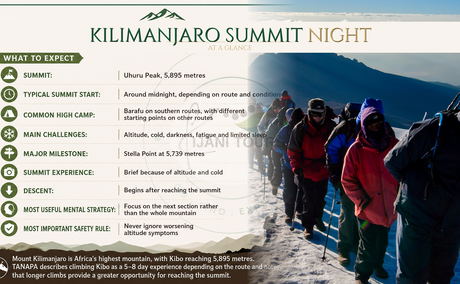
Kilimanjaro Summit Night: The Final Hours Before Uhuru Peak At midnight, the mountain disappears. Your headlamp becomes your horizon. Kilimanjaro summit night is the final and most demanding stage of the journey to Uhuru Peak at 5,895 metres. Starting around midnight, climbers face several hours of darkness, cold, fatigue, limited sleep and reduced oxygen availability. The challenge is physical, but it is also deeply mental. The key to managing summit night is...
Tanzania Safari Packing Guide: What to Wear and Bring by Season, Park, and Style (2026)
Posted by Wolfgang on Thu July 23, 2026 in Packing and Gear Guides.
A Tanzania safari runs on a strict set of practical constraints: a 15kg soft-duffel limit on light aircraft, a temperature swing of more than 20 degrees between a cold Ngorongoro dawn and a hot Tarangire afternoon, and a short list of things, camouflage prints and certain colours among them, that work against you rather than for you. Get those right and packing is simple. Kijani Tours runs game drives and walking safaris across the Serengeti, Ngorongoro, Tarangire, and Lake Manyara year-round, and this guide answers the packing questions travellers actually ask us before a Northern Circuit trip, organised by what you are packing, when you are travelling, and where you are going.
Quick Answer
Pack lightweight, quick-dry layers in neutral earth tones, a warm layer for early mornings, closed-toe shoes, sun protection, insect repellent, and a soft-sided duffel bag rather than a hard suitcase. Avoid cotton, camouflage, black, dark blue, bright white, and neon. If your itinerary includes a walking safari, add ankle-high boots and scent-free toiletries. If it includes a bush flight, pack to a 15kg limit from the start.
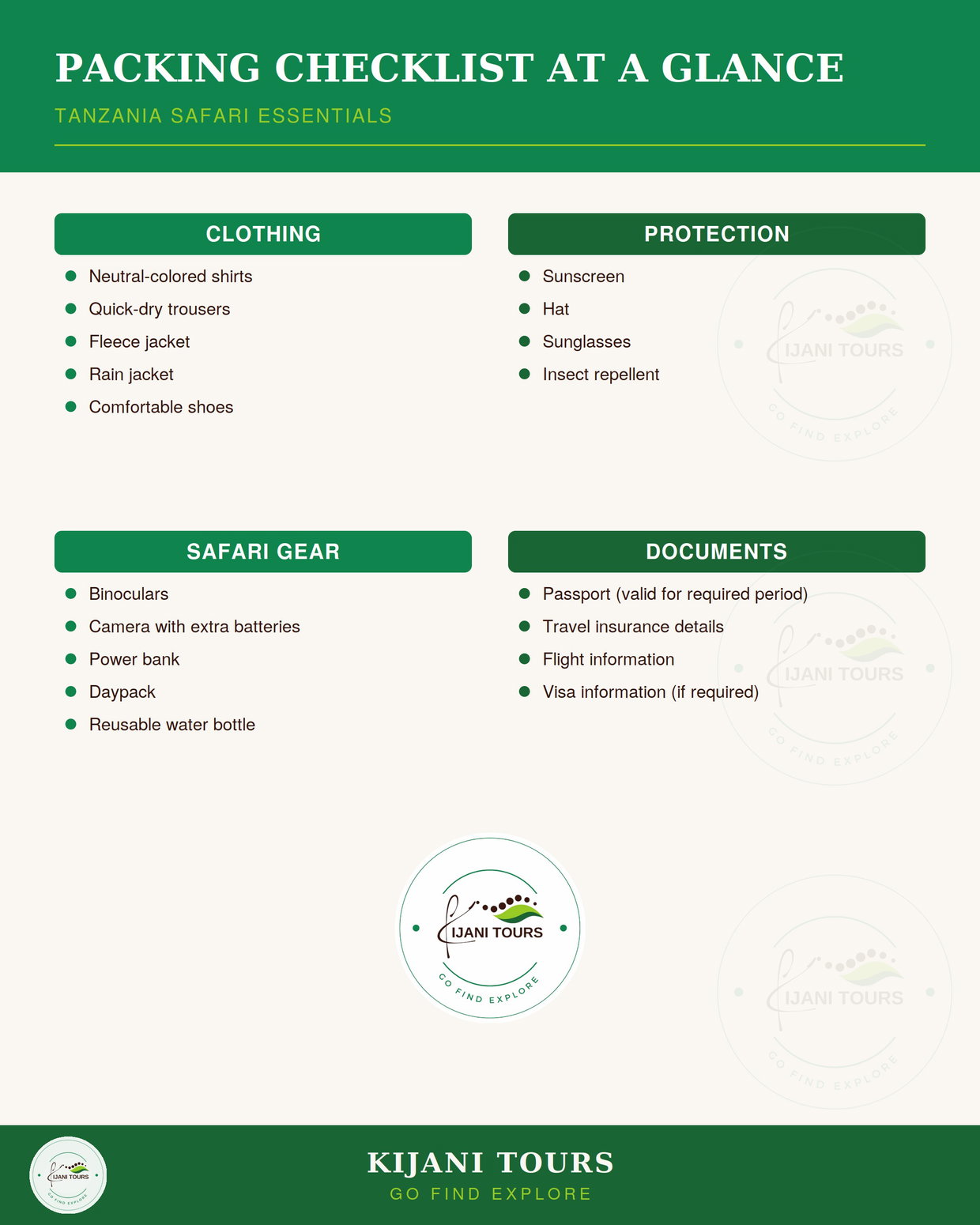
• Neutral-colored, quick-dry clothing
• One warm fleece or mid-layer
• Wide-brim hat, sunglasses, high-SPF sunscreen
• Binoculars
• Reusable water bottle
Everything else in this guide builds on those five.
Why Packing Matters More Than Most Travellers Expect
A safari day is not a beach day. You may leave the lodge before sunrise in near-freezing air, spend hours on dusty roads as the temperature climbs 20 degrees or more by midday, and be back out again for an evening drive as it cools. Your clothing needs to adapt through that whole arc, which is why layering, not volume, is the real packing strategy.
Tanzania's Safari Climate Isn't Uniform
One of the most common misconceptions is that Tanzania is hot everywhere, year-round. In reality, conditions shift with altitude and location as much as with season.
|
Destination |
Morning |
Afternoon |
Evening |
|
Serengeti |
Cool, sometimes near-freezing in dry season |
Warm to hot |
Mild, cooling quickly |
|
Ngorongoro Highlands |
Cold, especially on the crater rim |
Mild on the crater floor |
Cold |
|
Tarangire |
Mild |
Hot |
Warm |
|
Lake Manyara |
Mild, humid |
Warm |
Mild |
|
Arusha / Moshi |
Cool (highland town) |
Pleasant |
Cool |
General seasonal pattern, not a forecast. Confirm current conditions with your Kijani Tours consultant closer to departure.
Dry Season vs. Green (Wet) Season Packing
|
Item |
Dry Season (Jun–Oct, Jan–Feb) |
Wet / Green Season (Mar–May, Nov–Dec) |
|
Outerwear |
Warm fleece for near-freezing mornings; light dust protection |
Packable waterproof jacket; quick-dry layers |
|
Footwear |
Trail shoes; sandals for camp |
Trail shoes with grip; gaiters for muddy walking trails |
|
Insect protection |
Standard repellent |
Stronger repellent; consider permethrin-treated clothing |
|
Luggage |
Soft duffel |
Soft duffel plus a waterproof liner or dry bag for electronics |
|
Photography |
Dust covers, lens cloth |
Rain cover for camera gear, extra memory and batteries |
The short rains (November–December) and long rains (March–May) bring afternoon showers rather than all-day downpours, so a packable rain jacket covers most of it. April and May occasionally add cold fronts on top of the rain, which surprises travellers expecting only heat.
Tanzania Safari Packing FAQs
Luggage and Flight Logistics
1. What luggage should I bring for a Tanzania safari, including bush flights?
A soft-sided duffel bag with no rigid frame or built-in wheels, ideally 50–80 litres. Bush aircraft such as the Cessna Grand Caravans used by regional charter operators have small, irregularly shaped cargo holds that hard-shell suitcases cannot be compressed into. If your safari includes any internal flight between parks, a duffel is not optional.
2. What's the luggage weight limit on light-aircraft transfers?
Typically, 15kg (33lb) per person, covering checked and hand luggage combined. This is far below the international-flight standard and catches first-time safari travellers off guard. Some operators allow up to 20kg depending on the aircraft and how full the flight is, but planning around 15kg is the safest approach. Most hotels in Arusha or Moshi will store your international-flight suitcase for free while you're on safari with a smaller duffel.
3. What should I pack in my carry-on or hand luggage?
Passport, cash, flight tickets, any vaccination certificate, prescription medication, a change of clothes, and valuables. Carry-on allowances on light aircraft are typically 5–7kg and must fit under the seat, so keep this bag genuinely small. Packing a spare outfit here protects you if checked luggage is delayed on a multi-leg itinerary.
4. What documents should I carry with me on safari?
Passport, visa or e-visa confirmation, travel insurance details, vaccination certificate (if applicable), a printed itinerary, and emergency contacts, with digital backups stored separately. Keep physical copies in your carry-on and a photo or cloud copy accessible offline, since signal is patchy in many parks.
Clothing, Colours and Fabric
1. What should I pack for a Tanzania safari?
Pack light, breathable, quick-dry layers in neutral earth tones, a warm layer for early mornings, closed-toe shoes, sun protection, and a soft-sided duffel bag. The specifics shift with season and destination, covered question by question below.
2. How many outfits do I need for a 7–10 day safari?
Fewer than you'd think: about 4–5 shirts, 2–3 pairs of trousers, one fleece, one rain shell, and one pair of walking shoes. Most lodges and camps offer same-day or next-day laundry, so packing for three to four days and repeating is standard practice rather than a compromise.
3. Should I wear cotton or quick-dry fabric on safari?
Choose lightweight quick-dry fabrics instead of cotton. Quick-dry, moisture-wicking fabric, not cotton. Cotton absorbs sweat and dust and stays damp for hours, which is uncomfortable on long game drives and slow to dry if laundry isn't available every day. Technical or blended fabrics (nylon, polyester, merino blends) dry within about an hour and pack smaller. Bring one warm mid-layer regardless of fabric choice elsewhere.
4. What colours should I wear on safari, and which should I avoid?
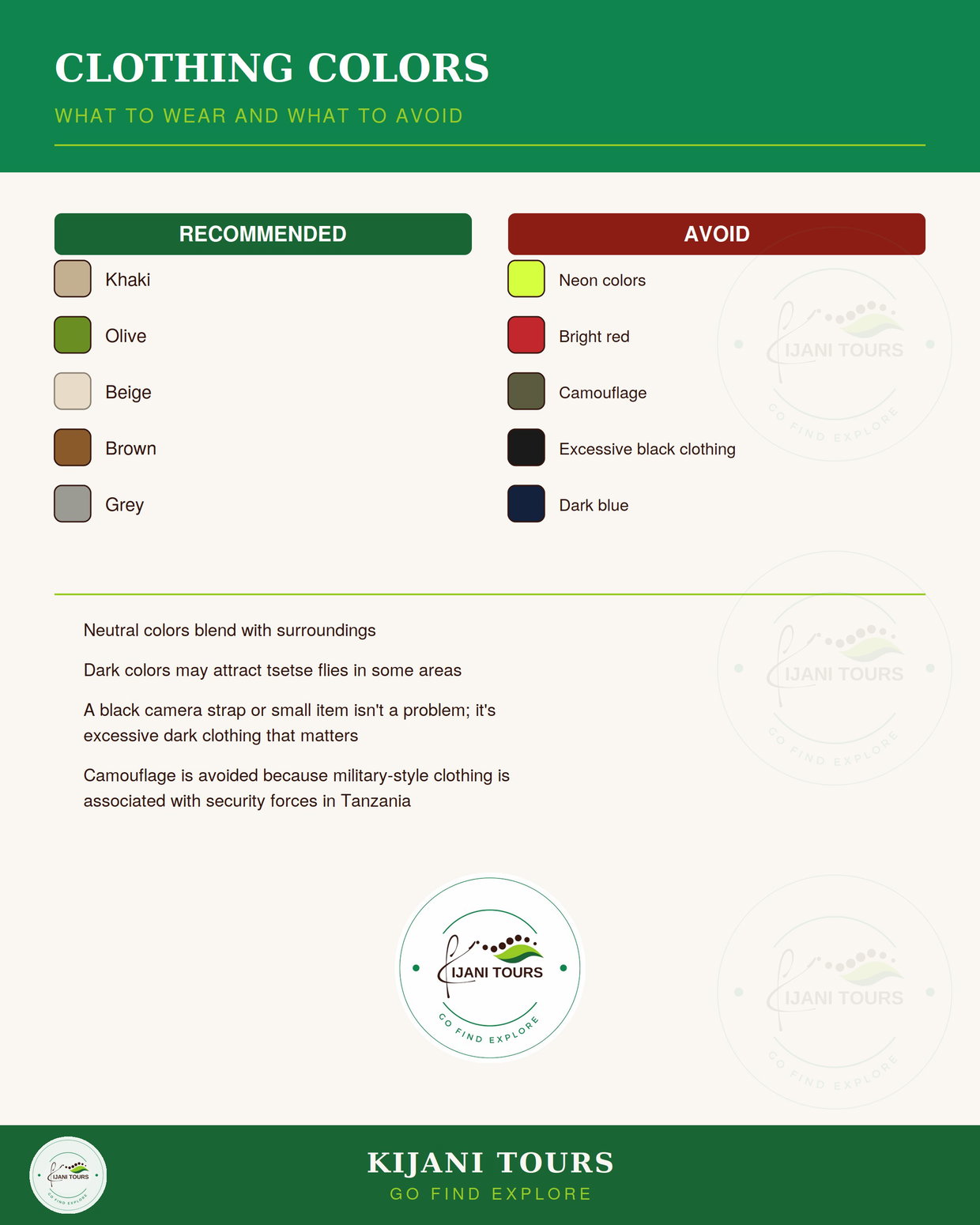
Wear khaki, olive, beige, and other earth tones. Avoid black, dark blue, bright white, and neon colours. Earth tones blend with the landscape and hide dust between laundry days. Bright white shows dust quickly, and neon can stand out and unsettle wildlife at close range.
5. Why do dark colours like black and navy attract tsetse flies?
Tsetse flies are drawn to dark blue and black specifically, more than to lighter colours. This matters most in wooded areas like Tarangire and parts of the Serengeti, where tsetse flies are more common. It's not present everywhere in Tanzania, but earth tones sidestep the issue entirely while also staying cooler in the sun.
6. Is camouflage clothing illegal in Tanzania?
Yes. Camouflage-pattern clothing is reserved for the Tanzania People's Defence Force, and civilians, including tourists, risk having it confiscated and being fined. This covers shirts, trousers, hats, and bags, not just full outfits. Enforcement against tourists is inconsistent, but there's no upside to testing it: pack khaki or olive instead.
7. Should I pack shorts, or only trousers?
Bring one pair of shorts for camp; rely on lightweight trousers for game drives and walks. Trousers protect against sun, insects, and vegetation better than shorts do, and most experienced safari travellers wear them for the majority of drives. Shorts are fine for relaxing at the lodge in the afternoon.
8. Do I need a jacket or fleece, even in the "hot" season?
Yes. A warm fleece or light insulated layer is essential for early morning departures regardless of season. Even travellers arriving from cold climates are often surprised by how cold a pre-dawn game drive feels, particularly in Ngorongoro and during the dry season when clear skies let heat escape overnight. A bulky winter coat isn't necessary, but skipping a warm mid-layer is one of the most common packing regrets.
Footwear
1. What footwear is best for a vehicle-based game drive safari?
Comfortable closed-toe shoes or lightweight trail shoes, plus sandals for camp. On a vehicle safari with pop-up roof hatches, you're standing to photograph rather than hiking, so heavy hiking boots are unnecessary weight. Closed shoes still matter for cold mornings, dust, and insects.
2. What footwear do I need for a walking safari?
Sturdy, well broken-in, ankle-high hiking boots with good tread. Closed, supportive boots protect against thorns, uneven ground, and biting insects on foot. Never bring boots you haven't already worn in at home; a walking safari is the wrong place to discover they cause blisters.
Walking safari section → 8-Day Tanzania Walking Safari itinerary page
Seasonal and Destination Packing
1. How does packing change between the dry and wet (green) seasons?
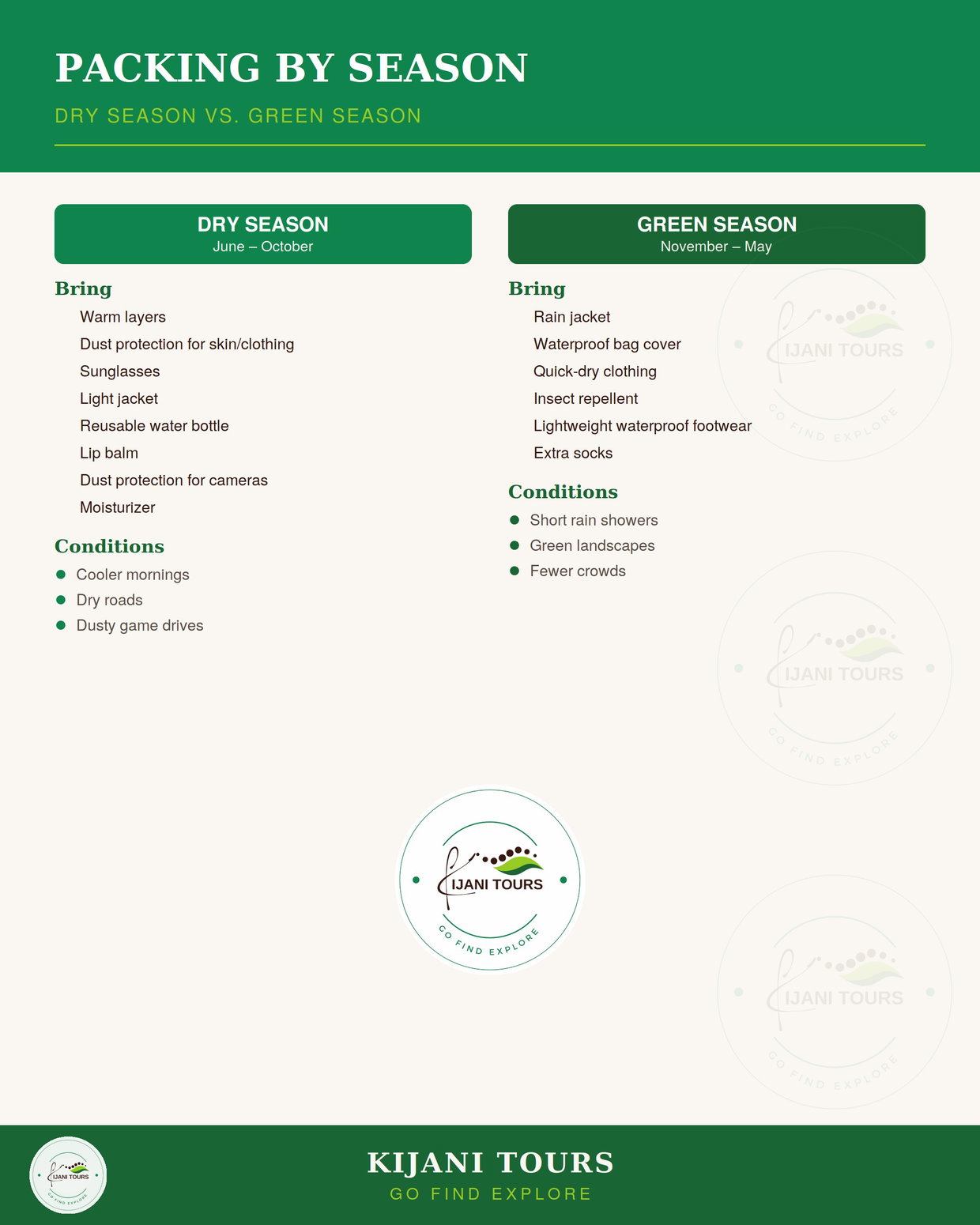
The dry season (June–October, January–February) needs warmer layers for near-freezing mornings and more dust protection; the wet season (March–May, November–December) needs a proper rain layer and stronger insect protection. See the seasonal matrix above for a full item-by-item comparison.
2. Does packing differ between Serengeti, Ngorongoro, Tarangire, and Lake Manyara?
Yes. Ngorongoro's highland rim is consistently the coldest spot on a Northern Circuit itinerary, while Tarangire's lower elevation runs hottest in the afternoon. Pack your warmest layer specifically for Ngorongoro mornings, your lightest breathable layers for Tarangire afternoons, and expect Serengeti and Manyara to sit in between. See the climate table above.
3. What should I pack for early morning game drives in Ngorongoro specifically?
A warm jacket, hat, and gloves for the crater rim, even in the dry season. The rim can drop below 10°C at dawn, occasionally closer to freezing, while the crater floor warms up by mid-morning. Guests consistently underestimate this stretch of the trip; layer up for the descent and expect to shed clothing by midday.
Electronics and Photography
1. What electronics and power gear should I bring?
Phone, charger, a high-capacity power bank (10,000–20,000 mAh), and a universal or UK-style (Type G) adapter. Tanzania runs on 230V Type G sockets, the same three-pin standard as the UK. Remote camps often run on solar or generator power that switches off overnight, so a charged power bank matters more here than on most trips.
2. What plug adapters does Tanzania use?
Type G (UK-style, three-pin), 230V. Bring one universal adapter rather than assuming your camp will have spares; lodges rarely stock them for guests.
3. What camera and optics gear should I prioritise?
A mid-range zoom lens, a longer telephoto in the 200–600mm range if wildlife photography matters to you, a monopod for stability in the vehicle, and spare batteries and memory cards. A monopod is far more practical than a full tripod inside a safari vehicle. Bring a dust blower and lens cloth; dry-season roads are dusty, and camps rarely stock cleaning kits.
Health, Safety and Responsible Travel
1. What health items and medications should I pack?
Prescription medication in original packaging, a basic first-aid kit, motion sickness tablets, oral rehydration salts, and any antimalarial medication prescribed by your doctor. Consult a travel health clinic four to six weeks before departure to confirm malaria prophylaxis and recommended vaccinations. Carry medication in your hand luggage, not checked bags, in case of delays.
2. What insect protection should I bring?
A DEET- or picaridin-based repellent, and long sleeves/trousers for dawn and dusk. Mosquito activity is highest around sunrise and sunset. Combining repellent with covered, light-colored clothing covers most of the risk without relying on chemicals alone.
3. Are plastic bags allowed in Tanzania?
No. Tanzania enforces a nationwide ban on single-use plastic bags, checked at entry points including Kilimanjaro International Airport. Pack toiletries in reusable fabric or silicone pouches rather than disposable plastic bags. Transparent zip-top bags used strictly for airport security liquid rules are generally tolerated inside luggage, but loose plastic shopping bags can be confiscated.
4. Are drones allowed on safari?
Generally, no, not without a permit, and most national parks prohibit recreational drone use entirely. Drones disturb wildlife and other guests. [TANAPA/Ngorongoro Conservation Area Authority drone policy and permit process, since rules can change.]
5. What should I wear and bring for cultural village visits?
Modest clothing that covers shoulders and knees, and small practical gifts rather than cash if you want to give something. Always ask permission before photographing people. School supplies or soap are generally more useful to a community than direct cash handouts, though your guide can advise on what's appropriate for the specific village you visit.
6. How should I pack sustainably and responsibly?
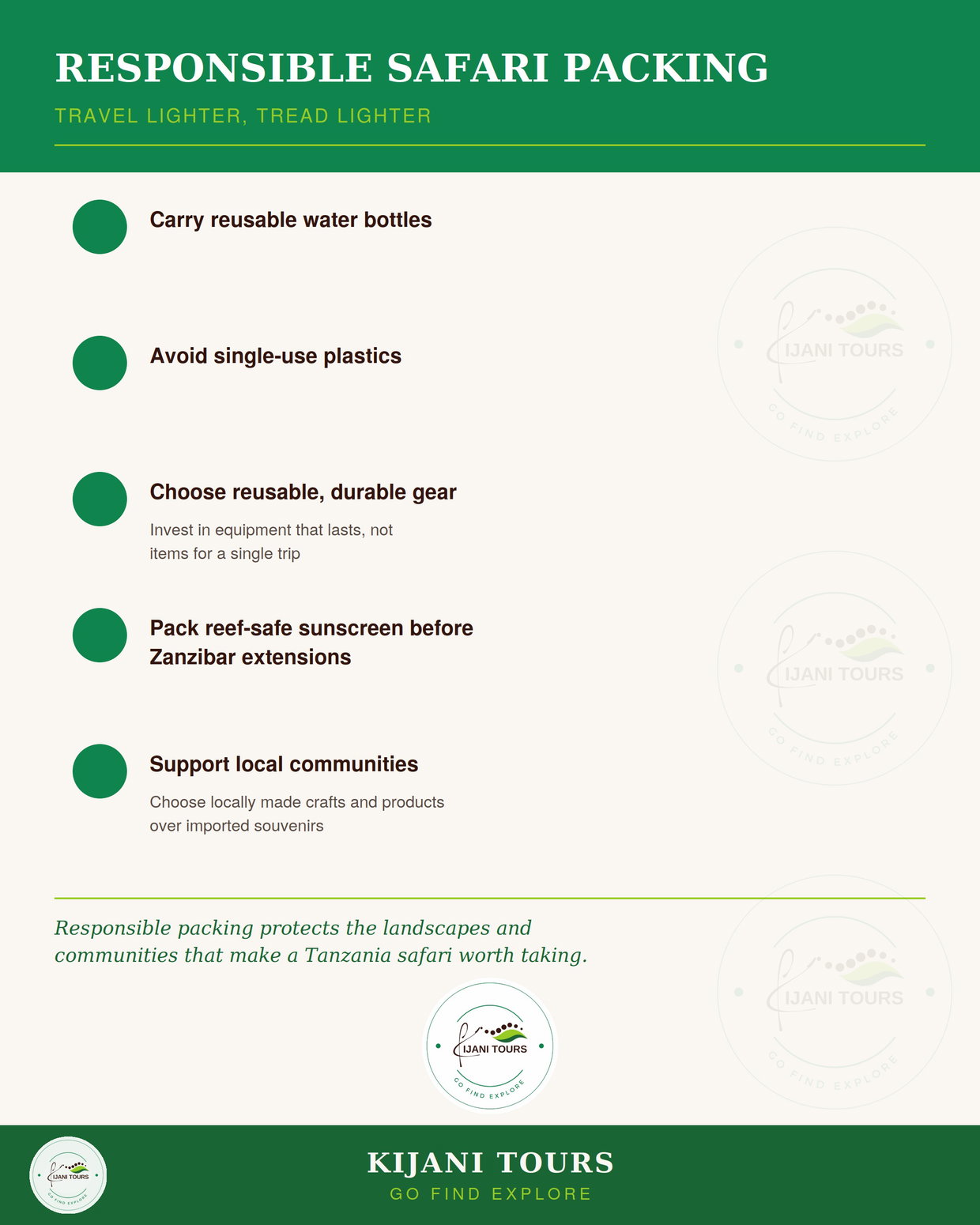
Bring a reusable water bottle and bag, biodegradable or reef-safe toiletries, and skip single-use plastics entirely. Tanzania's parks enforce strict no-litter rules, and scent-heavy products affect wildlife behaviour more than most travellers expect, particularly on walking safaris.
7. What should I NOT pack for a Tanzania safari?
Camouflage clothing, single-use plastic bags, hard-shell suitcases, heavy cotton items, and brand-new, unbroken-in footwear. Beyond the prohibited items, avoid overpacking. Most camps offer laundry service, so a week's worth of clothing comfortably covers a two-week trip.
Walking Safaris, Zanzibar and Kilimanjaro Add-Ons
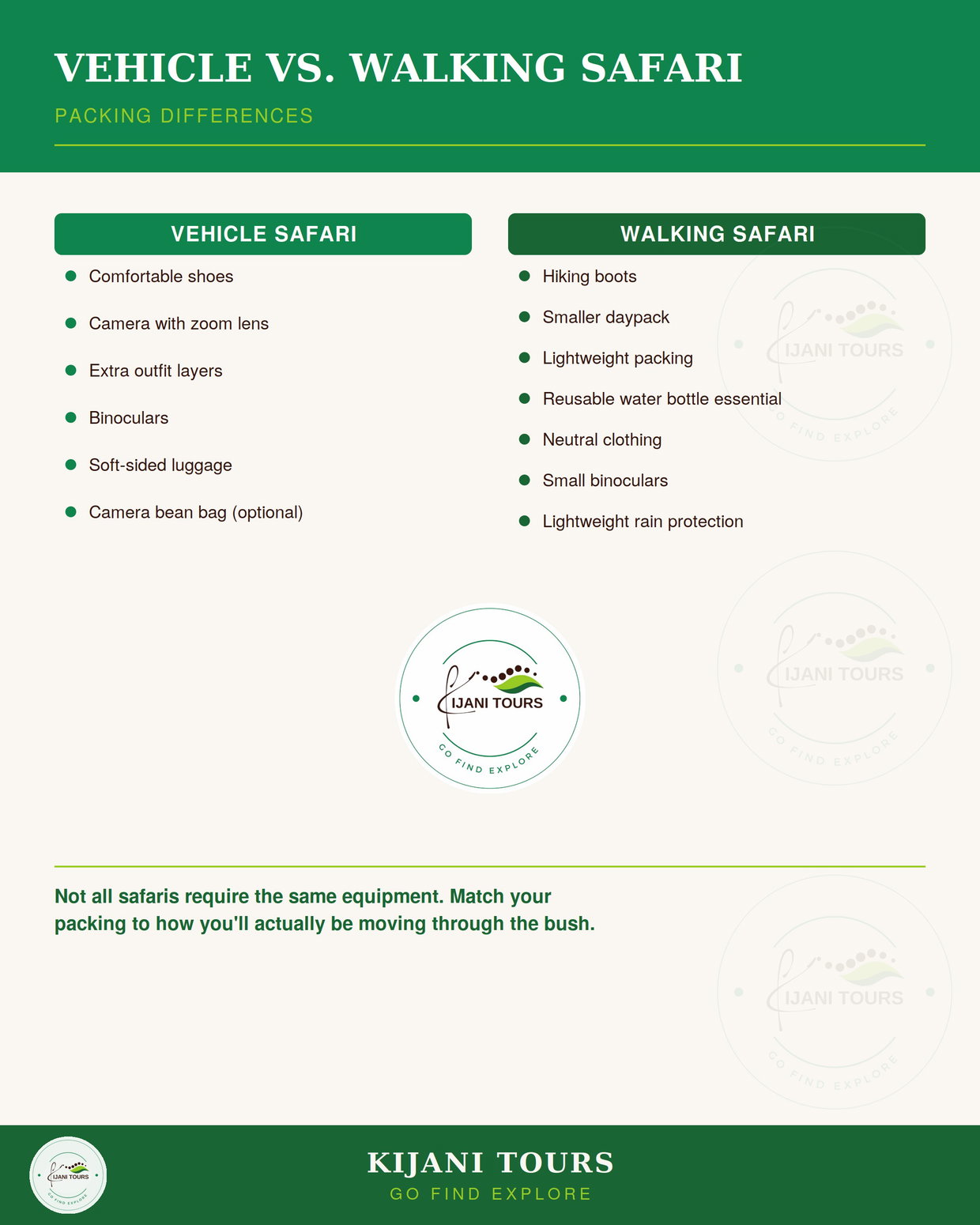
1. What's different about packing for a walking safari versus a vehicle safari?
Walking safaris call for sturdier ankle-high footwear, scent-free toiletries, and stricter noise and colour discipline than a vehicle-based safari. On foot, you're closer to wildlife and moving at animal pace, so gear choices matter more directly. See the breakdown below.
2. Do I need to pack differently for a Zanzibar beach add-on?
Yes: swimwear, a cover-up for modesty outside resorts, reef-safe sunscreen, and lightweight cotton or linen, which is fine on the coast even though it isn't ideal on safari. Zanzibar's climate is warm and humid year-round, so the quick-dry safari rules relax. Dress modestly away from hotel grounds and beaches, since Zanzibar's culture is more conservative than mainland safari areas.
Zanzibar packing → 12 Days Tanzania Honeymoon Safari
3. What extra gear do I need if I am adding a Kilimanjaro climb?
Thermal base layers, a warm insulated jacket, sturdy high-altitude boots, and altitude-specific medical advice from your doctor. Kilimanjaro's five climate zones require different gear entirely from lowland safari packing, since temperature is driven by elevation rather than season. See Kijani's dedicated Kilimanjaro packing and altitude guides for full detail rather than duplicating it here.
4. Walking Safari: Wear / Carry / Leave Behind
Wear: wide-brimmed hat, sunglasses, lightweight long-sleeved shirt, durable trousers, well-worn ankle-high hiking boots.
Carry: daypack with water, binoculars, zoom-lens camera, packable rain jacket, sunscreen, small first-aid kit.
Leave behind: strong perfumes and lotions, plastic bags, noisy snack wrappers.
Seasonal packing → Serengeti Safari Guide: Great Migration Routes, Timing, and Sustainability
10 Tanzania Safari Packing Mistakes to Avoid
- Packing only summer clothes
- Bringing a hard-shell suitcase
- Wearing camouflage
- Forgetting warm layers
- Bringing uncomfortable shoes
- Overpacking clothes
- Ignoring dust protection for cameras
- Forgetting a reusable bottle
- Packing bright colours
- Leaving medicines in checked luggage
Printable Packing Checklist
Checked Luggage (Soft Duffel)
• Quick-dry shirts and trousers (4–5 outfits for a 7–10 day trip)
• One warm fleece or mid-layer
• Packable rain jacket (wet season)
• Closed-toe shoes + camp sandals
• Ankle-high boots (walking safari)
• Sun hat, sunglasses, high-SPF sunscreen, insect repellent
• Binoculars and camera with spare batteries/memory cards
• Biodegradable toiletries, reusable toiletry pouches
• Reusable water bottle and bag
Carry-On / Hand Luggage
• Passport, visa confirmation, travel insurance, vaccination certificate
• Printed itinerary and emergency contacts
• Prescription medication (original packaging) and basic first-aid kit
• Phone, power bank, universal/Type G adapter
• One change of clothes
• Cash and cards
Advice From Our Safari Guides
"The biggest mistake first-time safari travellers make is packing for the afternoon heat but forgetting sunrise. Many game drives begin before the sun rises, especially in Serengeti and Ngorongoro."
David — Kijani Tours Safari Guide
Ready to Pack With Confidence
Packing well changes the way you experience Tanzania. Instead of worrying about the cold morning air, dusty roads, or changing weather, you can focus on reading the landscape, watching wildlife behaviour, and learning from the people who call these places home
You don't have to get it perfect on your own. Every itinerary Kijani Tours runs, whether it's a Northern Circuit game drive, a Ngorongoro Crater descent, or a walking safari through Tarangire, comes with packing guidance built around your specific route, season, and camps. If you're not sure whether you need a rain layer for your dates, or how many outfits actually make sense for your trip length, that's exactly what we're here for.
Share This Post
Latest News
Tanzania Travel Guide | Safaris, Kilimanjaro, Beaches, Culture and Responsible Travel
Kilimanjaro Summit Night: How to Prepare Mentally and What to Expect
Sun August 30, 2026
Read This Article
Is Tanzania Safe for Kids on Safari?: A Parent's Guide to Family Safari in Tanzania, 2026–2029
Sat August 29, 2026
Read This Article
Planning a Tanzania safari with children? This practical family safari guide helps parents understand when to go, which parks and experiences suit different ages, how to prepare for health and safety, and what to expect from accommodations, game drives, and wildlife encounters. It also explains how Kijani Tours can tailor a private safari to your family's needs, from the Serengeti and Ngorongoro to cultural experiences and Tanzania's coast, from Pangani to Mafia...
Climbing Kilimanjaro as a Woman: What No One Tells You Before You Go
Thu August 27, 2026
Read This Article
Climbing Kilimanjaro as a woman is absolutely possible, but there are practical things to prepare for before you arrive. This guide covers the realities many women want to know about, including hygiene at mountain camps, managing your period, physical preparation, altitude sickness, and what to expect on summit night. You will also learn which questions to ask Kijani Tours' team regarding privacy, female guides, hygiene and waste management, health monitoring, and emergency...
Share This Post