
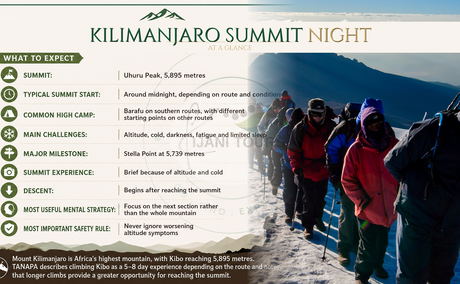
Kilimanjaro Summit Night: The Final Hours Before Uhuru Peak At midnight, the mountain disappears. Your headlamp becomes your horizon. Kilimanjaro summit night is the final and most demanding stage of the journey to Uhuru Peak at 5,895 metres. Starting around midnight, climbers face several hours of darkness, cold, fatigue, limited sleep and reduced oxygen availability. The challenge is physical, but it is also deeply mental. The key to managing summit night is...
The Unifying Power of Swahili Language in Tanzania: A Bridge Between Cultures and Communities
Posted by Wolfgang on Tue October 28, 2025 in Cultural Immersion .
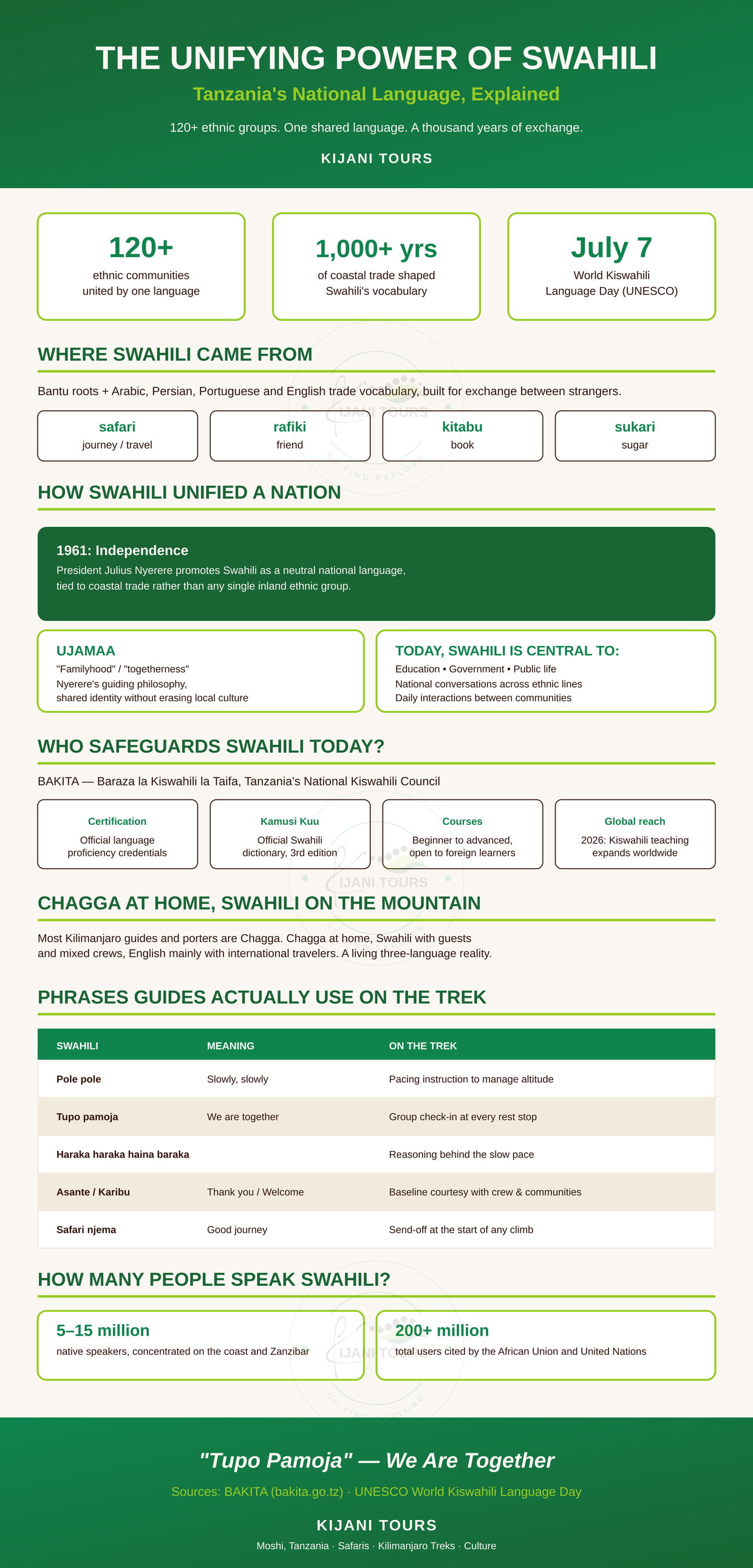
Swahili (Kiswahili) is Tanzania's National and unifying language, deliberately chosen after independence to connect the country's 120+ ethnic groups without favoring any one of them. It's safeguarded today by BAKITA, the National Kiswahili Council of Tanzania, and celebrated globally every July 7 on UNESCO's World Kiswahili Language Day. Travelers don't need it to visit Tanzania, but a handful of phrases change how guides, porters, and communities receive you.
The Language That Connects Tanzania
Tanzania is home to more than 120 ethnic communities, each with its own history, traditions and language. Around Mount Kilimanjaro, the Chagga people have preserved their own language and agricultural traditions for generations, and the same is true across the country's many other communities.
Yet one language links all of them: Kiswahili, known in English as Swahili. It is the language of markets, classrooms, government offices and daily greetings, and for a traveler, learning even a handful of words is the fastest way to move from being watched to being welcomed. For Kijani Tours, Swahili is also the language of the relationships travelers build on the road: with mountain guides, porters, farmers, conservation partners and village elders.
That significance now has international recognition to match it: UNESCO's General Conference declared July 7 as World Kiswahili Language Day in November 2021, the first time an African language received this honor, and it has been celebrated on that date every year since 2022.
Where Swahili Came From
Swahili developed over more than a thousand years along the East African coast, where Bantu-speaking communities traded across the Indian Ocean with merchants from Arabia, Persia, India and later Europe. Its foundation is Bantu, but centuries of trade folded in Arabic, Persian, Portuguese, German and English vocabulary.
Some familiar words that travelled beyond East Africa as a result
● Safari, journey or travel
● Rafiki, friend
● Kitabu, book
● Sukari, sugar
That trading origin is part of why the language absorbs outsiders so easily. It was built for exchange between strangers, not for keeping them out.
How Swahili Became Tanzania's Unifying Language
Tanzania's use of Swahili as a national language was a deliberate policy choice, not an accident of geography. After independence in 1961, President Julius Nyerere promoted Swahili as the basis of a shared national identity that did not favor any single ethnic group's language over another. Swahili, tied to coastal trade rather than to any one inland community, was the neutral common ground.
This was closely tied to Nyerere's philosophy of ujamaa, meaning "familyhood" or "togetherness": Tanzania's strength would come from a shared identity that still respected local cultures. Today, Swahili remains central to:
● Education
● Government and public life
● National conversations across ethnic lines
● Daily interactions between people from different backgrounds
That history is why the language still carries a unifying weight today. Speaking it in Tanzania is not just practical; it plugs directly into a national story about deliberately choosing unity over division.
Who Safeguards Swahili Today? Meet BAKITA
That National commitment to Swahili didn't end with Nyerere. Tanzania maintains a dedicated government institution for it: BAKITA, Baraza la Kiswahili la Taifa (the National Kiswahili Council), under the Ministry of Information, Culture, Arts and Sports. BAKITA standardizes and develops the language, issues official language certification, provides translation and interpretation services, publishes the authoritative Kamusi Kuu ya Kiswahili dictionary (now in its third edition), and runs structured Swahili courses for learners at beginner, intermediate and advanced levels, including foreigners.
BAKITA's work has an increasingly international dimension. In 2026, Tanzania's government directed the global expansion of Kiswahili teaching and the establishment of Swahili cultural centers in multiple countries; BAKITA signed an agreement to introduce Kiswahili teaching in Russia, and BAKITA represented Tanzania at the Second International Swahili Conference in Paris alongside UNESCO's World Kiswahili Language Day commemorations. For a language born of coastal trade a thousand years ago, that's the same instinct for exchange playing out on a global stage.
For travelers who want to go beyond a phrase card, BAKITA's beginner-level courses are the closest thing to an official starting point.
Chagga at Home, Swahili on the Mountain
Around Kilimanjaro specifically, the everyday bilingual reality looks like this: most mountain guides and porters are Chagga, and their Chagga language is what they speak with family and among themselves in villages on the mountain's lower slopes. Swahili is what they switch to with guests, with crew from other ethnic backgrounds, and in town in Moshi. English comes third, used mainly for direct guest communication, and varies more by individual than the other two.
This is worth knowing before a climb for a practical reason: proverbs and encouragement shared on the trail are almost always in Swahili rather than Chagga, because Swahili is the shared language between guide and guest, the same way it is the shared language between a Chagga porter and a crew member from another community on the same team. A simple asante after help from a porter, or a warm habari when greeting a guide in the morning, is understood and noticed.
Phrases and Proverbs Kijani Tours' Guides Actually Use
Generic phrasebooks tend to list the same handful of words without explaining how they're really used. Here is what actually comes up on a Kilimanjaro trek or a village visit, and why:
|
Swahili |
Literal meaning |
How it's actually used |
On the trek |
|
Pole pole |
Slowly, slowly |
A genuine daily-life phrase, not just a trekking slogan; used for anything done carefully |
The literal pacing instruction guides give at altitude, especially on summit night |
|
Tupo pamoja |
We are together |
A check-in phrase, asked and answered constantly in group settings |
Guides ask this at every rest stop to confirm the group is intact and okay |
|
Haraka haraka haina baraka |
Hurry hurry has no blessing |
A common proverb warning against rushing important things |
Often said alongside pole pole as the reasoning behind the slow pace |
|
Asante / Karibu |
Thank you / Welcome |
The most-used exchange in the country, in markets, homes and on the trail |
The baseline courtesy that opens every interaction with crew and communities |
|
Safari njema |
Good/ safe journey |
A send-off phrase for any trip, not specific to safaris in the English sense |
What crew say to each other and to guests at the start of a climb |
One correction worth making plainly: hakuna matata is real Swahili and does mean "no worries," but its worldwide fame comes almost entirely from a Disney film, not from how often it's said day to day. Travelers who lead with it are understood, but it will not land as the meaningful cultural gesture that pole pole or tupo pamoja does. Asante, karibu, pole pole, and tupo pamoja carry more genuine cultural weight.
A Short Practical Phrase List
Greetings: Jambo (hello, tourist-facing), Habari? (how are things?), Mambo? (informal, common among younger people)
Courtesy: Asante (thank you), Asante sana (thank you very much), Karibu (welcome), Samahani (excuse me/sorry)
On the trail: Pole pole (slowly), Tupo pamoja (we're together), Safari njema (good journey), Twende (let's go)
Market and dining: Bei gani? (what's the price?), Chakula (food), Maji (water), Karibu chakula (welcome, please eat)
Why Learn a Few Words at All?
You do not need Swahili to enjoy Tanzania. English is widely used across the tourism industry, among guides, drivers and hospitality staff. But a greeting or a thank-you in someone's own language signals respect for the culture, willingness to connect, and appreciation for the community hosting your trip. It shifts travel from observing a place to participating in it, in a conversation with a guide, a coffee farmer near Kilimanjaro, or a village host.
Language as a Form of Responsible Travel
Sustainable tourism is usually framed as protecting wildlife and landscapes. That's only half of it. The other half is protecting and respecting the cultures, traditions, and local knowledge that make a place worth visiting in the first place, and language is where that respect either shows up or doesn't.
Learning a handful of Swahili phrases before a Tanzania trip does four specific things a guidebook checklist doesn't capture:
- It shows respect for local communities. A greeting attempted in someone's own language, even imperfectly, signals that you see the encounter as an exchange rather than a transaction.
- It reflects genuine appreciation of cultural heritage. Swahili carries the proverbs, history, and worldview covered earlier in this guide. Using even a few words is a small act of engaging with that heritage rather than photographing past it.
- It moves you from observation to participation—tourism at its most extractive treats communities as scenery. A traveler who says Asante to a porter or karibu back to a host has stepped, briefly, into the relationship instead of standing outside it.
- It recognizes local people as knowledge holders, not backdrops. Guides, porters, and community members carry ecological, cultural, and historical knowledge that no phrasebook does. Speaking their language, even a little, acknowledges that the expertise runs in their direction too.
This is the same principle behind Kijani Tours' approach to Kilimanjaro more broadly: responsible travel isn't only about carrying out your trash and paying fair porter wages, real as those commitments are. It's also about how you show up in conversation. Language is simply the most immediate, daily place that shows up.
Frequently Asked Questions about Swahili Language
1. Do I need to speak Swahili to climb Kilimanjaro or go on safari in Tanzania?
No. English is spoken by guides, drivers, and hotel staff throughout Tanzania's tourism industry. Swahili is not required, but a handful of phrases noticeably changes how warmly you're received by crew and communities.
2. Is Swahili the same as Kiswahili?
Yes. Kiswahili is the Swahili term for the language itself; "Swahili" is the English term. Tanzanians generally say Kiswahili.
3. What language do Kilimanjaro guides and porters speak?
Most are Chagga and speak their Chagga language at home. Swahili is what they use with guests and with crew from other ethnic groups, and English varies by individual, most commonly used directly with international guests.
4. How many people speak Swahili?
Estimates vary widely depending on whether second-language speakers are counted. The commonly cited range is 50 to over 200 million; the African Union and United Nations, where Swahili is a recognized working language, use figures above 200 million. Native first-language speakers are a much smaller group, estimated at 5 to 15 million, concentrated on the coast and in Zanzibar.
5. Is Swahili difficult to learn?
It's considered one of the more approachable African languages for English speakers because it's phonetic, words are pronounced as spelled, and it has regular grammar patterns, though its noun-class system is unfamiliar to English speakers at first.
6. What does "ujamaa" mean?
Ujamaa translates roughly to "familyhood" or "togetherness." It was the guiding philosophy of Tanzania's first president, Julius Nyerere, who promoted Swahili as a national language partly to build unity across the country's many ethnic groups without favoring one language over another.
7. What does "pole pole" mean and why do guides say it so often?
It means "slowly, slowly." On Kilimanjaro, it's a literal pacing instruction: moving slowly is one of the most effective ways to reduce altitude sickness risk, not just a saying.
8. When was World Kiswahili Language Day declared, and when is it celebrated?
UNESCO's General Conference declared July 7 as World Kiswahili Language Day at its 41st session in Paris in November 2021, making Kiswahili the first African language to receive this recognition. The first celebration was held on July 7, 2022, and it has been observed on that date every year since. World Kiswahili Language Day is celebrated every year on 7 July following UNESCO’s declaration in November 2021. The day recognizes Kiswahili’s contribution to African unity, cultural diversity, peace, and intercultural dialogue.
9. What is BAKITA?
BAKITA, Baraza la Kiswahili la Taifa, is Tanzania's National Kiswahili Council, a government institution responsible for standardizing and developing the Swahili language, issuing language certification, publishing the official Kamusi Kuu ya Kiswahili dictionary, and running Swahili courses for local and foreign learners.
10. Can I get official Swahili lessons or certification in Tanzania?
Yes. BAKITA runs beginner, intermediate, and advanced Swahili courses, including for foreign learners, and issues official language certification through its national council.
11. Is "hakuna matata" actually commonly used in Tanzania?
It's a real, understood phrase, but its international fame comes from a Disney film rather than frequent daily use. Tanzanians will understand and appreciate it, but it isn't the phrase locals reach for most often.
12. What's the national language of Tanzania?
Swahili is Tanzania's national language and one of its two official languages alongside English. It's the primary language of government, primary education, and daily public life.
13. How can I start learning Swahili before my trip?
Apps like Duolingo, YouTube lessons, and short phrase guides cover the basics well. Kijani Tours also provides guests with a Swahili phrase card ahead of departure covering greetings, trail phrases, and dining vocabulary.
Experience Swahili Through Living Culture
Swahili means more when it's learned where the language actually lives: among the people, landscapes, and communities that have shaped Tanzania for generations.
Through the Kijani Tours, Swahili becomes more than greetings and vocabulary. It's part of a deeper cultural journey, connecting travelers with Chagga communities around Mount Kilimanjaro, coffee-growing families, traditional farming practices and local conservation work.
Guests practice everyday Swahili while talking with community members, learning traditional knowledge, exploring mountain landscapes, and discovering how language reflects the relationship between people and the land. At Kijani Tours, we believe responsible travel begins with understanding. A simple karibu, asante, or pole pole isn't just a word; it's an invitation to connect.
A Guide's Perspective: Why Swahili Matters on Kilimanjaro
"When we climb Kilimanjaro, the first thing we share with guests isn't information about the mountain. It's a greeting. Saying habari to the person walking beside you changes the relationship. It shows you're not just passing through; you're interested in connecting."
[Denis- Kijani Tours Mountain Guide,]
For our guides, Swahili is what brings together people from different regions and backgrounds sharing the same climb. An asante after help from a porter, a habari at the start of the day, a tupo pamoja during a hard stretch- each one is a small marker of the teamwork and respect that defines a Kilimanjaro trek.
Seeing Tanzania Through the Language of Its People
Words carry memory and relationship, and Tanzania's are easier to hear than to read about. They show up in conversations between coffee farmers and visitors, in greetings exchanged before sunrise on the mountain, in stories told by community elders, in the everyday transaction of a market stall, and in conservation conversations that connect people to the forests and wildlife around them.
That's the real classroom for Swahili: not a phrasebook, but a place where the language is still doing its original job, bringing people together.
Karibu Tanzania. Welcome to a journey where language, culture and community bring every experience closer.
Explore Tanzania Through Swahili: Discover the Language That Unites a Nation
Step into the vibrant soul of Tanzania through the rhythm and beauty of the Swahili language. More than just words, Swahili is the heartbeat that brings people together—bridging communities, traditions, and travelers from all walks of life.
With Kijani Tours, your journey isn’t just about seeing Tanzania—it’s about feeling it. From everyday conversations to cultural encounters, you willl experience the country in a way that goes far beyond the ordinary.
Share This Post
Latest News
Tanzania Travel Guide | Safaris, Kilimanjaro, Beaches, Culture and Responsible Travel
Kilimanjaro Summit Night: How to Prepare Mentally and What to Expect
Sun August 30, 2026
Read This Article
Is Tanzania Safe for Kids on Safari?: A Parent's Guide to Family Safari in Tanzania, 2026–2029
Sat August 29, 2026
Read This Article
Planning a Tanzania safari with children? This practical family safari guide helps parents understand when to go, which parks and experiences suit different ages, how to prepare for health and safety, and what to expect from accommodations, game drives, and wildlife encounters. It also explains how Kijani Tours can tailor a private safari to your family's needs, from the Serengeti and Ngorongoro to cultural experiences and Tanzania's coast, from Pangani to Mafia...
Climbing Kilimanjaro as a Woman: What No One Tells You Before You Go
Thu August 27, 2026
Read This Article
Climbing Kilimanjaro as a woman is absolutely possible, but there are practical things to prepare for before you arrive. This guide covers the realities many women want to know about, including hygiene at mountain camps, managing your period, physical preparation, altitude sickness, and what to expect on summit night. You will also learn which questions to ask Kijani Tours' team regarding privacy, female guides, hygiene and waste management, health monitoring, and emergency...
Share This Post