

About This Tanzania UNESCO World Heritage Guide This guide to Tanzania’s UNESCO World Heritage Sites has been created by Wolfgang Valerian, based in Tanzania. Wolfgang works directly with travellers exploring Mount Kilimanjaro, Tanzania’s national parks, Zanzibar’s cultural heritage sites, and community-based experiences throughout the country. Through years of designing and operating responsible journeys, Wolfgang combines UNESCO information with practical field knowledge, local interpretation, and an understanding of how travellers can experience Tanzania’s...
Why Elephants Bunch Together: Tarangire Herd Behavior
Posted by Wolfgang on Wed April 16, 2025.
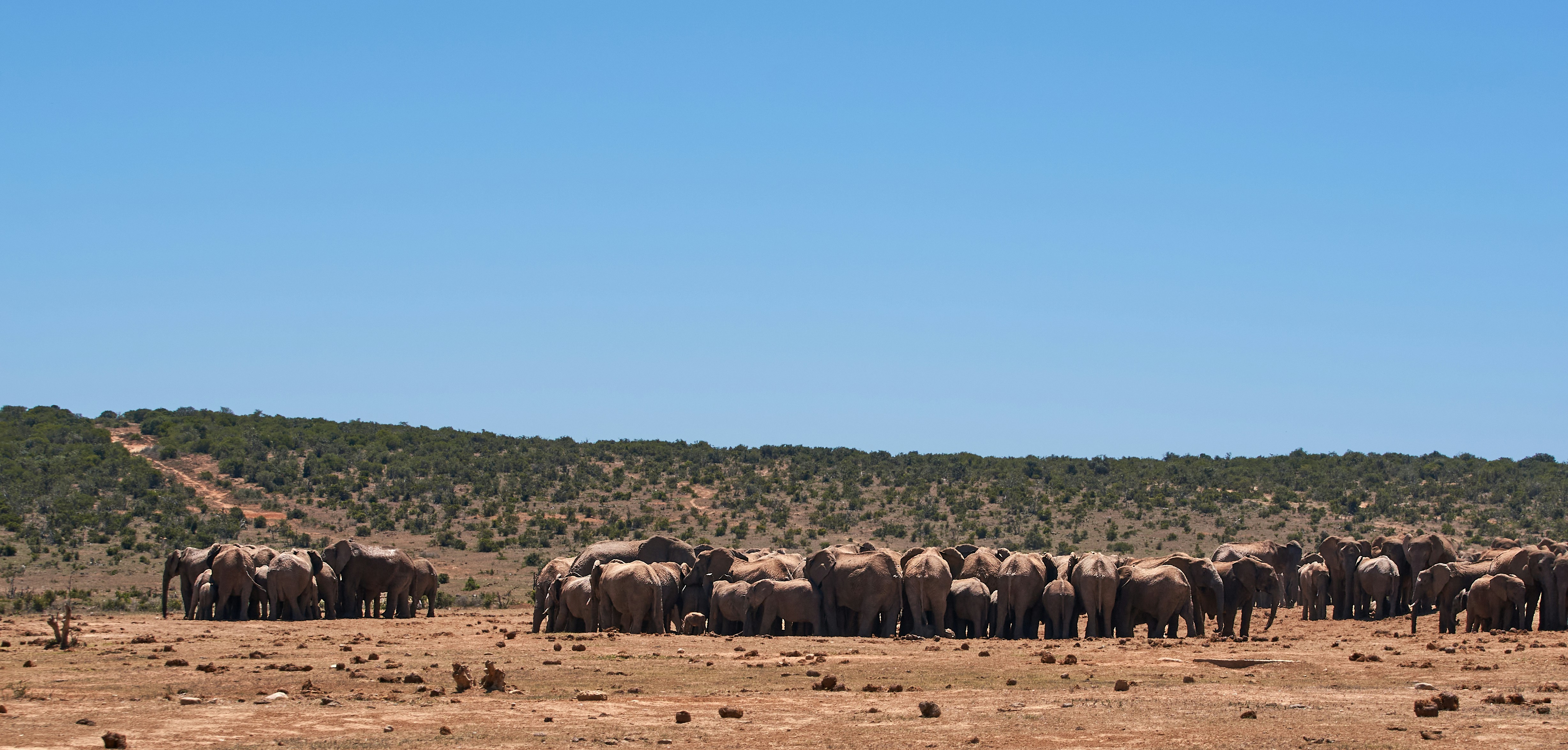
Every morning during Tarangire's dry season, something happens at the Tarangire River that most safari guests mistake for instinct. A matriarch pauses. The herd closes in. Four calves slip into a ring of adult females so tight you cannot see them from the vehicle. It is over in seconds. What you just watched has a name, a mechanism, and sixty years of field research behind it.
This is the guide to elephant bunching: what it is, why it works, who leads it, and what the aunts in the herd are doing while everyone watches the matriarch. It also covers what happens to a herd when that system breaks down and what a responsible game drive looks like from the elephant's perspective.
If you have seen it and wondered what you were really looking at, read on.
Why Do Elephants Bunch Together? How Tarangire Herds Protect Their Calves
By Wolfgang Valerian | Kijani Tours, Moshi, Tanzania
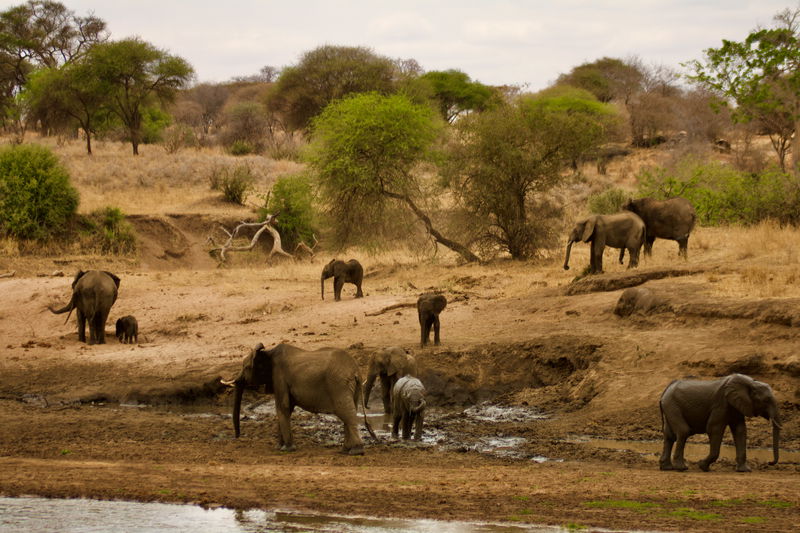
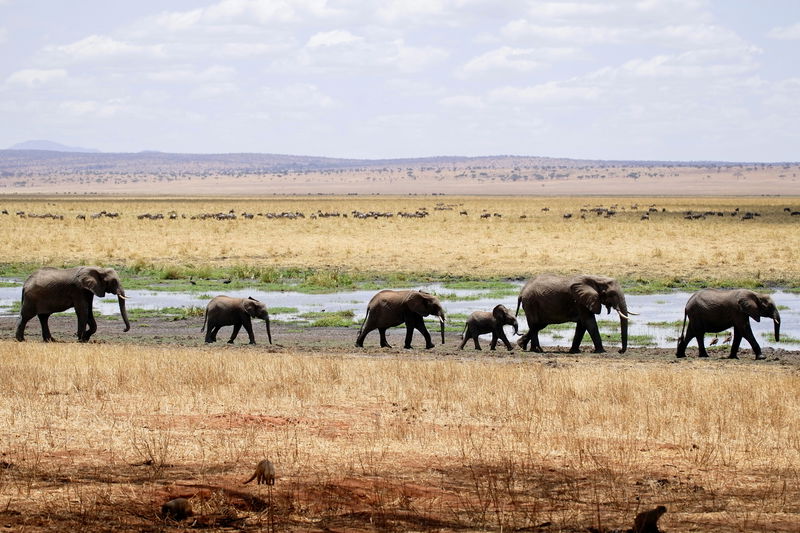
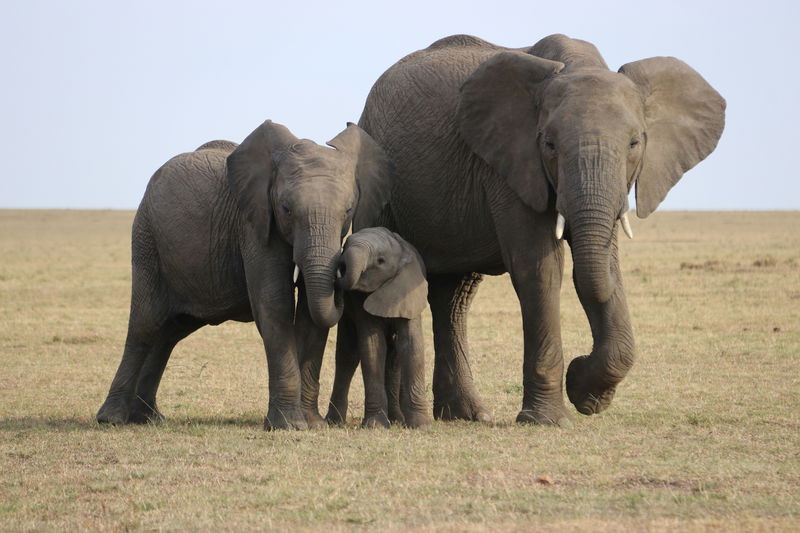
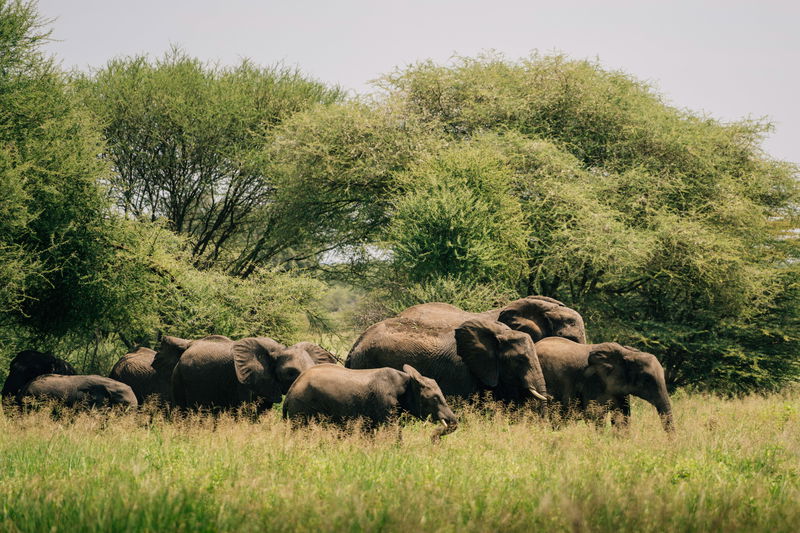
It is the dry season in Tarangire National Park, and the grass has turned the color of old paper. The Tarangire River is one of the few water sources that never fully disappears, and this morning, just after six, a matriarch is leading her family down the red-clay bank toward the water's edge. She is large, slow, and certain of where she is going. Behind her, pressed close on both sides, four calves move inside a ring of adult females whose shoulder height alone would stop most threats before they started. The calves are invisible from outside the ring. That is the point.
What you are watching is a behavior called bunching. It is not panic. It is not random crowding. It is one of the most well-documented protective strategies in the animal kingdom, passed down across generations through a social structure that researchers and field guides working in Tanzania's Tarangire-Manyara Ecosystem have studied for decades.
What Is Elephant Bunching?
Bunching is a behavior in which members of a family group move closely together, with younger calves near the center and adults positioned around them. The formation relies on a straightforward physical principle: a predator, a threat, or an unfamiliar disturbance cannot reach a calf at the center of a ring of three-tonne adult females. But bunching is more than a physical barrier. It is also a communication event. As adults close in, they make contact with their trunks, passing reassurance between individuals through touch. Low-frequency rumbles, sounds below the range of human hearing, travel through the group and through the ground itself, coordinating movement without alerting distant predators.
It is not a rigid formation that elephants use in the same way every time. The group's response depends on the cause of the disturbance, the perceived threat's distance and direction, the calves' ages, and the herd's composition. When elephants feel threatened, adults may face outward, raise their heads or ears, vocalize, or move between the calves and the source of the disturbance. If the threat passes, the herd may gradually spread out and return to normal feeding and movement.
For a safari observer, the key point is not merely that the elephants are standing close together. It is the coordinated change in behavior that signals the herd has become more vigilant. That shift, from relaxed and dispersed to tight and oriented, is one of the clearest examples of wildlife communication you will see from a game vehicle in Tarangire.
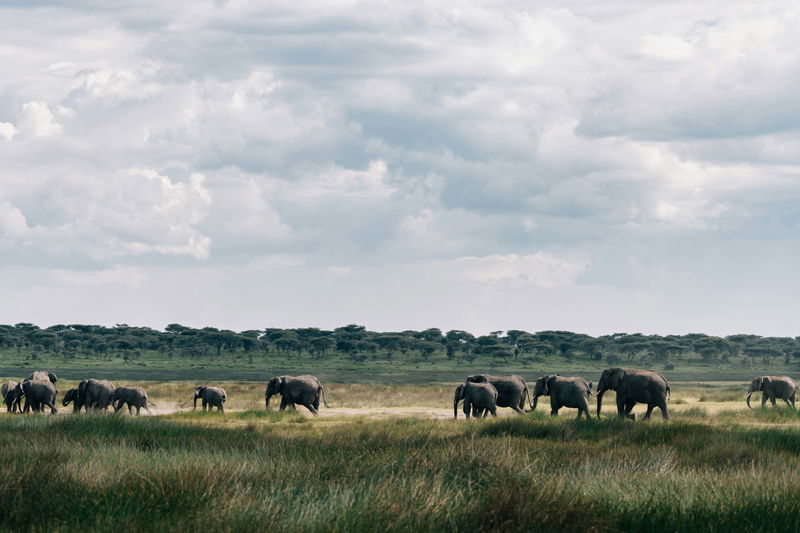
The behavior is documented across African elephant populations, from the Amboseli Basin in Kenya to Ruaha in southern Tanzania, but Tarangire offers some of the most observable bunching encounters on the continent. Tarangire National Park holds between 2,500 and 4,000 elephants during the dry season months of June through October, when herds converge on the Tarangire River from across the broader ecosystem. Family groups numbering 200 or more are regularly recorded. In those concentrations, with lion prides active along the riverbank and unfamiliar herds arriving daily, calves face genuine and varied threats. Adults respond accordingly.
How an Elephant Herd Responds to a Perceived Threat
Protective behavior can unfold quickly, and understanding its sequence helps you interpret what you are watching from the vehicle.
First, one or more elephants detect something unusual. They may use sight, hearing, or smell to investigate. The herd then becomes more alert. Adults may stop feeding, raise their heads, orient toward the disturbance, or communicate with other members of the group through contact rumbles that travel below the range of human hearing.
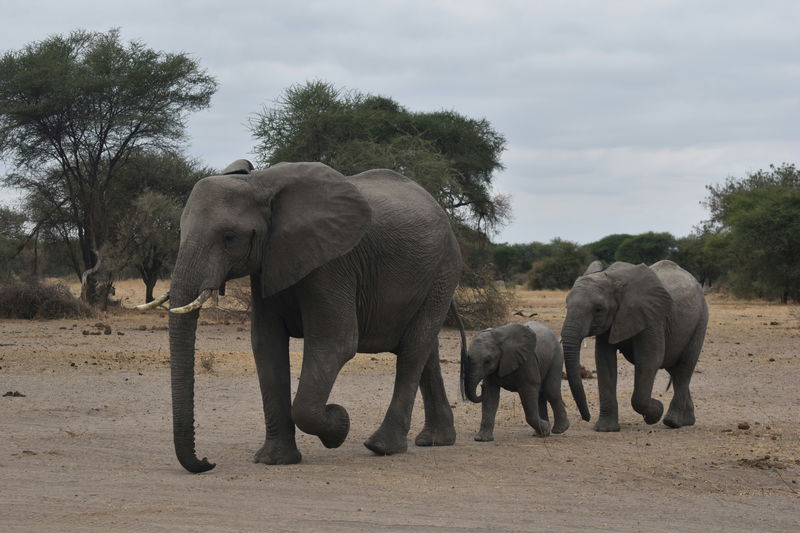
If the perceived threat draws closer, adults can tighten their formation. Calves move toward their mothers or other adults, while larger elephants position themselves between the young and the source of concern. The herd may then choose among several responses: staying together and monitoring, moving away as a group, confronting the disturbance directly, or waiting until the situation becomes clearer.
This is why a safari vehicle should never be treated as an invitation to approach. An elephant herd that has shifted from relaxed feeding to a tight defensive grouping is signaling that the situation has changed. Giving the animals space allows them to decide what to do next. The encounter you want is one in which the elephants return to feeding without acknowledging your vehicle as a threat at all.
Why the Matriarch Matters
Elephant herds are matriarchal. The oldest female leads, and her authority is not a social convention. It is practical survival intelligence accumulated over decades. Her value is not simply that she is the largest elephant. Older females carry years of experience with water sources, seasonal movements, threats, and the behavior of other animals within their home range. Matriarchs in the Tarangire population can live to sixty years, and field research conducted by TAWIRI (the Tanzania Wildlife Research Institute) and the Wildlife Conservation Society through the long-running Tarangire Elephant Project shows that this accumulated knowledge is measurable in outcomes. Matriarchs over forty have been documented guiding their herds to remote seasonal springs during severe drought years, enabling survival when younger-led groups did not locate water in time.
When a herd encounters something unfamiliar, the matriarch and other experienced females play a key role in assessing the situation and guiding the group's movement. Young elephants learn by observing older family members. This social learning helps calves develop the knowledge they need to navigate their environment long before they are old enough to face threats on their own.
This is one reason the loss of an experienced adult female has consequences that extend far beyond the individual animal. Research published in Oryx and tracked in the Tarangire population data shows that poaching in the 1970s and early 1980s removed most experienced females from the herd's age structure, leaving young, female-biased groups without the leadership layer they needed. Recovery took decades, and the behavioral deficits were measurable: higher risk-taking and less reliable migration. Elephant societies depend heavily on relationships and accumulated knowledge. Both are lost when experienced females are removed.
How Elephants Communicate During a Disturbance
Elephants communicate through a combination of vocalizations, touch, posture, movement, and chemical signals. Understanding the basics of this communication changes what you notice from the vehicle.
Some elephant calls are low-frequency rumbles that can travel considerable distances, passing not only through the air but also through the ground, which other herd members sense through their feet. Other sounds are much more obvious, including trumpets, which can occur in situations of excitement, alarm, or intense social interaction. Neither sound has a single fixed meaning. Context determines what is being communicated.
Body position matters equally. An elephant that stops feeding and turns toward a disturbance behaves differently from one that continues feeding without changing posture. Ears, head position, trunk movement, and the direction an elephant faces can all provide clues about its level of attention. Touch is equally important within family groups. Mothers and calves frequently maintain physical contact, and other family members interact through trunk touches and proximity, particularly when the herd is under pressure.
Safari guides assess the full situation rather than relying on a single signal. An elephant with its ears extended is not automatically aggressive, just as a relaxed-looking elephant should not be approached too closely. It is the combination of signals, read together and in sequence, that tells the full story.
Allomothers: The Aunts Who Share the Load
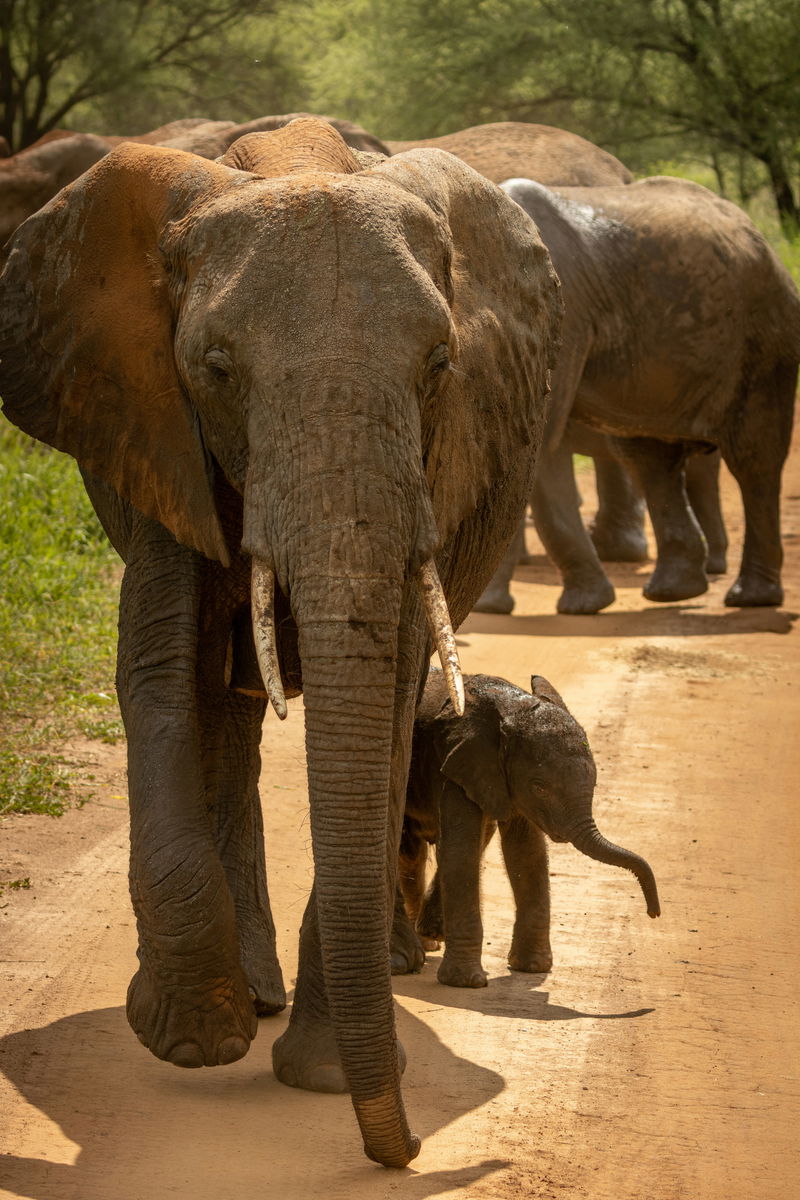
A calf in a healthy elephant family receives care not only from its mother but also from other females. Young females who have not yet given birth take on significant caregiving roles within the family unit. These females are called allomothers, and their contribution to calf survival is well documented. Allomothers help guide calves away from danger, position themselves around calves during bunching events, offer physical reassurance through trunk contact, and, in some populations, have been recorded nursing calves that are not their own. The San Diego Zoo Wildlife Alliance describes allomothering as one of the key mechanisms through which calves develop the social skills and environmental knowledge they need to survive independently.
For the herd, allomothering also serves as a form of training. A young female who has spent years protecting and guiding calves has already developed the instincts she will need when she has her first calf, typically between the ages of nine and twelve. The allomother learns by doing, and the calf benefits from multiple experienced caregivers. The herd's social fabric tightens. This is why family stability is not a conservation bonus. It is the mechanism by which elephant populations reproduce their own resilience.
Emotional Cohesion: Why Bunching Is Also About the Bond
Elephants bunch in response to threats. They also bunch during grief, births, and after reunions with related family groups they have not seen for a season. The physical closeness is not only defensive. It is how elephants maintain the emotional bonds that hold the social structure together. Behavioral research from ElephantVoices, the research initiative founded by Joyce Poole and Petter Granli, documents trunk-to-mouth contact during bunching events as a specific reassurance behavior, a gesture that functions like a handhold, communicating 'I am here' between individuals under stress.
Understanding the emotional dimension of bunching changes what it means to witness it on safari. You are not watching animals react to danger. You are watching a social system regulate itself under pressure. The calves at the center of the formation are learning, in real time, what it feels like to be held by the community they belong to. That lesson accumulates over years. It becomes the basis for the allomothering behavior those calves will eventually provide to the next generation.
Why Tarangire Is a Special Place to Observe Elephant Families
Tarangire National Park is particularly well known for its elephants. The park's river, seasonal water sources, woodlands, and surrounding wildlife landscape provide important habitat for large numbers of elephants year-round. Water availability becomes especially significant during the dry season. As some seasonal sources disappear, wildlife concentrates around remaining water and feeding areas. This creates conditions in which elephant families interact, travel, drink, and move in ways that are difficult to observe in more dispersed landscapes.
But Tarangire's elephants should not be understood only within the park's boundaries. Elephants move across a wider landscape, and their survival depends on access to habitats beyond individual protected areas. This wider ecosystem is also where conservation becomes more complex. Protecting elephants means considering not only the animals inside the park but also the surrounding communities, farms, wildlife corridors, and other land uses.
For travelers, this is an important lesson. A safari park is part of a much larger ecological system. The elephant you photograph at the river is part of a family that may travel forty kilometers overnight through community land to reach another water source. What happens outside the park boundary matters as much as what happens within it.
What You May Notice During an Elephant Encounter
One of the most interesting moments on safari is the transition between relaxed and alert behavior. A family may initially feed calmly, with calves walking between adults. Then something changes. Several elephants stop feeding. Heads rise. The group grows quieter or more tightly organized. A mother may draw a calf closer, while another adult turns toward the disturbance.
For a few moments, the herd may appear almost motionless as it assesses the situation. Then, depending on the situation, the elephants may relax and continue feeding, move away together, or become more defensive. The value of such an encounter is not in predicting exactly what the elephants will do next. It is in learning to recognize that they are making decisions and responding to their surroundings.
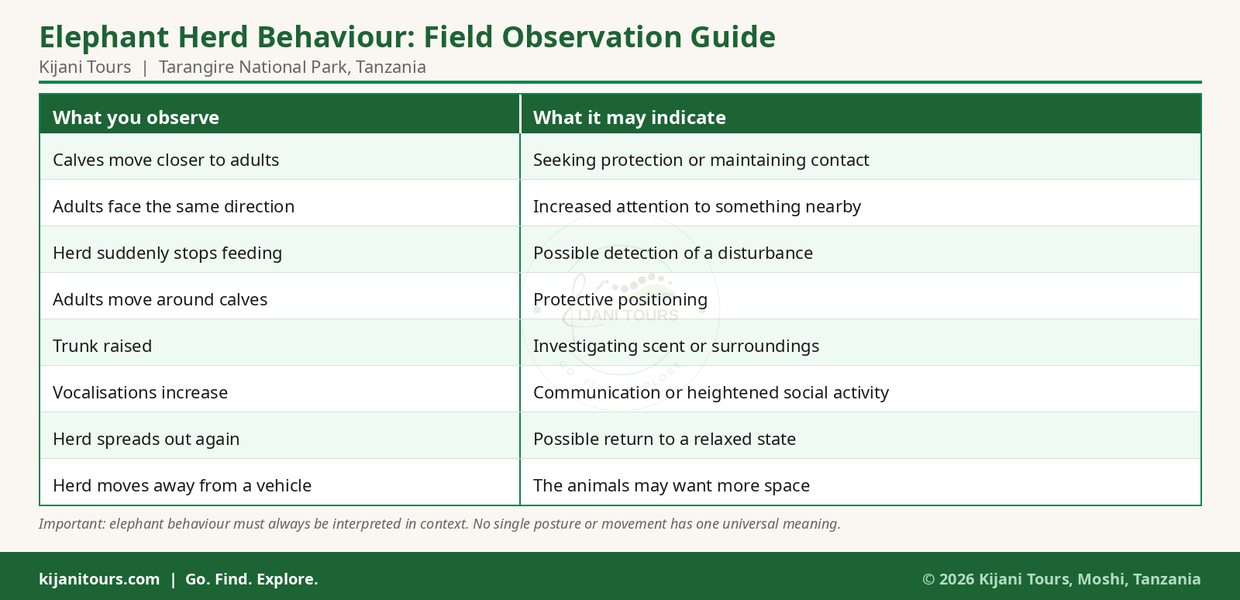
The table below outlines some of the specific signals a guide will observe during an elephant encounter. No single signal has a universal meaning. It is the combination and sequence that matter.
How to Watch an Elephant Herd Responsibly on Safari
A good elephant encounter is not necessarily the closest one. It is one in which the animals remain comfortable enough to continue behaving naturally. If an elephant family begins bunching around its calves, becomes unusually alert, or changes direction because of a safari vehicle, the appropriate response is to give the herd more space.
As a traveler: remain quiet and avoid sudden movements. Do not encourage your driver to move closer for a photograph. Never position a vehicle between a mother and her calf. Leave the elephants a clear route to move away. Follow your guide's decision about when to stop, wait, or move on. Avoid repeatedly repositioning around the herd simply to get a better angle. If the elephants show persistent signs of disturbance, allow them to move away without following.
Responsible wildlife viewing is based on observation rather than interference. The goal is to see the animal's behavior without becoming the reason that behavior changes. Every vehicle around a bunching herd is a variable in the threat calculation the matriarch is running. This is not abstract ethics. It is elephant cognition in action.
How Human Disturbance Can Affect Elephant Behaviour
Elephants live in landscapes increasingly shared with people. Roads, agriculture, settlements, livestock, and other human activities can alter how elephants move through their environment. Repeated disturbance can shape where elephants travel, when they use particular areas, and how they respond to people over time.
This is especially important where elephant habitat overlaps with agricultural land. An elephant moving outside a protected area may encounter crops, fences, or settlements, while local communities may face real risks to crops, property, and livelihoods. Conservation therefore cannot be reduced to protecting elephants inside national parks. It also requires finding ways for wildlife and communities to coexist across the wider landscape.
For this reason, responsible tourism should support conservation approaches that recognize both sides of the equation: protecting wildlife while respecting the people who share these landscapes. Solutions can include better land-use planning, maintaining wildlife corridors, community-based conservation programs, and early-warning systems to reduce conflict before it occurs. For travelers, understanding this connection changes how they see a safari. A photograph of an elephant in Tarangire is not the whole conservation story.
Why Elephant Family Behavior Matters for Conservation
Watching elephants protect their young reveals what statistics alone cannot: elephant conservation is also about safeguarding social systems. A calf depends on its mother and other family members for protection, learning, and knowledge of its environment. Older females carry experience accumulated over decades. That experience is stored only in the animal itself.
When elephant populations decline because of poaching, habitat loss, or conflict, the impact extends beyond the number of animals lost. The structure and knowledge of family groups can also be affected, sometimes in ways that take a generation to become visible. Protecting elephants means safeguarding the landscapes where these relationships can continue: water sources, feeding areas, movement routes, and the wider ecosystems that connect protected areas with community lands.
Frequently Asked Questions About Elephant Herd Behavior
Why do elephants bunch together?
Elephants bunch together when they perceive a potential threat. Adults move closer to one another and place younger calves within the group, while larger elephants position themselves between the young and the source of concern. This behavior can also occur during births, reunions, and other emotionally significant moments within the family.
How do elephants protect their calves?
Elephant mothers and other adults protect calves by keeping them close, positioning themselves between the young and a perceived threat, and moving as a family group when necessary. Allomothers, typically younger females who have not yet given birth, also help protect and guide calves within the family unit.
What is elephant bunching?
Elephant bunching is a close-grouping behavior in which a family becomes more alert or defensive. Calves move toward the center of the group while adults position themselves around them. It is not a fixed formation. The group's response depends on the nature of the disturbance, the direction and distance of the threat, the age of the calves, and the herd's composition.
Why is the matriarch important to an elephant herd?
The matriarch is typically the oldest female and provides valuable knowledge of water sources, seasonal movements, threats, and the wider landscape. Her knowledge shapes the decisions of the family group in ways that younger elephants have not yet acquired. Research shows that herds led by older, experienced matriarchs have better survival outcomes during droughts and periods of disturbance.
How do elephants communicate with each other?
Elephants communicate through vocalizations, physical contact, body posture, movement, smell, and other sensory signals. Low-frequency rumbles are particularly important for long-distance communication, traveling through both air and ground. Touch is equally important within family groups, with trunk contact used to reassure calves and maintain social bonds.
Are elephant herds dangerous on safari?
Elephants are wild animals and can become defensive if they feel threatened, surprised, or crowded. A professional safari guide maintains a safe distance and monitors changes in elephant behavior before they escalate. Guests should follow the guide's instructions at all times and avoid encouraging the driver to move closer.
Is Tarangire a good place to see elephants?
Yes. Tarangire National Park is well known for its elephants and offers opportunities to observe family groups in woodlands and grasslands, as well as around seasonal water sources. During the dry season, from June through October, between 2,500 and 4,000 elephants can be present in the park, making it one of the most reliable places in Africa to observe large elephant families.
What should I do if elephants approach a safari vehicle?
Remain calm and quiet. Stay inside the vehicle unless your guide instructs otherwise. Allow the elephants to set their own distance from the vehicle. Do not ask the driver to move closer for photographs. If the guide decides to move the vehicle back, do not question that decision.
Why should safari vehicles not get too close to elephant families?
Getting too close can alter natural behavior, increase stress, and restrict the animals' ability to move freely. Responsible wildlife viewing gives elephants enough space to choose whether to remain, approach, or move away. A vehicle that positions itself too close becomes a variable in the matriarch's threat calculation, which can cost the herd feeding time and cause unnecessary stress for calves.
Are elephant families always together?
Elephant family groups are typically centered on related females and their young, though their size and composition can change over time. Elephants may temporarily separate and later reunite, while males typically become more independent as they mature. In Tarangire, family groups can merge into much larger temporary aggregations of several hundred elephants during the dry season, particularly around the river.
The Kijani Approach to Wildlife Viewing
At Kijani Tours, we believe wildlife encounters should begin with respect for the animal, not the photograph. Our guides are encouraged to read animal behavior, maintain appropriate distances, and avoid actions that unnecessarily disturb wildlife. We want guests to leave Tanzania with memorable experiences and a deeper understanding of why these landscapes and the communities connected to them deserve protection.
What an Elephant Encounter Can Teach Us
The next time you see elephants gathering around a calf in Tarangire, look beyond the photograph.
Notice who moves first. Watch how the adults position themselves. Listen for shifts in vocalization. Observe whether the herd relaxes, moves away, or stays alert. These small details reveal a sophisticated social world built on family, experience, communication, and cooperation.
They also offer an important lesson for safari travelers: the best wildlife encounter is not the one in which we get closest to the animals. It is the one in which we give them enough space to remain wild.
That is the kind of safari experience worth protecting.
About This Guide
This article has been written by Wolfgang Valerian, founder and visionary at Kijani Tours, a Tanzanian-owned tour operator based in Moshi. Kijani Tours operates responsible safari experiences in Tarangire, Serengeti, Ngorongoro, and Ruaha. Field observations in this guide draw on direct experience in the Tarangire-Manyara Ecosystem and are supported by published research from TAWIRI, the Wildlife Conservation Society, and ElephantVoices.
Tanzania Travel Guide | Safaris, Kilimanjaro, Beaches, Culture and Responsible Travel
Tanzania UNESCO World Heritage Sites: A Local Expert Guide
Wed July 29, 2026
Read This Article
Tanzania Safari Packing Guide: What to Wear and Bring by Season, Park, and Style (2026)
Thu July 23, 2026
Read This Article
A Tanzania safari runs on a strict set of practical constraints: a 15kg soft-duffel limit on light aircraft, a temperature swing of more than 20 degrees between a cold Ngorongoro dawn and a hot Tarangire afternoon, and a short list of things, camouflage prints and certain colours among them, that work against you rather than for you. Get those right and packing is simple. Kijani Tours runs game drives and walking safaris...
Tanzania Biodiversity Guide: Wildlife, Ecosystems and Conservation
Sat February 28, 2026
Read This Article
Introduction: Journey to the Heart of Tanzania There is something about Tanzania that refuses to stay behind when you leave. You carry it home without meaning to. The low rumble of hooves across the plains of the Serengeti. The sharp, cold breath of air near the top of Mount Kilimanjaro. The way the light settles over Lake Tanganyika at sunrise, turning the surface into hammered silver. Weeks later, a warm breeze hits...
Share This Post