


Travel Deeper: How Cultural Respect Creates Truly Sustainable Tourism 1) True sustainability goes beyond eco‑habits—it begins with a respectful mindset toward local cultures. 2) Cultural respect strengthens the three pillars of tourism: environmental protection, economic resilience, and socio‑cultural preservation. 3) Empowering communities as guardians, artisans, and storytellers ensures conservation and dignified livelihoods. 4) Travel becomes legacy‑building when it shifts from extraction to authentic human connection.
The Unifying Power of the Swahili Language in Tanzania
Posted by Wolfgang on Tue October 28, 2025 in Cultural Immersion .
For the eco-conscious traveler, a trip to Tanzania is a quest for authentic connection. This article reveals that the most powerful tool for achieving this isn't found in your backpack, but in your voice: the Swahili language.
Moving beyond basic phrasebooks, we explore how Swahili is your key to responsible and transformative travel. It's a language born of trade and cultural exchange, making it inherently welcoming. We uncover how using Swahili fosters genuine respect, transforms you from a spectator into a participant, and unlocks a deeper understanding of local communities and conservation efforts.
Learn the essential phrases that build bridges, discover the cultural concepts like "pole pole" (slowly) and "ujamaa" (community) that align with an eco-mindset, and understand why speaking Swahili is the ultimate practice of sustainable travel. This is your guide to not just seeing Tanzania, but feeling it, connecting with its people, and leaving with a sense of true belonging.
Swahili—Kiswahili to its speakers—is more than a language. It is a living heritage, a bridge across over 120 ethnic groups in Tanzania, and a cultural compass for millions across East and Central Africa. UNESCO recognizes its global importance by celebrating World Kiswahili Language Day every July 7, honoring it as a symbol of African unity, resilience, and dialogue.
For eco-conscious travelers, learning even a few words of Swahili is not just practical—it is a way to connect, belong, and embrace the communities you visit. Unlike many languages confined to classrooms, Swahili thrives in markets, homes, schools, religion, and songs, making it a true people’s language.
A Language Born of Exchange
Swahili emerged along the East African coast over a thousand years ago, shaped by trade, migration, and cultural exchange. From Bantu roots, it absorbed Arabic, Persian, Portuguese, and later English influences. This adaptability is why Swahili vocabulary feels both familiar and unique—words like safari (journey), rafiki (friend), and uhuru (freedom) have traveled the world.
Swahili is not just a relic of history—it is a regenerative force today. It is the language of climate dialogues in East Africa, of conservation campaigns, and of community-led tourism initiatives. For travelers seeking meaningful impact, Swahili is the key to understanding not only people but also the values that sustain Tanzania’s landscapes.
Why Swahili Matters for Responsible Travel
1) Cultural Immersion: Speaking Swahili phrases like asante (thank you) or karibu (welcome) creates instant warmth.
2) Sustainability: Local guides, farmers, and artisans often express their environmental wisdom in Swahili. Listening in their language deepens respect for traditional ecological knowledge.
3) Unity in Diversity: Swahili dissolves barriers between ethnic groups, allowing travelers to witness Tanzania’s multicultural harmony firsthand. This article emphasizes how Swahili shapes the traveler’s journey today—from trekking Kilimanjaro with guides who share proverbs, to joining village ceremonies where Swahili songs carry ancestral wisdom.
Swahili Vocabulary That Enriches Travel
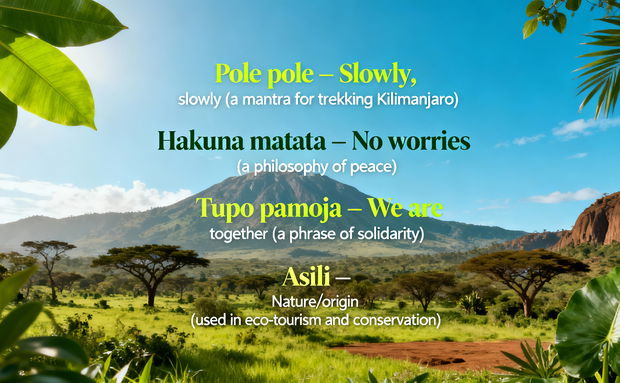
Pole pole – Slowly, slowly (a mantra for trekking Kilimanjaro)
Hakuna matata – No worries (a philosophy of peace)
Tupo pamoja – We are together (a phrase of solidarity)
Asili – Nature/origin (used in eco-tourism and conservation)
These words are not just vocabulary—they are emotional anchors that help travelers feel, connect, and grow.
Swahili Heritage and Storytelling
Swahili is the language of Tanzanian poetry, taarab music, and oral storytelling. Guides often share methali (proverbs) on treks:
Haraka haraka haina baraka – haste haste has no blessing.
Bahari haikosi mawimbi – The sea is never without waves.
These sayings are more than words; they are life lessons that resonate with travelers seeking reflection and renewal.
FAQ: Swahili Language in Tanzania
Q1: How many people speak Swahili?
Over 200 million people across Africa use Swahili, making it the most widely spoken African language.
Q2: Is Swahili hard to learn?
Swahili is considered one of the easiest African languages for English speakers due to its phonetic spelling and simple grammar.
Q3: Why is Swahili important for eco-conscious travel?
Because it is the language of local communities, conservation projects, and cultural rituals, learning Swahili helps travelers engage respectfully and sustainably.
Q4: What makes Swahili unique compared to other African languages?
Its blend of Bantu roots and global influences makes it both authentically African and globally accessible.
Q5: How can I start learning Swahili before my trip?
Apps like Duolingo, English-Kiswahili AI Dictionary, YouTube lessons, and Kijani Tours’ Swahili phrase cards for guests are great starting points.
Q6: What is the national language of Tanzania?
Swahili is the national and unifying language of Tanzania.
Q7: What does “pole pole” mean in Swahili?
It means “slowly, slowly” and is often used as encouragement on treks.
Q8: Why did UNESCO create World Kiswahili Language Day?
To celebrate Swahili as a symbol of African unity, peace, and cultural heritage.
When you speak Swahili in Tanzania, you do not just communicate—you belong. You feel the rhythm of the land, the resilience of its people, and the peace of moving pole pole through mountains and markets. Swahili is not just a language; it is a pathway to connection, growth, and renewal.
Conclusion
Your safari through Tanzania will show you the dust of the Serengeti, the mist of the Ngorongoro Crater, and the towering summit of Kilimanjaro. But the true landscape of your journey will be the human connections you forge, and Swahili is the path that leads you there.
The phrases you learn—"asante," "pole pole," "tupo pamoja"—are more than vocabulary. They are keys: one opens the door to a vendor’s authentic smile when you try. A key to the deeper stories your guide will share when they feel your respect. A key to understanding that you are not just passing through, but are a welcome part of a living, breathing community, even for a short while.
This is the heart of responsible travel: moving from observation to participation. It is the feeling of victory when you order your coffee in Swahili, the connection when you understand a local proverb, and the growth that comes from embracing a new perspective.
At Kijani Tours, we do not just guide you through places; we guide you into moments. Let the first of those moments be the simple, powerful decision to learn. Let Swahili be your compass, and discover a Tanzania that remains hidden to those who only listen.
Your journey begins with a single word. Karibu – You are welcome.
Explore Tanzania Through Swahili: Discover the Language That Unites a Nation
Step into the vibrant soul of Tanzania through the rhythm and beauty of the Swahili language. More than just words, Swahili is the heartbeat that brings people together—bridging communities, traditions, and travelers from all walks of life.
With Kijani Tours, your journey isn’t just about seeing Tanzania—it’s about feeling it. From everyday conversations to cultural encounters, you willl experience the country in a way that goes far beyond the ordinary.
Adventure with Impact: Experience Tanzania Through Kijani Tours
Travel Deeper: How Cultural Respect Creates Truly Sustainable Tourism
Sun October 5, 2025
Read This Article
Wildebeest Birth Season: A Drama of Life and Survival
Sat October 4, 2025
Read This Article
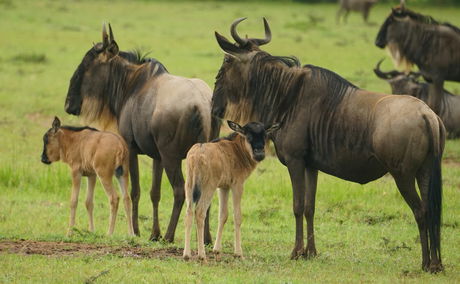
This blog explores the breathtaking drama of the wildebeest calving season in Tanzania’s southern Serengeti, where over 500,000 calves are born within a few short weeks between January and March. It highlights the synchronized birthing strategy known as predator satiation, which helps ensure survival by overwhelming predators, such as lions, cheetahs, and hyenas, with sheer numbers. The piece captures the emotional intensity of this natural phenomenon—where life and death unfold in real...
Uhuru Peak: A Journey to Purpose on the Roof of Africa
Sat September 13, 2025
Read This Article
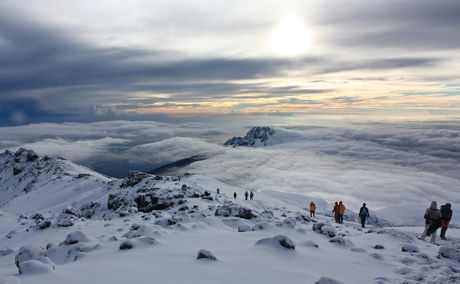
The article depicts climbing Mount Kilimanjaro as a journey of personal growth, emphasizing inner transformation, resilience, and empowerment rather than mere physical achievement, highlighting profound connections and lasting change through struggle and triumph.
Share This Post